Tree diagram to second derivative

Click For Summary
SUMMARY

The discussion focuses on formulating the second derivative using a tree diagram, similar to the first derivative. It emphasizes the application of the product rule in calculating higher-order partial derivatives. The user references a paper that discusses higher-order partial derivatives and illustrates the process of deriving with respect to different variables using paths in a tree diagram. The key takeaway is that it is indeed possible to derive twice using this method, although it is complex and not intuitive.

PREREQUISITES
  • Understanding of partial derivatives and their notation
  • Familiarity with tree diagrams in calculus
  • Knowledge of the product rule in differentiation
  • Basic concepts of multivariable functions
NEXT STEPS
  • Read the referenced paper on higher-order partial derivatives for deeper insights
  • Study the application of the product rule in multivariable calculus
  • Practice deriving functions using tree diagrams for both first and second derivatives
  • Explore advanced topics in multivariable calculus, such as the chain rule and its applications
USEFUL FOR

Mathematicians, students of calculus, and anyone interested in advanced differentiation techniques using tree diagrams.

Jhenrique
Messages
676
Reaction score
4
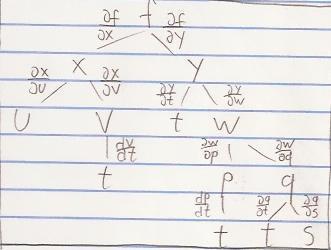
Is it possible to formulate the second derivate trough of a tree diagram, as we do with a first derivative? If yes, how do it?
attachment.php?attachmentid=64310&stc=1&d=1385521171.jpg


\frac{\partial f}{\partial t}=\frac{\partial f}{\partial x}\frac{\partial x}{\partial v}\frac{\partial v}{\partial t}+\frac{\partial f}{\partial y}\left(\frac{\partial y}{\partial t}+\frac{\partial y}{\partial w}\left(\frac{\partial w}{\partial q}\frac{\partial q}{\partial t} + \frac{\partial w}{\partial p}\frac{\partial p}{\partial t}\right )\right )

Edit: example: suppose you need to make the second partial derivative ∂²f/∂s∂t
 

Attachments

  • imagem.JPG
    imagem.JPG
    11.8 KB · Views: 752
Physics news on Phys.org
I was sleepy when wrote this topic, sorry!

My ask is: Is it possible to formulate the frist derivate trough of a tree diagram, so that, start at f and finish at t, multiplicand all derivatives contained in this path and adding all paths with this same process (I think/hope you already know how do it). So, how can we do to derive twice (with respect to different variables) using a tree driagm as tool? Is it possible?
 
Yep it is possible, this is a paper I came across some time ago when looking for the same answer.

http://www.sefi.be/conference-2012/Papers/Papers/030.pdf

Starts talking about higher order partial derivatives at bottom of page 3. It's a clever use of the product rule.
 
Interesting! But, hard and not intuitive...
 
Start with the first figure, where z is a function of x and y, and x and y are each functions of s and t. Then z has a partial with respect to s and a partial with respect to t.

The partial of z w.r.t. (with respect to) s involves both paths from z to s. The things along a given path are multiplied, and the resulting products of the two paths are added.

So,
$$ \frac{\partial z}{\partial s} = \frac{\partial z}{\partial x} \frac{\partial x}{\partial s} + \frac{\partial z}{\partial y} \frac{\partial y}{\partial s} $$

The first term in the sum represents the path from z through x to s; the second term represents the path from z through y to s.

Calculating ##\frac{\partial z}{\partial t}## would be done in a similar manner.

Figure 2 in the linked document is doing the same thing as in Figure 1, except that it reproduces the nodes at s and t to spread the figure out.
 
This I already know! What I don't know is w.r.t. to 2 variables. This I think hard
 
Relativistic Momentum, Mass, and Energy Momentum and mass (...), the classic equations for conserving momentum and energy are not adequate for the analysis of high-speed collisions. (...) The momentum of a particle moving with velocity ##v## is given by $$p=\cfrac{mv}{\sqrt{1-(v^2/c^2)}}\qquad{R-10}$$ ENERGY In relativistic mechanics, as in classic mechanics, the net force on a particle is equal to the time rate of change of the momentum of the particle. Considering one-dimensional...

Similar threads

  • · Replies 16 ·
Replies
16
Views
3K
  • · Replies 3 ·
Replies
3
Views
3K
  • · Replies 1 ·
Replies
1
Views
3K
  • · Replies 4 ·
Replies
4
Views
3K
  • · Replies 3 ·
Replies
3
Views
2K
  • · Replies 3 ·
Replies
3
Views
2K
  • · Replies 3 ·
Replies
3
Views
3K
  • · Replies 1 ·
Replies
1
Views
2K
  • · Replies 1 ·
Replies
1
Views
3K
  • · Replies 2 ·
Replies
2
Views
2K