Triangular Matrix RIngs .... Another Question

  • Context: Undergrad 
  • Thread starter Thread starter Math Amateur
  • Start date Start date
  • Tags Tags
    Matrix Rings
Join the discussion
Ask a follow-up here, or get your own question answered by working scientists, mathematicians and engineers — people, not an autocomplete.
Real named experts · corrections over time · the nuance an AI answer skips
3 replies · 2K views
Math Amateur
Gold Member
MHB
Messages
3,920
Reaction score
48
I am reading T. Y. Lam's book, "A First Course in Noncommutative Rings" (Second Edition) and am currently focussed on Section 1:Basic Terminology and Examples ...

I need help with yet another aspect of Example 1.14 ... ...

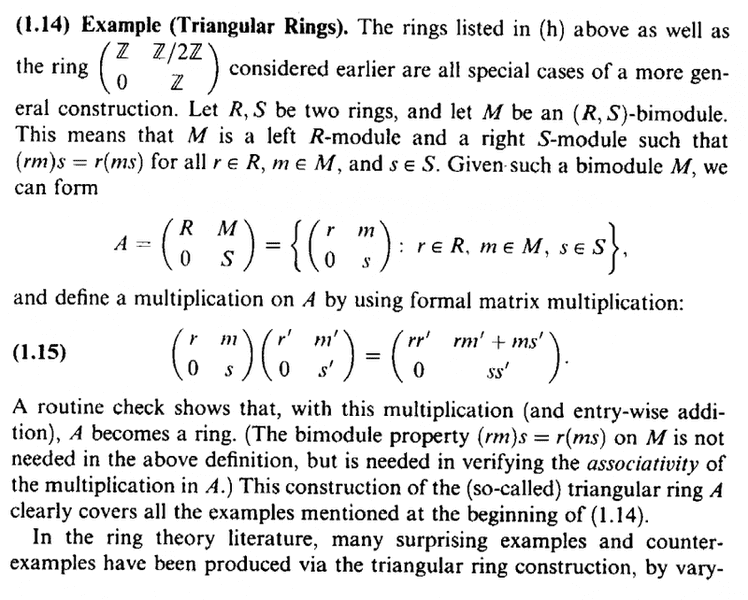
Example 1.14 reads as follows:
?temp_hash=be8a623e9154ee8ca2b39fa65a5078a6.png

?temp_hash=be8a623e9154ee8ca2b39fa65a5078a6.png
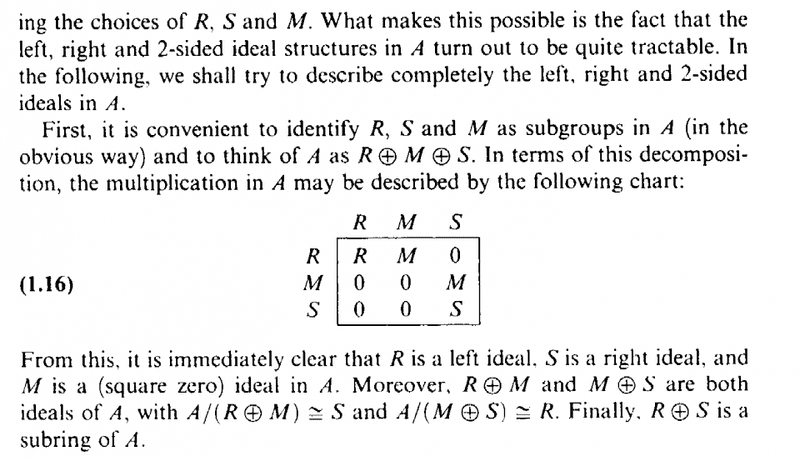
Near the end of the above text from T. Y. Lam we read the following:

" ... ... Moreover ##R \oplus M## and ##M \oplus S## are both ideals of ##A##, with ##A / (R \oplus M ) \cong S## and ##A / ( M \oplus S ) \cong R## ... ... "Can someone please help me to show, formally and rigorously that ##A / (R \oplus M ) \cong S## and ##A / ( M \oplus S ) \cong R## ... ...My only thought so far is that the First Isomorphism Theorem for Rings may be useful ...

Hope someone can help ... ...

Peter
 

Attachments

  • Lam - 1 -  Example 1.14 - PART 1.png
    Lam - 1 - Example 1.14 - PART 1.png
    57.7 KB · Views: 643
  • Lam - 2 -  Example 1.14 - PART 2      .png
    Lam - 2 - Example 1.14 - PART 2 .png
    81.2 KB · Views: 757
Last edited:
Physics news on Phys.org
Thanks for the help, micromass ... ...

Use of the First Isomorphism Theorem for Rings in order to show that R/ ( R \oplus M ) \cong S would proceed as follows:

Define a surjection ##\phi \ : \ A \longrightarrow S## ... ...

... where ##\phi## is defined as the map ##\begin{pmatrix} r & m \\ 0 & s \end{pmatrix} \ \mapsto \ \begin{pmatrix} 0 & 0 \\ 0 & s \end{pmatrix}####\phi## is clearly an epimorphism with kernel ... :

##\text{ ker } \phi = \begin{pmatrix} r & m \\ 0 & 0 \end{pmatrix} \ \cong \ R \oplus M## So by the First Isomorphism Theorem for Rings we have the following

##A / \text{ ker } \phi \ \cong \ S## ...

... that is ...

##A / ( R \oplus M ) \ \cong \ S## ...Is the above analysis correct?

If it is correct ... then ##A / ( M \oplus S ) \ \cong \ R## ... follows similarly ...

[Note: I think we could have proved the above by only invoking the First Isomorphism Theorem for Groups ... ]

Any comments critiquing the above analysis are welcome ...

Peter
 
Looks correct, although I think you should check (as an exercise) that your homomorhisms are actually ring homomorphims.
And this is the reason, why the group isomorphism theorem would not be enough. You need ring homomorphisms and ideals ##M \oplus S## and ##R \oplus M##. It should be easy to check whether they are really ideals in ##A##.

Ideals and kernels of ring homomorphisms correspond 1:1.
 
  • Like
Likes   Reactions: Math Amateur