Triangular Matrix RIngs .... Lam, Proposition 1.17

  • Context: Undergrad 
  • Thread starter Thread starter Math Amateur
  • Start date Start date
  • Tags Tags
    Matrix Rings
Join the discussion
Ask a follow-up here, or get your own question answered by working scientists, mathematicians and engineers — people, not an autocomplete.
Real named experts · corrections over time · the nuance an AI answer skips
8 replies · 2K views
Math Amateur
Gold Member
MHB
Messages
3,920
Reaction score
48
I am reading T. Y. Lam's book, "A First Course in Noncommutative Rings" (Second Edition) and am currently focussed on Section 1:Basic Terminology and Examples ...

I need help with Part (1) of Proposition 1.17 ... ...

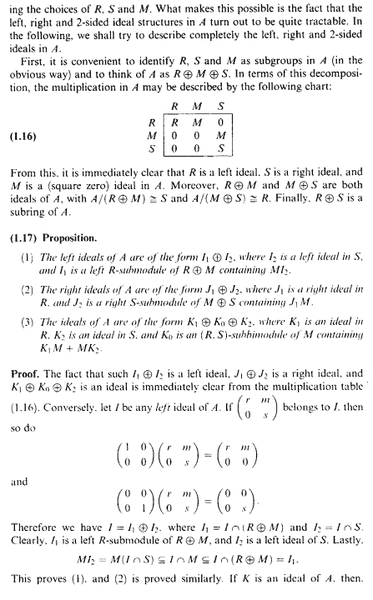
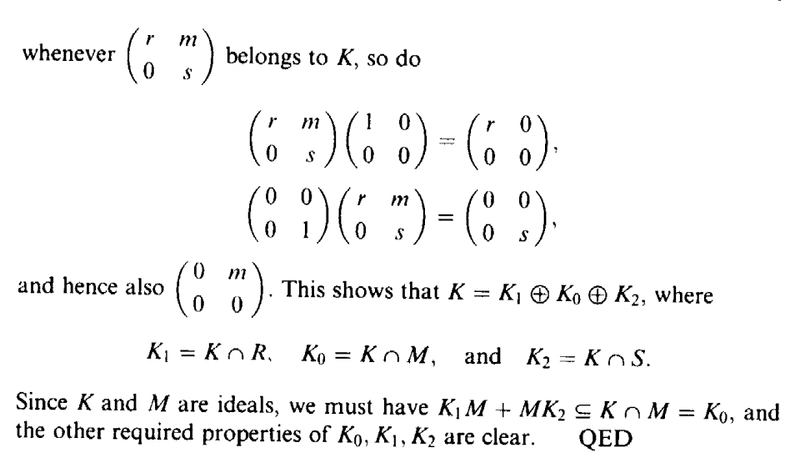
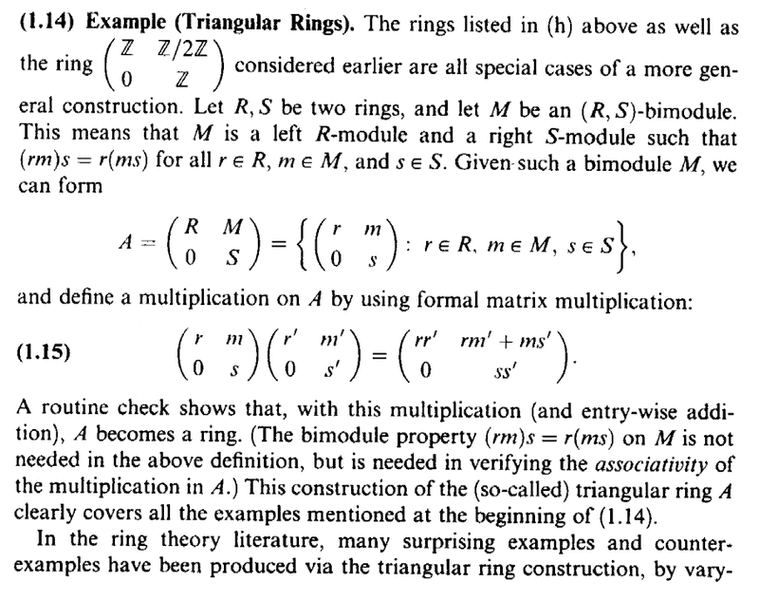
Proposition 1.17 (together with related material from Example 1.14 reads as follows:
?temp_hash=c2ab6f278b1ec79fc4e34ad95cf673a9.png

?temp_hash=c2ab6f278b1ec79fc4e34ad95cf673a9.png

?temp_hash=c2ab6f278b1ec79fc4e34ad95cf673a9.png


Can someone please help me to prove Part (1) of the proposition ... that is that ##I_1 \oplus I_2## is a left ideal of A ... ...

Help will be much appreciated ...

Peter
 

Attachments

  • Lam - 1 - Example 1.14  -  Including Propn 1.17  -  PART 1    ....png
    Lam - 1 - Example 1.14 - Including Propn 1.17 - PART 1 ....png
    61.5 KB · Views: 1,071
  • Lam - 2 - Example 1.14  -  Including Propn 1.17  -  PART 2    ....png
    Lam - 2 - Example 1.14 - Including Propn 1.17 - PART 2 ....png
    32.7 KB · Views: 700
  • Lam - 3 - Example 1.14  -  Including Propn 1.17  -  PART 3    ....png
    Lam - 3 - Example 1.14 - Including Propn 1.17 - PART 3 ....png
    32.9 KB · Views: 715
Physics news on Phys.org
I have been reflecting on the problem I posed ... here is my 'solution' ... Note: I am quite unsure of this ...

Problem ... Let ##I = I_1 \oplus I_2## where ##I_1## is a left ideal of ##S## and ##I_2## is a left submodule of ##R \oplus M## ...

Show ##I## is a left ideal of ##A##
Let ##a \in I##, then there exists ##a_1 \in I_1## and ##a_2 \in I_2## such that ##a = (a_1, a_2) \in I##

[ ... ... actually ##a_2 = (c_1, c_2) \in R \oplus M## but we ignore this complication in order to keep notation simple ... ]Similarly let ##b \in I## so ##b = (b_1, b_2) \in I## ... ...
Now ... if ##I## is a left ideal then

##a, b \in I \ \Longrightarrow \ a - b \in I##

and

##r \in A## and ##a \in I \ \Longrightarrow \ ra \in I##--------------------------------------------------------------------------------------------------------------------------------------------

To show ##a, b \in I \ \Longrightarrow \ a - b \in I##
Let ##a,b \in I##

then ##a - b = (a_1, a_2) - (b_1, b_2)## where ##a_1, b_1 \in S## and ##a_2, b_2 \in R \oplus M##

so, ##a - b = (a_1 - b_1, a_2 - b_2)##

But ... ##a_1 - b_1 \in I_1## since ##I_1## is an ideal in ##S##

and ... ##a_2 - b_2 \in I_2## since ##I_2## is a left sub-module of ##A##

hence ##(a_1 - b_1, a_2 - b_2) = a - b \in I##------------------------------------------------------------------------------------------------------------------------------------To show ##r \in A \text{ and } a \in I \ \Longrightarrow \ ra \in I##
Now ... ##r \in A## and ##a \in I \ \Longrightarrow \ ra = r(a_1, a_2) = (ra_1, ra_2)## [I hope this is correct!]

But ##ra_1 \in I_1## since ##I_1## is a left ideal ...

and ##ra_2 \in I_2## since ##I_2## is a left ##R##-submodule ...

Hence ##(ra_1, ra_2) = ra \in I##-------------------------------------------------------------------------------------------------------------------------------------

The above shows that I is a left ideal ... I think ...

Comments critiquing the above analysis and/or pointing out errors are more than welcome ...

Peter
 
Math Amateur said:
I have been reflecting on the problem I posed ... here is my 'solution' ... Note: I am quite unsure of this ...

Problem ... Let ##I = I_1 \oplus I_2## where ##I_1## is a left ideal of ##S## and ##I_2## is a left submodule of ##R \oplus M## ...

Show ##I## is a left ideal of ##A##
Let ##a \in I##, then there exists ##a_1 \in I_1## and ##a_2 \in I_2## such that ##a = (a_1, a_2) \in I##

[ ... ... actually ##a_2 = (c_1, c_2) \in R \oplus M## but we ignore this complication in order to keep notation simple ... ]Similarly let ##b \in I## so ##b = (b_1, b_2) \in I## ... ...
Now ... if ##I## is a left ideal then

##a, b \in I \ \Longrightarrow \ a - b \in I##

and

##r \in A## and ##a \in I \ \Longrightarrow \ ra \in I##--------------------------------------------------------------------------------------------------------------------------------------------

To show ##a, b \in I \ \Longrightarrow \ a - b \in I##
Let ##a,b \in I##

then ##a - b = (a_1, a_2) - (b_1, b_2)## where ##a_1, b_1 \in S## and ##a_2, b_2 \in R \oplus M##

so, ##a - b = (a_1 - b_1, a_2 - b_2)##

But ... ##a_1 - b_1 \in I_1## since ##I_1## is an ideal in ##S##

and ... ##a_2 - b_2 \in I_2## since ##I_2## is a left sub-module of ##A##

hence ##(a_1 - b_1, a_2 - b_2) = a - b \in I##------------------------------------------------------------------------------------------------------------------------------------To show ##r \in A \text{ and } a \in I \ \Longrightarrow \ ra \in I##
Now ... ##r \in A## and ##a \in I \ \Longrightarrow \ ra = r(a_1, a_2) = (ra_1, ra_2)## [I hope this is correct!]

But ##ra_1 \in I_1## since ##I_1## is a left ideal ...

and ##ra_2 \in I_2## since ##I_2## is a left ##R##-submodule ...

Hence ##(ra_1, ra_2) = ra \in I##-------------------------------------------------------------------------------------------------------------------------------------

The above shows that I is a left ideal ... I think ...

Comments critiquing the above analysis and/or pointing out errors are more than welcome ...

Peter
Yes, I don't see anything wrong. And, yes, ##r(a_1,a_2) = (ra_1,ra_2)##. Remember that you wrote ##a_1 + a_2## as ##(a_1,a_2)##.
I would have used a more general approach, i.e. not with single elements, but it's been a good exercise though.
Addition is clear, because addition is component-wise and the components are closed under addition (ideal and module).
And multiplication goes
$$ \begin{bmatrix}R && M \\ 0 && S\end{bmatrix} \cdot \begin{bmatrix} I_1 \\ I_2\end{bmatrix}=\begin{bmatrix}RI_1 + MI_2 \\ S I_2\end{bmatrix} \subseteq \begin{bmatrix}I_1 + I_1 \\ I_2 \end{bmatrix}\subseteq \begin{bmatrix}I_1 \\ I_2 \end{bmatrix}$$
I guess this is also used for the converse direction. Comparison of the second component (plus a similar equation for addition) gives you immediately that ##I_2 \subseteq S## has to be a left ideal, so only the first component with a few conditions more needs to be examined.
 
  • Like
Likes   Reactions: Math Amateur
Sorry for late reply, fresh_42 ... been traveling ...

So grateful for your help on this matter ...

Reflecting on what you have said ...

Peter
 
fresh_42 said:
Yes, I don't see anything wrong. And, yes, ##r(a_1,a_2) = (ra_1,ra_2)##. Remember that you wrote ##a_1 + a_2## as ##(a_1,a_2)##.
I would have used a more general approach, i.e. not with single elements, but it's been a good exercise though.
Addition is clear, because addition is component-wise and the components are closed under addition (ideal and module).
And multiplication goes
$$ \begin{bmatrix}R && M \\ 0 && S\end{bmatrix} \cdot \begin{bmatrix} I_1 \\ I_2\end{bmatrix}=\begin{bmatrix}RI_1 + MI_2 \\ S I_2\end{bmatrix} \subseteq \begin{bmatrix}I_1 + I_1 \\ I_2 \end{bmatrix}\subseteq \begin{bmatrix}I_1 \\ I_2 \end{bmatrix}$$
I guess this is also used for the converse direction. Comparison of the second component (plus a similar equation for addition) gives you immediately that ##I_2 \subseteq S## has to be a left ideal, so only the first component with a few conditions more needs to be examined.
fresh_42 said:
Yes, I don't see anything wrong. And, yes, ##r(a_1,a_2) = (ra_1,ra_2)##. Remember that you wrote ##a_1 + a_2## as ##(a_1,a_2)##.
I would have used a more general approach, i.e. not with single elements, but it's been a good exercise though.
Addition is clear, because addition is component-wise and the components are closed under addition (ideal and module).
And multiplication goes
$$ \begin{bmatrix}R && M \\ 0 && S\end{bmatrix} \cdot \begin{bmatrix} I_1 \\ I_2\end{bmatrix}=\begin{bmatrix}RI_1 + MI_2 \\ S I_2\end{bmatrix} \subseteq \begin{bmatrix}I_1 + I_1 \\ I_2 \end{bmatrix}\subseteq \begin{bmatrix}I_1 \\ I_2 \end{bmatrix}$$
I guess this is also used for the converse direction. Comparison of the second component (plus a similar equation for addition) gives you immediately that ##I_2 \subseteq S## has to be a left ideal, so only the first component with a few conditions more needs to be examined.
Thanks again for your help, fresh_42 ...

You write:

"... ... And, yes, ##r(a_1,a_2) = (ra_1,ra_2)##. Remember that you wrote ##a_1 + a_2## as ##(a_1,a_2)##. ... ... My justification for doing this was that the direct sum and the direct product are isomorphic for finite cases in rings/modules ... is this correct?You also wrote:

"... ... I would have used a more general approach, i.e. not with single elements ... ...

Can you give me an idea of your more general approach ... ?

Peter
 
Math Amateur said:
You write:

"... ... And, yes, ##r(a_1,a_2) = (ra_1,ra_2)##. Remember that you wrote ##a_1 + a_2## as ##(a_1,a_2)##. ... ...My justification for doing this was that the direct sum and the direct product are isomorphic for finite cases in rings/modules ... is this correct?
Yes, it is correct.

The difference between direct products and direct sums is that we consider projections ##p_\nu : \Pi_{\mu \in I} M_\mu \twoheadrightarrow M_\nu## in the case of direct products and injections ##i_\nu : M_\nu \rightarrowtail \Sigma_{\mu \in I} M_\mu ## in the case of direct sums to define them. So it is more of a categorical difference.

There is nothing wrong with your notation. I simply mentioned it, because written as a sum, ##r(a_1,a_2) = (ra_1,ra_2)## becomes more obvious.

Math Amateur said:
"... ... I would have used a more general approach, i.e. not with single elements ... ...

Can you give me an idea of your more general approach ... ?
General approach was a bit high-flown. I haven't been lucky with the wording but couldn't find an alternative quickly.
I simply wanted to say, that it's enough to work with the entire sets instead of with single elements. But your right that the latter is more rigor.
The notation with sets is likely a sloppiness I got used to through the years.
##R I \subseteq I## is simply shorter than ##\forall r \in R \; \forall i \in I \Rightarrow r \cdot i \in I## and likewise for addition, or as in our case the matrix multiplication. It spares all the ##Let \; r \in R \, , \, s \in S \, , \, m \in M \, , \, i_1 \in I_1 \, , \, i_2 \in I_2 \, \dots##
However, one has to be careful when using it, because ##RI + RJ \subseteq I+J## does not mean ##ri +rj \in I+J## but ##r_1 i+r_2 j \in I+J##.
 
  • Like
Likes   Reactions: Math Amateur
Thanks fresh_42 ... appreciate all your help ...

Peter