Tricky problem worth 2 points on my final grade

  • Thread starter Thread starter AryRezvani
  • Start date Start date
  • Tags Tags
    Final Points
Click For Summary

Homework Help Overview

The discussion revolves around a physics problem related to energy conversion, kinematics, and collisions involving two blocks. The original poster expresses uncertainty in approaching the problem, which appears to involve concepts of potential energy (PE), kinetic energy (KE), and momentum conservation.

Discussion Character

  • Exploratory, Conceptual clarification, Mathematical reasoning, Problem interpretation

Approaches and Questions Raised

  • Participants discuss the need for kinematic equations and energy conservation principles. There are attempts to derive relationships between potential and kinetic energy, as well as to set up equations for momentum conservation during the collision. Some participants question the correctness of their calculations and seek clarification on the equations involved.

Discussion Status

The discussion is active, with participants providing guidance on setting up equations and addressing the original poster's confusion. There are multiple interpretations of the problem being explored, particularly regarding the application of energy conservation and momentum equations. Some participants express uncertainty about their results and seek verification from others.

Contextual Notes

Participants note the importance of maintaining symbolic representations in equations until the final step and discuss the implications of mass cancellation in the context of the problem. There is mention of potential discrepancies in calculated velocities, prompting further examination of the equations used.

AryRezvani
Messages
65
Reaction score
0
Tricky problem worth 2 points on my final grade :)
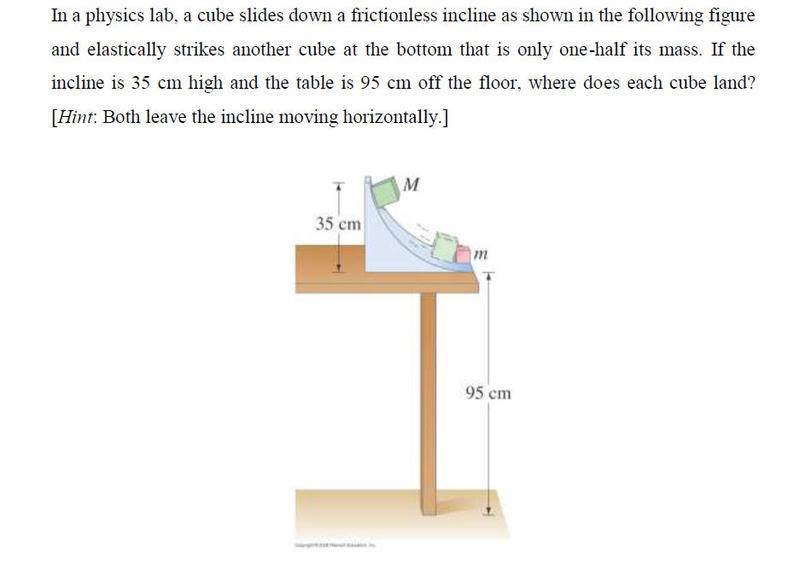
Homework Statement


ibxqo9.jpg


Homework Equations


I honestly don't know how to tackle this.

I think it's going to contain ƩF=mg, and some basic kinematic equations.

The Attempt at a Solution


Where do is start?
 
Physics news on Phys.org


You are right that some kinematic equations will be needed.

But the first part of the problem is fundamentally about conversion of energy. What equations do you know for different kinds of mechanical energy?


Nytik said:
You are right that some kinematic equations will be needed.

But the first part of the problem is fundamentally about conversion of energy. What equations do you know for different kinds of mechanical energy?

Err

mgh=PE
1/2kx2=Springs.
1/2m2=KE


Right, so at the beginning of the problem, the bigger block has some PE that is converted into KE.
When the blocks collide, the collision is elastic meaning KE is conserved. Of course momentum is conserved too (as always).
Using this information you should be able to find the velocities of the blocks as they are leaving the table. From there it's basic kinematics.


Nytik said:
Right, so at the beginning of the problem, the bigger block has some PE that is converted into KE.
When the blocks collide, the collision is elastic meaning KE is conserved. Of course momentum is conserved too (as always).
Using this information you should be able to find the velocities of the blocks as they are leaving the table. From there it's basic kinematics.

Mgh = 1/2mv2, right?

How would you know what your mass is in this problem?


Don't worry, the mass will cancel in all the equations you do.

So you have Mgh = \frac{1}{2}Mv2, that's a good start.

You can rearrange that equation to find v. Next you'll need to write two equations for the collision, one for conservation of KE and one for conservation of momentum. These can be solved simultaneously.


Nytik said:
Don't worry, the mass will cancel in all the equations you do.

So you have Mgh = \frac{1}{2}Mv2, that's a good start.

You can rearrange that equation to find v. Next you'll need to write two equations for the collision, one for conservation of KE and one for conservation of momentum. These can be solved simultaneously.

Okay, well rearranging that equation, you get 2mghv2/m.

O... Then the masses cancel out and you're left with 2gh=v2.
Sqr[(2)(9.8)(.3)] = 2.619
So M hits m with a velocity of 2.619 m/s.
_______________________________________

Okay, now for conservation of momentum and KE:

I'm a little lost on this part.


The momentum of the big block before they collide must be equal to the combined momentums of the big and little block after the collision. Do you know how to write an equation for this?

Similarly, the KE of the big block before the collision equals the combined KE of the big block and little block after the collision. Can you write this equation?


Nytik said:
The momentum of the big block before they collide must be equal to the combined momentums of the big and little block after the collision. Do you know how to write an equation for this?

Similarly, the KE of the big block before the collision equals the combined KE of the big block and little block after the collision. Can you write this equation?
Hmm I could give it a try. In regards to KE,

1/2Mv2= 1/2mv2+1/2Mv2

Not sure how to signify a collision above. Sorry for giving you a hard time. My physics professor isn't much a professor.
 
  • #10


That equation is perfect, I'm just going to add some subscript to make things clearer:

\frac{1}{2}Mv_{i}^{2} = \frac{1}{2}Mv^{2}_{1} + \frac{1}{4}Mv^{2}_{2}

So v_{1} is the resulting velocity of the big block, and v_{2} for the small block. Also notice I have substituted in the mass of the small block (m = 1/2M) to make it easier for you to cancel.

The equation for momentum is very similar,
Mv_{i} = Mv_{1} + \frac{1}{2}Mv_{2}

Now that you have two simultaneous equations for v_{1} and v_{2}, you can solve them. (e.g. rearrange the momentum equation for v_{1}, then substitute the result into the KE equation). It might get a bit fiddly. Don't forget to cancel all the M's first!
 
  • #11


Hopefully you read this before solving, I accidentally missed out a 1/2 in the momentum equation (which I have now edited in). Sorry about that!
 
  • #12


Nytik said:
Hopefully you read this before solving, I accidentally missed out a 1/2 in the momentum equation (which I have now edited in). Sorry about that!

That equation was ugly as hell hahaha.

Okay, the velocity of the smaller block was 1.75 m/s
the larger .8 m/s
 
  • #13


The 1st thing that comes to mind when I see this assignment is freefalling.

The blocks get an acceleration which is computable by the given information - once knocked off the table they will take exactly the same amount of time to reach the floor as they would have if just let fall to the floor from the same height. Once the time is known, everything else is a cinch.

I'm going to test this out,cuz technically, it should work
 
  • #14


Sorry it's taken me so long to get back to this thread. Did you check those numbers with the equations (sub them back into make sure they work)? Because they don't look correct to me.

By the way, when solving the two equations the preferred method is to keep all symbols in until the final step (I don't know if you solved them this way or not). Using this method the velocities I get are:

v_{1} = \frac{1}{3}\sqrt{2gh}

v_{2} = \frac{4}{3}\sqrt{2gh}

And these answers solve both equations so I believe them to be correct. Can you try again and see if you come up with these answers? (Perhaps you didn't put the 1/2 in that I missed first time around.)
 

Similar threads

Replies
4
Views
2K
  • · Replies 11 ·
Replies
11
Views
2K
  • · Replies 3 ·
Replies
3
Views
1K
  • · Replies 8 ·
Replies
8
Views
3K
Replies
4
Views
1K
Replies
55
Views
6K
  • · Replies 12 ·
Replies
12
Views
3K
  • · Replies 3 ·
Replies
3
Views
1K
  • · Replies 3 ·
Replies
3
Views
2K
  • · Replies 5 ·
Replies
5
Views
2K