Trig/Geometry Help For Dynamics: Daniela's Story

  • Thread starter Thread starter daniiela
  • Start date Start date
Click For Summary
SUMMARY

This discussion centers on the application of trigonometric functions in dynamics, specifically regarding the equation of relative motion. Daniela seeks clarification on why sin(30°) is used for the x-direction and cos(30°) for the y-direction in vector components. The consensus is that the component of a vector V in a direction is calculated as Vcosθ, where θ is the angle between the vector and the direction. The discussion also highlights that the y component can be expressed as Vcos(30°) and the x component as Vcos(60°), which is equivalent to Vsin(30°).

PREREQUISITES
  • Understanding of basic trigonometric functions (sine and cosine)
  • Familiarity with vector components in physics
  • Knowledge of relative motion concepts
  • Ability to interpret angles in a Cartesian coordinate system
NEXT STEPS
  • Study the application of trigonometric functions in physics problems
  • Learn about vector decomposition in dynamics
  • Explore the relationship between angles and vector components
  • Practice drawing vector diagrams to visualize motion
USEFUL FOR

This discussion is beneficial for students in physics or engineering courses, particularly those struggling with dynamics and the application of trigonometry in vector analysis.

daniiela
Messages
2
Reaction score
0
I am currently in dynamics and I know the only thing holding me back is understanding the position of angles, no matter how much time I spend attempting to figure out the trig behind most of these problems I never gain any ground. If anyone can simply and sweetly explain to me why the equation of relative motion (IMAGE BELOW) uses sin(30) in the x-direction and cos(30) in the y-direction, and also how is it possible to use 60° rather than the 30°.

I would be unbelievably grateful if someone can shed light onto what may be the only reason holding me back from the grade I deserve in this class! If you can draw a simple picture that would be beyond fantastic as I am absolutely a visual learner.

Thank you soo much in advance!
-Daniela
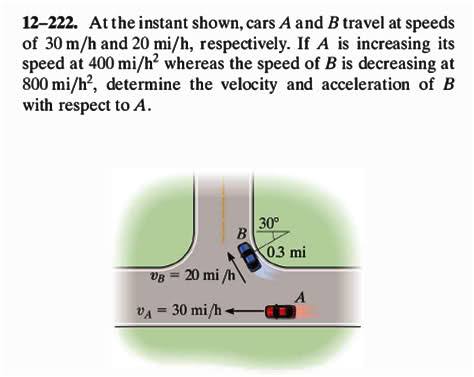
zujtkx.jpg


**The conceptual basis of the problem being one of relative motion I am having NO problem understanding. So please do not consider this a homework problem that I need help solving.**
 
Engineering news on Phys.org
Hi Daniela! :smile:
daniiela said:
… why the equation of relative motion (IMAGE BELOW) uses sin(30) in the x-direction and cos(30) in the y-direction, and also how is it possible to use 60° rather than the 30°.

The rule to remember is that it's always cos.

The component of a vector V (such as velocity or force) in a particular direction is always Vcosθ, where θ is the angle between the velocity and the direction.

So the car B is pointing 30° from the y direction, and 60° from the x direction.

So the y component is Vcos30°, and the x component is Vcos60°. :wink:

(obviously, the latter is also Vsin30°)
 
What mathematics software should engineering students use? Is it correct that much of the engineering industry relies on MATLAB, making it the tool many graduates will encounter in professional settings? How does SageMath compare? It is a free package that supports both numerical and symbolic computation and can be installed on various platforms. Could it become more widely used because it is freely available? I am an academic who has taught engineering mathematics, and taught the...

Similar threads

  • · Replies 3 ·
Replies
3
Views
3K
  • · Replies 15 ·
Replies
15
Views
3K
  • · Replies 2 ·
Replies
2
Views
2K
  • · Replies 30 ·
2
Replies
30
Views
10K
  • · Replies 2 ·
Replies
2
Views
4K
  • · Replies 3 ·
Replies
3
Views
2K
Replies
2
Views
1K
  • · Replies 45 ·
2
Replies
45
Views
6K
  • · Replies 21 ·
Replies
21
Views
2K
  • · Replies 6 ·
Replies
6
Views
3K