Troubleshooting a FET-controlled car tailgate

Click For Summary

Discussion Overview

The discussion revolves around troubleshooting a FET-controlled tailgate actuator in a vehicle, focusing on the electrical connections, potential failures, and diagnostic approaches. Participants explore various hypotheses regarding the functionality of the FET, the actuator, and associated components.

Discussion Character

  • Technical explanation
  • Debate/contested
  • Exploratory

Main Points Raised

  • One participant describes the electrical sequence involved in activating the tailgate actuator and expresses uncertainty about the FET's pinout arrangement.
  • Another participant suggests that FETs typically do not fail intermittently and proposes that a faulty connector may be the issue.
  • Concerns are raised about potential thermal overload or auto-reset circuit breakers affecting the actuator's operation.
  • Participants discuss the possibility of the FET switching either the 12V side or the ground side, with differing opinions on which is more likely.
  • One participant notes that the ECU appears to send a signal, but no output is observed at the FET's output pin, raising questions about the ECU's functionality.
  • A suggestion is made to check the voltage pulse at the ECU output to further diagnose the issue.
  • Another participant shares a link to a common problem with the same vehicle model, indicating that this issue may not be unique.
  • One participant reports that replacing the actuator resolved the issue, attributing the problem to the old actuator drawing too much current.
  • Another participant reflects on a similar experience with a different vehicle component, suggesting that measuring resistance could have been beneficial.

Areas of Agreement / Disagreement

Participants express differing views on the cause of the tailgate issue, with some suspecting the FET and others pointing to the actuator or connectors. The discussion remains unresolved regarding the exact nature of the fault, although one participant claims to have fixed the issue by replacing the actuator.

Contextual Notes

Participants mention various assumptions about the electrical connections and the functionality of components, but these assumptions are not universally agreed upon. There are also references to specific wiring diagrams and components that may not be fully detailed in the discussion.

Who May Find This Useful

Individuals troubleshooting similar electrical issues in automotive systems, particularly those involving FETs and actuators, may find the insights and diagnostic approaches shared in this discussion useful.

Guineafowl
Messages
891
Reaction score
414
TL;DR
Intermittent failure of the opening mechanism on my Land Rover Discovery 4 (LR4). I’m trying to work out how the controlling FET is arranged.
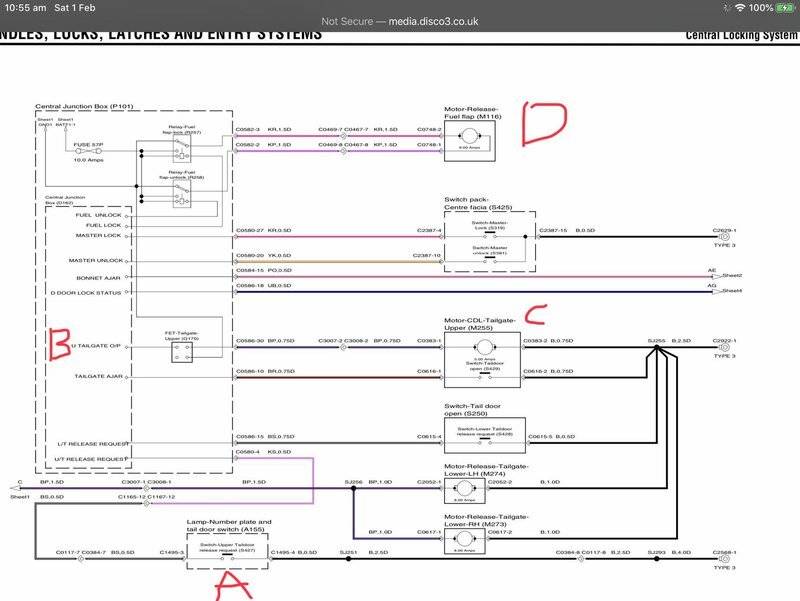
Pressing the switch at (A) grounds the “U/T release request” pin of the ECU.
The “U tailgate O/P” pin at (B) then changes state and signals the FET G170.
The connector 586 pin 30 then goes high and powers the tailgate actuator at (C).
If you follow the third pin of the FET, it appears to go to GND1 (I can’t find the follow-on sheet), but is also linked into the fuel flap release motor at D. I suspect GND1 is a switched ground, allowing the fuel flap lock to release or engage, then off.

I assume the fuel flap release motor is involved so that the tailgate may only open if the car is unlocked, changing the state of the controlling relays. What I can’t work out is how the G-D-S pinout of the FET is arranged.

There is only 0.217V to ground at C3007-pin 2 (unplugged) and this does not change when requesting a tailgate open.

I suspect the FET has failed, but it’s extremely hard to get to, so would like to rule out a power feed problem involving the fuel flap relays.
F432408F-9AE3-48F4-B892-50BC6DA2FBE9.jpeg
 
Engineering news on Phys.org
FETs do not normally fail intermittent. I can't read the diagram, but the fact that the fuel flap works normally, and the rear door fault is intermittent, suggests that a connector somewhere is faulty.
 
Thanks - sometimes, repeatedly activating the actuator results in ‘fatigue’ and then it stops working for a bit. It might not be the FET, but a corroded or cracked solder joint.

The GND1 pin is in fact a permanent ground. Assuming the signal at (B) goes to the gate, and the source goes to the motor at (C), I assume the 12V supply must come from the unpopulated pin in the diagram.
 
Guineafowl said:
Thanks - sometimes, repeatedly activating the actuator results in ‘fatigue’ and then it stops working for a bit.
That sounds like a Thermal Overload, or an auto-reset circuit breaker is tripping. Either of these may be built into any or all of the 3 tailgate motors.

One, or both, of the "Motor-Release-Tailgate-Lower-..." may not be operating, holding the tailgate closed. This COULD be a mechanical problem associated with the release motor(s).

Do you have any idea where C2022-1 connects to? That is the wire that connects to the right-hand-side of the three motors.

For measuring connector voltage when mated, you can often stick a small, stiff wire into the back of a connector parallel with the wire. A stainless steel T-pin used in sewing works well, maybe you can 'borrow' one from your local females sewing box.:eek:

Please let us know what you find.

Cheers,
Tom
 
Thanks @Tom.G - I didn’t want to flood the first post with info, but I think I’ve ruled out the actuator by substituting a new one. Also, during the fault, there is no 12V pulse at the actuator.

The car has a split tailgate - upper releases first, then you press another button and the lower releases. The lower side is working fine (on a different FET).

Both upper and lower parts latch mechanically, and are released by a pulsed movement of the actuator(s).

According to my diagnostic scanner, the tailgate open request is always received, and the ECU ‘thinks’ its sends a pulse out, but nothing appears at C0586-pin 30 (the output of the FET).

The FET has 4 pins, but none seem to connect to a 12V rail, unless this is not shown. I wonder if it’s a module with a stabilising cap to ground (lower right pin)?
 
Guineafowl said:
The FET has 4 pins, but none seem to connect to a 12V rail, unless this is not shown. I wonder if it’s a module with a stabilising cap to ground (lower right pin)?
Do you think the FET is switching the 12V side? What if it is switching the ground side...that looks likely to me.
 
hutchphd said:
Do you think the FET is switching the 12V side? What if it is switching the ground side...that looks likely to me.
The non-FET side of the motor goes to a common ground point, so I’d say it’s likely to be power side switched. My test light indicated the same thing.
 
  • Like
Likes   Reactions: hutchphd
At this point, the information points to item "B" of the schematic (the ECU?) having the high current switch that drives "U tailgate O/P".

The item labeled G170 (since it has only "In", "Out", and "Gnd") may be ambiguously named and serve instead as a surge protector.

See if you can check the voltage pulse at "U tailgate O/P" (item "B").

(The above approach is common "signal tracing." There is no signal at C3007-2 but signal is reportedly present going into the ECU, yet we don't know if the signal comes OUT of the ECU.)

Cheers,
Tom
 
Thanks Tom, that seems a logical next step. Sadly, it will take a few hours of dismantling just to get to the area, and I’m not sure if I can probe it live as everything’s rather boxed in. In order to get to the problem area, it will have to be unplugged.

For interest, I’ve found the schematic showing the working lower tailgate FET. Note how it has in, out, ground and 12V connections.
6260DEF8-6CE6-425D-9E4D-A2F16599E1F1.jpeg
 
  • #11
Tom.G said:
OK, before you dig in THAT deeply, take a look at:
https://www.landroverworld.org/threads/lr4-tailgate-not-opening.40021/

Above, and many others, found with:
https://www.google.com/search?&q=land+rover+discovery+4+tailgate+won't+open

It seems to be a somewhat common problem.

Also, can you get a stiff wire or pin into the back of C3007-2 (while it is mated) to measure the voltage?

Cheers,
Tom
I haven’t had a chance to look at it yet, but will report back.

I hadn’t considered driver circuit lockout as there were no error codes. It might be worth swapping in a new actuator to rule that out.
 
  • #12
I think it’s fixed.

The link that @Tom.G provided about driver circuit lockout led me to replace the actuator, even though my troubleshooting had ruled it out.

It looks like the old actuator was drawing too much current, causing the lockout, which persisted short term when I plugged in a new actuator. There were no error codes.

@Baluncore was also correct that it was unlikely to be the FET.

It’s hard to clear faults when the troubleshooting doesn’t play fair. Thanks to all.
 
  • Informative
  • Like
Likes   Reactions: Tom.G and hutchphd
  • #13
Guineafowl said:
It looks like the old actuator was drawing too much current, causing the lockout, which persisted short term when I plugged in a new actuator. There were no error codes.
Sounds like some shorted turns in the actuator.

I had a similar incident a few months ago. My car has variable valve timing, implemented as hydraulic control of cam timing. The mechanic measured resistance of the actuating coil in the hydraulic valve and declared it "too low." Problem solved.
 
  • Like
Likes   Reactions: Guineafowl
  • #14
Tom.G said:
Sounds like some shorted turns in the actuator.

I had a similar incident a few months ago. My car has variable valve timing, implemented as hydraulic control of cam timing. The mechanic measured resistance of the actuating coil in the hydraulic valve and declared it "too low." Problem solved.
One step I missed out was comparing resistances of the new and old actuator.

At 12V I imagine it would require nulled leads and hi-res mode.

@Tom.G do you remember the inductor ringing circuit that you and Jim Hardy helped me build? It would ping the inductor with a pulse and count the resulting oscillations by clocking a shift register. Should have used that.
 
  • Like
Likes   Reactions: dlgoff
  • #15
Guineafowl said:
One step I missed out was comparing resistances of the new and old actuator.

At 12V I imagine it would require nulled leads and hi-res mode.

@Tom.G do you remember the inductor ringing circuit that you and Jim Hardy helped me build? It would ping the inductor with a pulse and count the resulting oscillations by clocking a shift register. Should have used that.
For measuring the resistance, many handheld multimeters can read down to tenths of an Ohm, although not too accurately. But all you need is a comparison reading anyhow.

I suppose one way would be use a flashlight battery feeding the two actuators wired in series, then measure the voltage across each of them (before the battery voltage droops).

I do vaguely recall that inductor ringing project but not any details. And yes, now that you mention it, that would be an ideal test!

In fact, you could probably still do it without removing the new actuator, just unplug and measure it in place. That's assuming you still have the old actuator.

Cheers,
Tom

p.s. Out of curiousity, what use have you put the inductor ringing device to?
 
  • #16
Tom.G said:
For measuring the resistance, many handheld multimeters can read down to tenths of an Ohm, although not too accurately. But all you need is a comparison reading anyhow.

I suppose one way would be use a flashlight battery feeding the two actuators wired in series, then measure the voltage across each of them (before the battery voltage droops).

I do vaguely recall that inductor ringing project but not any details. And yes, now that you mention it, that would be an ideal test!

In fact, you could probably still do it without removing the new actuator, just unplug and measure it in place. That's assuming you still have the old actuator.

Cheers,
Tom

p.s. Out of curiousity, what use have you put the inductor ringing device to?
I bought a job lot of broken rack-mount 24V switching supplies, all of a similar type, and used the ringer to assess the transformers.

SMPS secondaries have such low resistance that subtle shorts are not easily detectable. The ringer device tests them as an inductor, not a resistor, and was handy in ruling out, by comparison, the secondary as a cause of low output

It also gives some fantastic scope shots: (TBA).
 
  • Like
Likes   Reactions: Tom.G

Similar threads

  • · Replies 11 ·
Replies
11
Views
4K
Replies
13
Views
3K
  • · Replies 18 ·
Replies
18
Views
3K
  • · Replies 1 ·
Replies
1
Views
4K
  • · Replies 4 ·
Replies
4
Views
9K