Motorcycle starter safety circuit

Click For Summary

Discussion Overview

The discussion revolves around the safety circuit of motorcycle starters, specifically focusing on the role of various switches and diodes in preventing unintended engine starts. Participants explore the functionality of the side stand switch, clutch switch, and neutral switch, as well as the implications of diodes in the circuit design.

Discussion Character

  • Technical explanation
  • Exploratory
  • Debate/contested

Main Points Raised

  • Some participants describe how the starter relay in motorcycles is activated by a combination of the side stand switch, clutch switch, and neutral switch, emphasizing the need for safety mechanisms to prevent starting in gear.
  • There is a suggestion that the diode in the circuit may serve to protect the switches from potential reverse current, although the necessity and function of this diode are questioned by several participants.
  • One participant proposes that the neutral light shares the neutral switch and that the diode prevents it from lighting through the clutch and side stand switches.
  • Another participant raises confusion about the function of an additional diode in a different motorcycle's circuit, questioning why it is needed if the neutral light pin is already acting as positive.
  • Concerns are expressed about potential faults in the instrument panel that could lead to unexpected current flow, with references to "sneak circuits" that could cause unintended behavior in electrical systems.
  • Participants share anecdotes about unexpected behaviors in other vehicles, drawing parallels to the current discussion on motorcycle circuits.

Areas of Agreement / Disagreement

Participants express various hypotheses regarding the function of diodes and the behavior of the neutral light circuit, but there is no consensus on the exact role of the diodes or the implications of potential faults. The discussion remains unresolved with multiple competing views presented.

Contextual Notes

Some participants acknowledge missing information about the internal circuitry of the instrument panel and the programming that determines the behavior of the neutral light pin, which adds to the complexity of the discussion.

Hondaboi1729
I don't know if it's the same for a car but bikes uses a starter relay to set off a starter motor which cranks the engine.

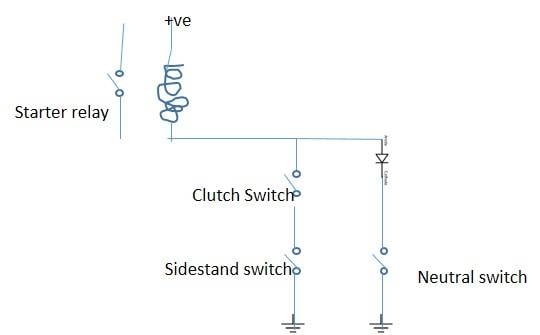
Bikes have a side stand for you to lean the bike against when stationary. In case the rider tries to start the bike with side stand deployed (could cause crash if forget to lift up out of the way when cornering the bike) there is a side stand switch to cut off the ground to the starter relay if stand down.
In conjunction there is a clutch switch in series to prevent being started in gear. there is also a neutral switch in parallel to these two connected to ground so the bike can be started in neutral even if the side-stand is deployed
i.e side stand switch off (open)

But in every bike there's a diode below in the pic:
bike_safety_circuit1.jpg


Basically as far as I can see the way each switch works is when it's open it cuts off the ground to the coil in the starter relay.
So either neutral switch is closed or BOTH clutch and sidestand switches are closed for current to be flowing into the relay...
Now I really can't see what difference would be made if you deleted that diode (presumably to protect the switches from backwards current). But I mean why on Earth would current go back the wrong way to potentially damage the switches? Is it something to do with the collapse of the magnetic field causing current to try and flow the other way when the starter button is released (since no more current to +ve so relay so field collapses)? Just a suggestion here- I'm asking not telling- I've no idea

IF this was the case though, then why is there no diode to the fuel pump relay, the cooling fan relay and any other kind of relay on the bike?

Also I've just thought- they're just bloody switches so unpolarised so why would the direction of the current matter- it makes less sense to me what this component does...
icon_confused.gif


Edit I think I'm missing another diode to the clutch and sidestand switches in the diagram sorry.
 
Engineering news on Phys.org
My guess is there's also a neutral light and it shares the neutral switch.
The diode keeps it from lighting via the kickstand and clutch switches.

motorcycle_startswitch.jpg


old jim
 
  • Like
Likes   Reactions: Hondaboi1729 and dlgoff
Oh my lord Jim how clever are you? :woot: goddamn you figured it out without me even posting the complete circuit.
yeah on the small motorcycle I have there is indeed a neutral light connected to where you put it. The only thing though is that is in the instrument panel
a block connector which has pins which go into the dashboard. there is a designated neutral light pin. So that neutral pin must act as a +ve for conventional current to start flowing from it throught the neutral switch to ground. That explains that.

However because I don't understand the internals of the circuitry inside the dashboard or how it's programmed which leads a certain pin to be +ve or -ve the following also confuses me:

This time this is for a different bike of larger engine size and it has two diodes now:

https://ibb.co/mHws6G

The labelled pin "NL" in the instrument cluster is the Neutral Light pin:

We have established what the vertical diode is for: it's to stop current flowing from the +ve Neutral light pin through the closed clutch and sidestand switches to ground making the neutral light come on.

However the horizontal diode is for what? I mean looking at the current flow of the circuit the only thing it can be for is stop current flowing from the +ve at the top down throught the vertical diode and into the neutral light pin. But why would that ever happen? We said that it was connected to +ve already?
 
I think it might be to prevent a fault in the instrument panel (short to 0V) grounding the starter relay?
 
But had we not established the NL pin was acting as +ve? why would current flow from +ve at top of coil to +ve NL pin? Unless the polarity of a pin is not fixed and can actually vary as controlled by some chip or whatever in the circuit board which the pin is connected to in the instrumental?
 
Hondaboi1729 said:
But had we not established the NL pin was acting as +ve? why would current flow from +ve at top of coil to +ve NL pin?

It wouldn't...unless there was a fault in the instrument cluster. For exampe a fault that connected NL to 0V.
 
@CWatters is close, I think .

My guess is it's so that ---
when you're not in neutral, no current can flow backward into the instrument cluster's NL pin.
Current should only come OUT OF that pin to light the neutral light, not sneak back IN and get to who knows where through the neutral light bulb.
Furthermore, if it's a LED bulb you can't afford to reverse bias it very hard.

That's called a "Sneak Circuit" and "Sneak Circuit Analysis" is a field of its own. "Sneak Circuits" cause strange things to happen, like aircraft cargo doors to open in flight. I used to chase them in the power plant...

My two cents, and that's overpriced .
 
  • Like
Likes   Reactions: Hondaboi1729
jim hardy said:
@CWatters

That's called a "Sneak Circuit" and "Sneak Circuit Analysis" is a field of its own. "Sneak Circuits" cause strange things to happen, like aircraft cargo doors to open in flight. I used to chase them in the power plant...

My two cents, and that's overpriced .
Jim, how many aircraft cargo doors came open in your nuke plant? :)
I recall missing the boat one time with push button switches all being used to switch some relays on the low side. This particular test fixture was also controlled from a PC and I used a relay to open the ground connection to all the switches. This way the operator couldn't screw up the test when the PC was doing the auto test by accidentally pushing a button on the fixture. Sounds foolproof right? That is until the user would push two buttons at the same time. Doh!
 
jim hardy said:
My guess is it's so that ---
when you're not in neutral, no current can flow backward into the instrument cluster's NL pin.
Current should only come OUT OF that pin to light the neutral light, not sneak back IN and get to who knows where through the neutral light bulb.

If the fuse supplying the Instruement Panel blows, then all connections in the Panel are at ground... another case of a "Sneak Circuit."
 
  • Like
Likes   Reactions: CWatters and Hondaboi1729
  • #10
Tom.G said:
... another case of a "Sneak Circuit."
yep, right around the neutral switch.

I've had two '83 Ford Rangers that will start in gear and clutch not depressed. THAT was a surprise first time... Must be a sneak circuit there somewhere. Both were diesels, i think the gasoline ones are okay..
 
  • Like
Likes   Reactions: Hondaboi1729
  • #11
No Jim that was a very valuable two cents thank you :)
Thanks to Tom and C Watters too I now understand :)
 
  • #12
Averagesupernova said:
Jim, how many aircraft cargo doors came open in your nuke plant? :)

Hmmm. I'm glad we didn't have any of those. ( See my signature...)
 

Similar threads

  • · Replies 7 ·
Replies
7
Views
1K
  • · Replies 1 ·
Replies
1
Views
2K
  • · Replies 9 ·
Replies
9
Views
4K
Replies
37
Views
7K
  • · Replies 31 ·
2
Replies
31
Views
5K
  • · Replies 42 ·
2
Replies
42
Views
6K
  • · Replies 5 ·
Replies
5
Views
5K
  • · Replies 15 ·
Replies
15
Views
2K
Replies
12
Views
3K
  • · Replies 26 ·
Replies
26
Views
7K