lerngen
- 4
- 2
- Homework Statement
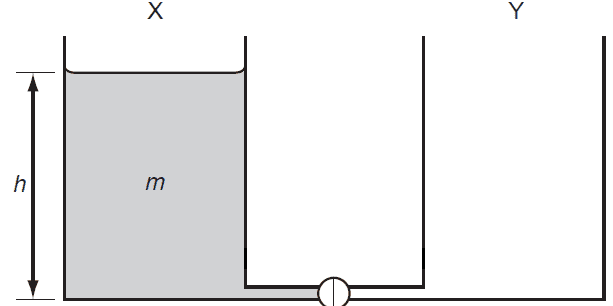
- The diagram shows two identical containers, X and Y, that are connected by a thin tube of negligible volume. Initially container X is filled with water of mass 'm' up to a height 'h' and Y is empty.
[IMG]https://www.physicsforums.com/attachments/problem-png.252768/?hash=c542de39b0a9c79f411453b2931feac5[/IMG]
The valve is then opened and both containers contain equal quantities of water. The loss of gravitational potential
energy of the water is?
- Relevant Equations
- Energy_potential = mass*gravity*height
The image doesn't seem to be appearing in the problem statement so here it is:
I already know the correct answer and the method to arrive at it. However, I didn't find it very satisfying. So in attempting to create an answer that was, imo, more intuitively satisfying I:
a. treated the container as two parts
b. divided the containers into discreet rows of water spaced at integer height levels (h, h-1, h-2, ...h = 0) with center of gravity being at h + 0.5 levels
c. calculated the gravitational potential energy (Egrav) of each row and summed to get the original amount of Egrav for first side of the container
d. moved each row one by one to the other container
e. at the end, calculated the Egrav of each half of the container, added them together and compared to the original amount
f. I keep ending up with the lost gravitational energy being 1/2 the starting amount instead of the correct answer of 1/4 the starting amount.
Image demonstrating the general idea of what I am describing:
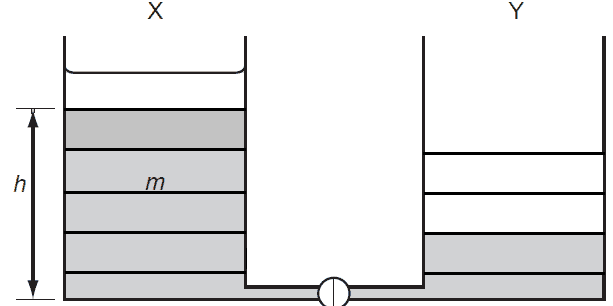
tl;dr - To summarize the entire process, first half of the container loses half of its mass and half of its height (1/4 * Egrav) which is a loss of 3/4 of the starting amount. The 2nd half of the container gains half the mass and half the height (1/4 * Egrav).
Thus -3/4 loss + 1/4 gain -> -2/4 -> -1/2 loss of starting amount. This does not match the correct answer of mgh/4 that is in the book and I've found online.
I feel like I've been staring at this too long and very likely missing something very obvious but I'll ask anyway. Where is the flaw in my physics thinking here? Thanks for your time.
I already know the correct answer and the method to arrive at it. However, I didn't find it very satisfying. So in attempting to create an answer that was, imo, more intuitively satisfying I:
a. treated the container as two parts
b. divided the containers into discreet rows of water spaced at integer height levels (h, h-1, h-2, ...h = 0) with center of gravity being at h + 0.5 levels
c. calculated the gravitational potential energy (Egrav) of each row and summed to get the original amount of Egrav for first side of the container
d. moved each row one by one to the other container
e. at the end, calculated the Egrav of each half of the container, added them together and compared to the original amount
f. I keep ending up with the lost gravitational energy being 1/2 the starting amount instead of the correct answer of 1/4 the starting amount.
Image demonstrating the general idea of what I am describing:
tl;dr - To summarize the entire process, first half of the container loses half of its mass and half of its height (1/4 * Egrav) which is a loss of 3/4 of the starting amount. The 2nd half of the container gains half the mass and half the height (1/4 * Egrav).
Thus -3/4 loss + 1/4 gain -> -2/4 -> -1/2 loss of starting amount. This does not match the correct answer of mgh/4 that is in the book and I've found online.
I feel like I've been staring at this too long and very likely missing something very obvious but I'll ask anyway. Where is the flaw in my physics thinking here? Thanks for your time.
 ##\qquad## !
 , I now see where my blind spots were/are. Due to the wording of the question I was focused on 'mgh' as stand-in for E_g and was zeroed-in on fractional amounts of that. Instead this problem is really a question about center of mass and how that affects calculations of height for an object. Further, up to now I realize my unexamined assumption of 'h' in physics problem was the height from the ground to the bottom of an object (hence my attempt to create containers; my initial approach didn't use 0.5 center of mass).