The minimum inclination of a surface

  • Thread starter Thread starter Quill
  • Start date Start date
  • Tags Tags
    Minimum Surface
Click For Summary

Homework Help Overview

The discussion revolves around determining the minimum angle of inclination required for a container to allow grains to slide down through a tube using gravity. The context involves an automated system designed to dispense servings of grains, with specific parameters regarding grain size, weight, and the total capacity of the container.

Discussion Character

  • Exploratory, Assumption checking, Problem interpretation

Approaches and Questions Raised

  • Participants discuss the challenges of calculating the minimum angle for grain flow, considering the variable nature of the grains and their behavior under different conditions. There are questions about the appropriateness of the equations referenced and the impact of design choices on grain dispensing.

Discussion Status

Some participants have offered insights into potential design solutions, such as using a paddle wheel mechanism to manage grain flow and prevent jams. There is an ongoing exploration of the implications of different designs and the need for trial and error in practical applications.

Contextual Notes

Participants note that the grains behave differently than fluids, and factors like humidity may affect their flow. The original poster expresses uncertainty about the physics involved and seeks clarification on the equations and concepts relevant to their project.

Quill
Messages
2
Reaction score
0
I am an IT student and working on a project, an automated system. It's not for a physics class. I can't say exactly what the system can do. But it uses Arduino to dispense servings of grains on a given schedule. I am more of a programmer than a physicist, I am looking for help on this.

1. Homework Statement

The problem is knowing what the minimum angle the side of the container should incline at, so that the grains will be able to slide down through a tube using gravity. Let's say that an individual grain ranges from 4-7 mm and weighs about 0.028 g. The container will be able to hold up to 5 kg of these grains. One serving will contain around 340 g of grains. The container needs to be completely empty once all the servings of grain has been dispensed, which can take about half or more of a month. That is about 14-15 servings.
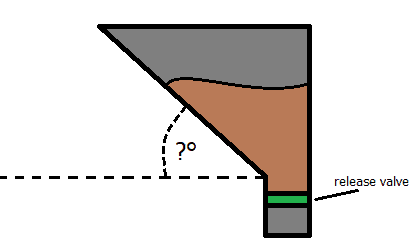
jc9Zd54.png

What makes this more difficult is that the grains aren't one whole solid object. There will be thousands of grains inside the container. So when the container reaches nearly empty, It'll be difficult knowing how much of an angle (at a minimum) the surface needs to be inclined at to let the few amounts of grain that are left to slide easily without the added weight of the other grains.

Given data:
Grain size = 4-7 mm
Grain weight = 0.028 g
Max weight of grains = 5 kg
Required data:
Minimum inclined angle = X degrees

Homework Equations


I am not good at physics. But from researching, this might be a relevant equation:
X = sin^-1 (ax / g)
ax = acceleration on x-axis
g = gravity

The Attempt at a Solution


I need help with this. I am not even sure if I got the correct equation for my problem.

Also, the reason I am looking for the minimum angle is to help figure out how much space I can work with for other objects that I might put under the container. So I can adjust the inclination based on the minimum for how much space I might need. And also to help adjust the height of the whole system based on whatever needed.
 

Attachments

  • jc9Zd54.png
    jc9Zd54.png
    1.4 KB · Views: 678
Physics news on Phys.org
Quill said:
I am an IT student and working on a project, an automated system. It's not for a physics class. I can't say exactly what the system can do. But it uses Arduino to dispense servings of grains on a given schedule. I am more of a programmer than a physicist, I am looking for help on this.

1. Homework Statement

The problem is knowing what the minimum angle the side of the container should incline at, so that the grains will be able to slide down through a tube using gravity. Let's say that an individual grain ranges from 4-7 mm and weighs about 0.028 g. The container will be able to hold up to 5 kg of these grains. One serving will contain around 340 g of grains. The container needs to be completely empty once all the servings of grain has been dispensed, which can take about half or more of a month. That is about 14-15 servings.
View attachment 234792
What makes this more difficult is that the grains aren't one whole solid object. There will be thousands of grains inside the container. So when the container reaches nearly empty, It'll be difficult knowing how much of an angle (at a minimum) the surface needs to be inclined at to let the few amounts of grain that are left to slide easily without the added weight of the other grains.

Given data:
Grain size = 4-7 mm
Grain weight = 0.028 g
Max weight of grains = 5 kg
Required data:
Minimum inclined angle = X degrees

Homework Equations


I am not good at physics. But from researching, this might be a relevant equation:
X = sin^-1 (ax / g)
ax = acceleration on x-axis
g = gravity

The Attempt at a Solution


I need help with this. I am not even sure if I got the correct equation for my problem.

Also, the reason I am looking for the minimum angle is to help figure out how much space I can work with for other objects that I might put under the container. So I can adjust the inclination based on the minimum for how much space I might need. And also to help adjust the height of the whole system based on whatever needed.
I assume your algorithm will hold the gate open for a fixed time, so one issue may be having the grains flow at the same rate at each serving. Fortunately, grains do not behave quite like a fluid.
Conversely, grains are apt to jam in the aperture.
I don't think theoretical physics is going to help much. It will take trial and error, using the specific grain in question. Even humidity may affect it.
 
haruspex said:
I assume your algorithm will hold the gate open for a fixed time, so one issue may be having the grains flow at the same rate at each serving.
I was planning on making the tube that holds the released grains a certain size, as in the tube will hold 1 serving. So the container will release the grains into a tube that is already 1 serving size. When the container dispenses, the serving size tube at the end will stop the flow. I'll test how long it takes for the tube to fill up, and use that to adjust the algorithm for how long it should keep the gate open.

haruspex said:
Conversely, grains are apt to jam in the aperture.
True, I've been trying to find/think of a design that can prevent that.By the way, I haven't yet created the system. Right now I am designing the blueprint before implementation. Anyways, thanks! :biggrin:
 
Quill said:
I was planning on making the tube that holds the released grains a certain size, as in the tube will hold 1 serving. So the container will release the grains into a tube that is already 1 serving size. When the container dispenses, the serving size tube at the end will stop the flow.
Won't that create a problem closing the valve?
 
The pet feeders I've seen have used a paddle wheel arrangement at the bottom of the chute. It serves as both metering agent and valve. As the wheel turns it moves a fixed quantity to the exit while the backside of the paddles serve to block the passage from more pellets. I've not seen them in cross section, but I imagine such a section might look something like this:

upload_2018-11-28_15-59-55.png


Edit: Oh, I should mention that the paddles were made of a flexible plastic material so that pellets cannot jam the rotation by getting wedged.
 

Attachments

  • upload_2018-11-28_15-59-55.png
    upload_2018-11-28_15-59-55.png
    1.6 KB · Views: 653
Last edited:
  • Like
Likes   Reactions: Quill
gneill said:
The pet feeders I've seen have used a paddle wheel arrangement at the bottom of the chute. It serves as both metering agent and valve. As the wheel turns it moves a fixed quantity to the exit while the backside of the paddles serve to block the passage from more pellets. I've not seen them in cross section, but I imagine such a section might look something like this:

View attachment 234816

Edit: Oh, I should mention that the paddles were made of a flexible plastic material so that pellets cannot jam the rotation by getting wedged.
Can't put my finger on why, but intuitively I expected the rotation to be the other way.
 
  • Like
Likes   Reactions: gneill
haruspex said:
Can't put my finger on why, but intuitively I expected the rotation to be the other way.
I think that you may be right. Perhaps it's less likely for a jam to occur against a smooth surface transition. I drew the diagram from a "static" memory of what I saw looking down into the maw of the hopper, I didn't view it in operation. I believe that your intuition is correct. Thanks.
 

Similar threads

  • · Replies 7 ·
Replies
7
Views
5K
  • · Replies 3 ·
Replies
3
Views
18K
  • · Replies 1 ·
Replies
1
Views
3K
  • · Replies 11 ·
Replies
11
Views
5K
  • · Replies 36 ·
2
Replies
36
Views
6K
  • · Replies 18 ·
Replies
18
Views
2K
Replies
46
Views
7K
  • · Replies 5 ·
Replies
5
Views
2K
  • · Replies 63 ·
3
Replies
63
Views
5K
Replies
4
Views
3K