Troubleshooting Euclid's Lemma Proof in Modular Arithmetic
- Context: MHB
- Thread starter Joe20
- Start date
-
- Tags
- Arithmetic Proof
Click For Summary
Discussion Overview
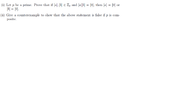
The discussion revolves around proving Euclid's Lemma in the context of modular arithmetic. Participants are troubleshooting specific aspects of the proof and exploring counterexamples related to the lemma.
Discussion Character
- Technical explanation
- Debate/contested
Main Points Raised
- Some participants express difficulties in proving the lemma and seek assistance.
- One participant presents a counterexample involving modular arithmetic: \(2\,\textrm{mod}\,4 \times 2\,\textrm{mod}\,4 = 0\,\textrm{mod}\,4\).
- Another participant discusses the implications of \(p\) being prime and asserts that a multiple of \(p\) must have \(p\) as a factor, leading to the conclusion that the only way to achieve \(0\,\textrm{mod}\,p\) through multiplication is by including \(0\,\textrm{mod}\,p\) in the product.
- A later reply clarifies that the discussion pertains specifically to Euclid's Lemma.
Areas of Agreement / Disagreement
Participants do not appear to reach a consensus, as there are competing views regarding the proof and the validity of the counterexample presented.
Contextual Notes
The discussion includes unresolved mathematical steps and assumptions regarding the properties of prime numbers in modular arithmetic.
Similar threads
- · Replies 5 ·
- · Replies 4 ·
- · Replies 3 ·
- · Replies 3 ·
- · Replies 1 ·
- · Replies 2 ·
- · Replies 5 ·
- · Replies 2 ·