Fundamental Theorem of Arithmetic - Bhattacharya et al

Click For Summary

Discussion Overview

The discussion revolves around the proof of the Fundamental Theorem of Arithmetic (FTA) as presented in the book "Basic Abstract Algebra" by Bhattacharya et al. Participants are examining specific aspects of the proof, particularly the implications of certain algebraic manipulations and the conditions under which unique prime factorization holds.

Discussion Character

  • Technical explanation
  • Debate/contested
  • Mathematical reasoning

Main Points Raised

  • One participant seeks clarification on how the algebraic steps in the proof lead to the conclusion that either ##q_1 = p_i## for some ##i = 2, \ldots, s## or ##q_1 | (p_1 - q_1)##.
  • Another participant suggests that if the two prime factorizations are different, they must have no primes in common, leading to the assumption that ##p_1 > q_1##.
  • It is proposed that the number ##m = (p_1 - q_1)p_2 \ldots p_s## must have a unique prime factorization, implying that ##q_1## must appear in the factorization of ##(p_1 - q_1)p_2 \ldots p_s##.
  • A participant expresses the need for further assistance in demonstrating that ##q_1## appearing in the prime factorization of ##(p_1 - q_1)## leads to ##p_1 = q_1##.
  • Another participant provides a potential pathway to show that if ##q_1## divides ##(p_1 - q_1)##, then it leads to ##p_1 = (r + 1)q_1## for some integer ##r##, suggesting that this could indicate a contradiction.

Areas of Agreement / Disagreement

The discussion contains multiple competing views and remains unresolved. Participants express differing interpretations of the proof and its implications, particularly regarding the uniqueness of prime factorization and the relationships between the primes involved.

Contextual Notes

Participants are working through the implications of the proof and the algebra involved, with some steps remaining unclear or contested. The discussion reflects a reliance on the definitions and assumptions presented in the text, which may not be fully agreed upon by all participants.

Math Amateur
Gold Member
MHB
Messages
3,920
Reaction score
48
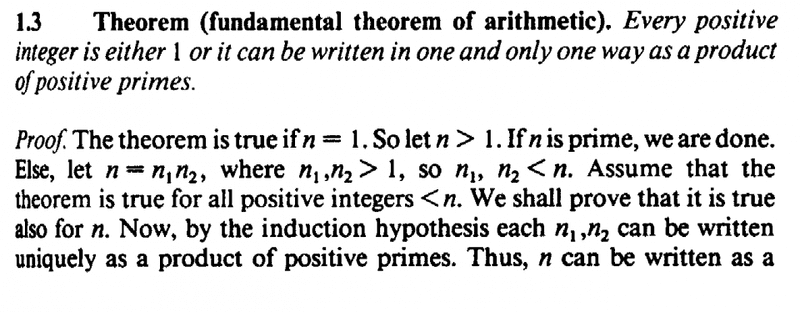
I am reading the book, Basic Abstract Algebra by P.B. Bhattacharya, S.K. Jain, and S.R. Nagpaul ... ... and am currently focused on Chapter 2: Integers, Real Numbers and Complex Numbers ...I need help with an aspect of the proof of the Fundamental Theorem of Arithmetic in Section 1.3 ... ...The Fundamental Theorem of Arithmetic and its proof as presented by Bhattacharya et al reads as follows:
?temp_hash=527395e91194c9b9972ae8b938d4b624.png

?temp_hash=527395e91194c9b9972ae8b938d4b624.png


In the above text we read the following:" ... ... So let ##p_1 \neq q_1##. For definiteness, let ##p_1 \gt q_1##. Then

##n \gt (p_1 - q_1) p_2 \ ... \ p_s = p_1p_2 \ ... \ p_s - q_1p_2 \ ... \ p_s##

##= q_1q_2 \ ... \ q_t - q_1p_2 \ ... \ p_s = q_1 (q_2 \ ... \ q_t - p_2 \ ... \ p_s)##

By the induction hypothesis either ##q_1 = p_i## for some ##i = 2, \ ... \ , s## or

##q_1 | (p_1 - q_1)##. ... ... "I do not follow how

##n \gt (p_1 - q_1) p_2 \ ... \ p_s = p_1p_2 \ ... \ p_s - q_1p_2 \ ... \ p_s##

##= q_1q_2 \ ... \ q_t - q_1p_2 \ ... \ p_s = q_1 (q_2 \ ... \ q_t - p_2 \ ... \ p_s)##

leads to

either ##q_1 = p_i## for some ##i = 2, \ ... \ , s## or ##q_1 | (p_1 - q_1)##. ... ...
Can someone slowly and clearly explain exactly how the above follows ...Hope someone can help ... ...

Peter

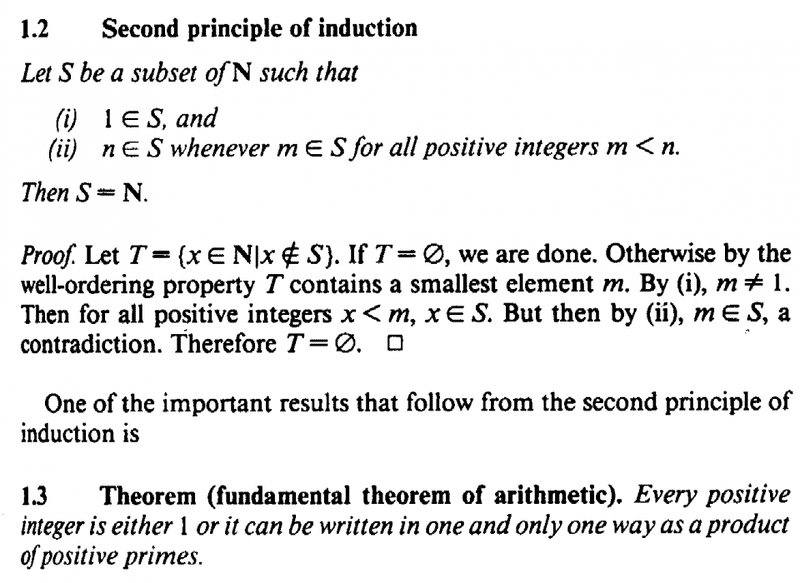
======================================================The above refers to what Bhattacharya et al call the Second Principle of Induction ... this principle reads as follows in their text ... ... :
?temp_hash=527395e91194c9b9972ae8b938d4b624.png
 

Attachments

  • Bh et al - 1 - Fundamental Theorem of Arith.png
    Bh et al - 1 - Fundamental Theorem of Arith.png
    39.1 KB · Views: 1,319
  • Bh et al - 2 - Fundamental Theorem of Arith.png
    Bh et al - 2 - Fundamental Theorem of Arith.png
    66.7 KB · Views: 6,264
  • Bhattacharya et al - Second Principle of Induction.png
    Bhattacharya et al - Second Principle of Induction.png
    91.3 KB · Views: 973
Physics news on Phys.org
The basis of this proof is that, if the FTA does not hold, then there must be a least whole number that has a non-unique prime factorisation. He's assuming that

##n = p_1 \dots p_s = q_1 \dots q_t##

is that whole number. And that any whole number less than ##n## must, therefore, have a unique prime factorisation.

I would change the proof slightly. If the two prime factorisations are different, then we know that they have no primes in common (otherwise we could cancel the common prime). In particular, this means that (without loss of generality) ##p_1 > q_1## and ##q_1## is distinct from all the ##p's##.

Now, a bit of algebra gives:

##n > m = (p_1 -q_1)p_2 \dots p_s = q_1(q_2 \dots q_t - p_2 \dots p_s)##

Now, this number ##m## is less than ##n## so must have a unique prime factorisation. In particular, ##q_1## must appear in the prime factorisation of ##(p_1 -q_1)p_2 \dots p_s##.

And, as we know ##q_1## is distinct from the ##p's## (*) it must appear in the prime factorisation of ##(p_1 -q_1)## and so, in fact, ##p_1 = q_1##, which is a contradiction. You might want to prove this last bit yourself.

(*) note also that ##p_2 \dots p_s < n## so has a unique prime factorisation and cannot have an alternative factorisation involving ##q_1##.
 
  • Like
Likes   Reactions: Math Amateur
Thanks for the help PeroK ... much appreciated...

... just working through your post now ...

Thanks again,

Peter
 
PeroK said:
The basis of this proof is that, if the FTA does not hold, then there must be a least whole number that has a non-unique prime factorisation. He's assuming that

##n = p_1 \dots p_s = q_1 \dots q_t##

is that whole number. And that any whole number less than ##n## must, therefore, have a unique prime factorisation.

I would change the proof slightly. If the two prime factorisations are different, then we know that they have no primes in common (otherwise we could cancel the common prime). In particular, this means that (without loss of generality) ##p_1 > q_1## and ##q_1## is distinct from all the ##p's##.

Now, a bit of algebra gives:

##n > m = (p_1 -q_1)p_2 \dots p_s = q_1(q_2 \dots q_t - p_2 \dots p_s)##

Now, this number ##m## is less than ##n## so must have a unique prime factorisation. In particular, ##q_1## must appear in the prime factorisation of ##(p_1 -q_1)p_2 \dots p_s##.

And, as we know ##q_1## is distinct from the ##p's## (*) it must appear in the prime factorisation of ##(p_1 -q_1)## and so, in fact, ##p_1 = q_1##, which is a contradiction. You might want to prove this last bit yourself.

(*) note also that ##p_2 \dots p_s < n## so has a unique prime factorisation and cannot have an alternative factorisation involving ##q_1##.
PeroK,

Thanks again for your help ...

BUT ... I need help to show that ##q_1## appearing in the prime factorization of ##(p_1 -q_1)## leads to ##p_1 = q_1## ... ...

Can you help further ...

Peter
 
Math Amateur said:
PeroK,

Thanks again for your help ...

BUT ... I need help to show that ##q_1## appearing in the prime factorization of ##(p_1 -q_1)## leads to ##p_1 = q_1## ... ...

Can you help further ...

Peter

Yes, but if you can't do something simple like that for yourself, then you are going to struggle.

##p_1 - q_1 = rq_1## for some ##r##

##p_1 = (r+1)q_1##

(That itself could be taken to be the contradiction, as you have an alternative prime factorisation for ##p_1##)

Or, to continue:

##r = 0## and ##p_1 = q_1##

You need to get used to doing this for yourself. You can't learn number theory by letting Bhattacharya (or me) just spoon feed you all the steps.
 
Thanks again for your help,

Peter
 

Similar threads

Replies
4
Views
2K
  • · Replies 5 ·
Replies
5
Views
3K
  • · Replies 35 ·
2
Replies
35
Views
5K
  • · Replies 5 ·
Replies
5
Views
2K
  • · Replies 6 ·
Replies
6
Views
2K
  • · Replies 4 ·
Replies
4
Views
2K
  • · Replies 4 ·
Replies
4
Views
3K
  • · Replies 5 ·
Replies
5
Views
3K
  • · Replies 2 ·
Replies
2
Views
2K
  • · Replies 197 ·
7
Replies
197
Views
33K