Trying to establish a connection between the 2 rotating quadrants

  • Context: Graduate 
  • Thread starter Thread starter bugatti79
  • Start date Start date
  • Tags Tags
    Polynomial
Click For Summary
SUMMARY

The discussion centers on establishing a mathematical connection between two rotating quadrants using angles alpha (α) and beta (β). The user created a polynomial function of β in terms of α, leading to the relation $$\sin \beta = \frac 1 {K_2} \left( 1 - \cos \alpha + \sin \alpha \right)$$. The lengths of the chords are defined as $$L = \sqrt 2 R$$ and $$L_2 = \sqrt 2 K_2 R$$, with angles θ and φ related to α and β respectively. The derived equation has been confirmed as correct, indicating a viable approach to solving the problem.

PREREQUISITES
  • Understanding of trigonometric functions and their properties
  • Familiarity with polynomial functions and their applications
  • Knowledge of geometric concepts related to quadrants and angles
  • Basic proficiency in mathematical notation and equations
NEXT STEPS
  • Explore advanced polynomial functions in mathematical modeling
  • Study the properties of trigonometric identities and their applications
  • Investigate the geometric relationships in rotating systems
  • Learn about analytic functions and their role in solving equations
USEFUL FOR

Mathematicians, physics students, and engineers interested in geometric transformations and trigonometric relationships in rotating systems.

bugatti79
Messages
786
Reaction score
4
TL;DR
establish connection between the 2 rotating quadrants
Hello All,

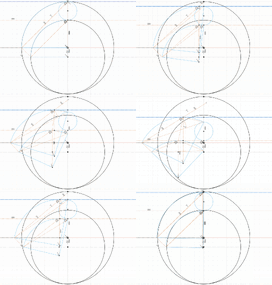
I struggled to find a closed form solution connecting the 2 quadrants via the angles alpha and beta. I filled the schematic with right angle triangles hoping to find a connection but to no avail.
In the end, I decided to create a polynomial function of beta in terms of alpha as I know the coordinates of the vertices. Could someone confirm that a closed form solution is not possible? Is there any way I could use a custom analytic function of beta in terms of alpha? Thanks!

mechanism_v1.gif


Relationship_between_alpha_beta_v1.png


mechanism_v1.gifRelationship_between_alpha_beta_v1.png
 
Last edited by a moderator:
Physics news on Phys.org
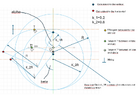
I find the following relation between ##\alpha## and ##\beta##: $$\sin \beta = \frac 1 {K_2} \left( 1 - \cos \alpha + \sin \alpha \right).$$ See if you can confirm this using the method sketched below.

1736366783251.png

In the figure, ##L## and ##L_2## are the lengths of the chords of the two quadrants: ##L = \sqrt 2 R## and ##L_2 = \sqrt 2 K_2 R##.

##\theta## and ##\phi## denote the angles that the two chords make with respect to the horizontal. You can show that ##\theta = \pi/4 - \alpha## and ##\phi = \pi/4 - \beta##.

Thus, ##\sin \theta = (\cos \alpha – \sin\alpha)/\sqrt 2## and ##\sin \phi = (\cos \beta – \sin\beta)/\sqrt 2##.

##A, B, C, D, ## and ##E## label various points. Note that $$AC +CE = AB + BD +DE $$ where

##AC = L \sin \theta##

##CE = R – K_2 R##

##AB = 2K_1R##

##BD = K_2R(1-\cos \beta)##

##DE = L_2 \sin \phi##

Use these relations along with ##K_1 + K_2 = 1##.
 
Last edited:
  • Like
Likes   Reactions: Baluncore, bugatti79 and renormalize
Hallo TSny,

Indeed the equation you derived is correct and matches the angles calculated from the program/sketch. Many thanks for your input. I neglected to consider in futher detail the segments on the vertical axis.
Much appreciated and Thanks!
 
  • Like
Likes   Reactions: TSny, Baluncore and berkeman

Similar threads

  • · Replies 19 ·
Replies
19
Views
2K
  • · Replies 29 ·
Replies
29
Views
4K
  • · Replies 1 ·
Replies
1
Views
1K
  • · Replies 2 ·
Replies
2
Views
2K
  • · Replies 9 ·
Replies
9
Views
3K
  • · Replies 21 ·
Replies
21
Views
4K
  • · Replies 0 ·
Replies
0
Views
2K
  • · Replies 1 ·
Replies
1
Views
2K
  • · Replies 14 ·
Replies
14
Views
2K
  • · Replies 1 ·
Replies
1
Views
3K