Twin turbo intercooler pipe merge using air ejector design

5 replies · 8K views · last reply
V8KILR
Messages
4
Reaction score
0
I'm converting my turbo system from a single turbo to a sequential twin turbo system. Where the two turbos intercooler pipes join, the flow from the first turbo to spool can easily reverse back through the second turbo to spool, unless you have a one way valve like a swing check valve to stop this happening.

What I would like to do is eliminate the swing check valve by using an air ejector design with the first turbo's intercooler pipe to stop the flow reversing back through the second turbo's intercooler pipe. Here is a diagram I have done.
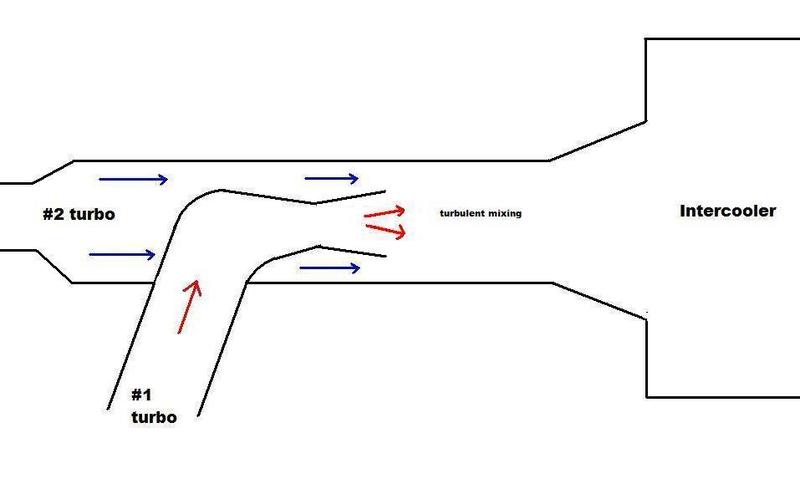
Diagram of two intercooler pipes merging: #2 turbo pipe runs straight along the top, #1 turbo pipe angles in from below, blue arrows show flow forward, red arrows show turbulent mixing, joining one intercooler on the right.


Could this design work such that at all stages of both turbos boost from vacuum to full boost, there would be no flow backwards to the second turbo?
 
Last edited:
Google "twin turbo merger" and you will see plenty of smooth transitions into the throttle/carb. If you have similar turbos being fed by equal banks of exhaust the rest of it "will work itself out".

Looking straight into a round aluminum pipe where two smaller tubes merge into one oval-shaped passage divided by a central wall, with a cardboard box labeled 4 GALLONS below.


Engine bay of a car on jack stands showing a V8 with two large turbochargers mounted low on the side, with polished aluminum intake pipes running from them, and a red fuel pressure regulator on top of the carburetor.
 
This is a sequential twin turbo setup I am doing which means one turbo makes boost first while the other one is making no boost. The pic you show is one of the better designs, but I still don't think that I can merge the intercooler pipes like your pic shows otherwise the boost from the first turbo will still partly flow back out the second turbo (as it is making no flow or boost) instead of it all going out through the intercooler. This is because the flow path back out through the second turbo presents less resistance to the first turbos boosted air then going through the intercooler does.

What the air ejector method should do is turbulently mix the air from the first turbo (which is at high speed and pressure) with the atmospheric pressure air in the second turbo intercooler pipe. This mixing should impart forward velocity to the second turbos static air resulting in it also moving towards the intercooler, albeit at a slower speed. The more mixing that occurs, the better this idea will work and the less chance that any air will flow backwards out the second turbo.

That's why I'm hoping someone with more maths skills then me can help work out (or point me in the right direction) if my idea of using an air ejector design for the pipe merging will achieve maximum mixing of the air and result in no air ever flowing backwards out the second turbo.
 
Last edited:
A check valve should work for the intake.
Cross-sectional diagram of a check valve in two states: left, open position with forward flow to the right, labelled Body, Guide, Spring and Disc; right, close position with reverse flow to the left.


This should solve the exhaust part.
Polished stainless steel exhaust kit parts: a Y-shaped merge pipe marked RatSport, an angled elbow pipe, a flanged electric exhaust cutout valve with a solenoid, a V-band clamp, flange gaskets, bolts, washers, and a toggle switch with wiring.
 
The EGCV (exhaust gas control valve) design I like the best is this one as it is boost activated, but unfortunately they are out of stock at the moment.

Stainless steel exhaust pipe fitting with a vacuum-actuated diaphragm canister on top, a flanged inlet on the left and a straight tube outlet on the right, held by a band clamp.


The intake check valve design I like the best is this one. It is a swing check valve so should have very little flow resistance.

Cutaway diagram of a Val-Matic Surgebuster swing check valve with a 35° hinged disc, labeled 100% FLOW AREA, with red arrows showing flow through the open valve. Figure 1.


I'd still like to be able to have the intercooler pipe merging done so that there is no need for the swing check valve though, and I still think that the air ejector design should be able to achieve that.
 
Last edited:
Hi,

I am not sure if this will help at all but there is a company that manufacture diesel engine charge air coolers, you should try Vestas aircoil A/S in Denmark (www.vestas-aircoil.com)