Two cylinders: free to fall and rotate

Click For Summary

Homework Help Overview

The problem involves analyzing the motion of two cylinders, one blue and one red, that are free to fall and rotate. The original poster seeks to find the acceleration of the blue cylindrical disk, given that both cylinders have the same mass and radius, and a massless string is involved in their motion.

Discussion Character

  • Exploratory, Assumption checking, Conceptual clarification

Approaches and Questions Raised

  • The original poster attempts to establish equations for linear and angular accelerations but encounters confusion regarding the signs in their equations. Some participants question the relationship between angular and linear acceleration, suggesting that more clarity is needed on how these are connected.

Discussion Status

Participants have provided feedback on the original poster's equations and reasoning, indicating areas where clarification is needed. There is a recognition that the no-slipping condition may not be sufficient to determine the acceleration of the blue cylinder, and suggestions have been made to explore the relationship between angular displacements further.

Contextual Notes

There is an indication that the original poster's equations were mislabeled, which may have contributed to the confusion. The discussion also highlights the complexity of the relationship between the angular accelerations of both cylinders and the linear acceleration of the blue cylinder.

wirefree
Messages
110
Reaction score
21
Problem: Find the acceleration of the blue cylindrical disk. Both, red and blue, cylinders have same mass and radius, and string is massless.
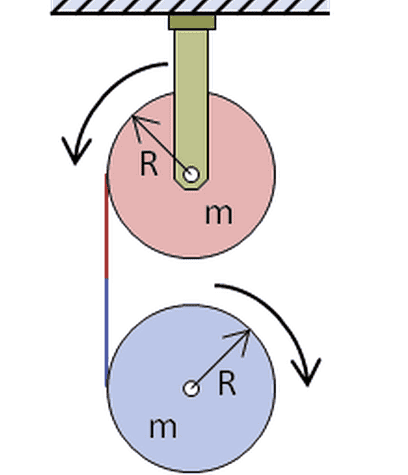
image.png


Attempt:
Identified three equations: one for linear acceleration of blue cylinder, and two of angular accelerations (one each for blue and red cylinder).

1) mg - T = ma
2) Tr = I*alpha (blue)
3) -Tr = -I*alpha (fred)

I have chosen downward and anti-clockwise to be positive.

Trouble: I obtain T from equation 2 and substitute it in eqn. 1 and solve for 'a' (=2*g). This answer has been marked red.

Would appreciate advice to correct course.

Regards,
wirefree
 
Physics news on Phys.org
I'm a little confused with your signs. You said that you are taking anti-clockwise as positive. The red cylinder rotates anti-clockwise. Yet your equation 3 has negative signs. I think we would need to see more of your work to make sure you are treating the signs correctly.

You have not indicated how you relate the angular acceleration of the blue cylinder to its linear acceleration. This is an important part of this problem and it's a little bit tricky.
 
Last edited:
EDIT: My equations were mislabeled. Properly, they are:

1) ) mg - T = ma
2) Tr = I*alpha (red)
3) -Tr = -I*alpha (blue)

NOTE: Apologies; could not edit original Usenet post
 
Can you please show your steps that lead to your answer? That way we can pinpoint any mistakes.
 
wirefree said:
EDIT: My equations were mislabeled. Properly, they are:

1) ) mg - T = ma
2) Tr = I*alpha (red)
3) -Tr = -I*alpha (blue)

NOTE: Apologies; could not edit original Usenet post
At a guess, you have the relationship between a and alpha wrong.
 
Appreciate all responses.

My attempt, as requested, was:

1) obtain T from equation 2
- for 'alpha' in the T expression, I inserted the no-slipping constraint: alpha*r=a
2) substitute T in eqn. 1 and solve
3) a = 2*g

This answer has been marked red.

Please advise.

Regards,
wirefree
 
wirefree said:
- for 'alpha' in the T expression, I inserted the no-slipping constraint: alpha*r=a

The constraint is a little more complicated due to the string unwinding off of the top cylinder. The linear acceleration of the bottom cylinder depends on both the angular acceleration of the top cylinder and the angular acceleration of the bottom cylinder.

The diagram shows a specific point of the string in green, a specific point on the rim of the lower cylinder in blue, and a specific point on the red cylinder in red. During a small time interval, the point on the string moves down from ##a## to ##a'## while the points on the cylinders rotate from ##b## to ##b'## and ##c## to ##c'##. This diagram might help you relate the angular displacements ##\theta_{red}## and ##\theta_{blue}## of the cylinders to the vertical drop of the center of the blue cylinder from ##a## to ##d##.
 

Attachments

  • Two Cylinders.png
    Two Cylinders.png
    29.2 KB · Views: 487
  • Like
Likes   Reactions: wirefree
Greatly appreciate the direction, TSny.

My key take-away from all discussions above is that the no-slipping condition alone is not sufficient in determining acceleration of the blue cylinder because, to quote TSny, "linear acceleration of the bottom cylinder depends on both the angular acceleration of the top cylinder and the angular acceleration of the bottom cylinder."

To the above extend, it was suggested I start with the relationship between angular displacements and proceed.

My unsuccessful attempt at that aside, a confirmation of my understanding of the basic premise - a = alpha_b*R + alpha_r*R - would be appreciated.

Regards,
wirefree
 
wirefree said:
My unsuccessful attempt at that aside, a confirmation of my understanding of the basic premise - a = alpha_b*R + alpha_r*R - would be appreciated.
Yes, that's the correct relation.
 

Similar threads

  • · Replies 21 ·
Replies
21
Views
2K
  • · Replies 13 ·
Replies
13
Views
2K
  • · Replies 22 ·
Replies
22
Views
3K
  • · Replies 4 ·
Replies
4
Views
2K
Replies
34
Views
3K
  • · Replies 24 ·
Replies
24
Views
5K
  • · Replies 78 ·
3
Replies
78
Views
11K
  • · Replies 14 ·
Replies
14
Views
3K
  • · Replies 22 ·
Replies
22
Views
3K
  • · Replies 1 ·
Replies
1
Views
2K