Two different answers for work done during compression

Click For Summary
The discussion revolves around the confusion regarding the work done during a compression process in a thermodynamic system, specifically when applying the first law of thermodynamics and the relationship between pressure, volume, and temperature. The user initially assumes a reversible process, leading to a work equation that contrasts with the result obtained from the first law, which includes a different coefficient for the change in internal energy. The discrepancy is clarified by recognizing that the coefficient of 3/2 applies specifically to monatomic ideal gases, prompting a reevaluation of the gas type in the problem. The user discovers that for an ideal monatomic gas, the value of gamma is approximately 1.66, aligning the two methods of calculation. Ultimately, the clarification resolves the initial confusion regarding the coefficients in the equations.
etotheipi
Homework Statement
Calculating work done during adiabatic compression (please see problem statement below)
Relevant Equations
Ideal gas laws, internal energy
I'm having a little trouble with part a) of this question:
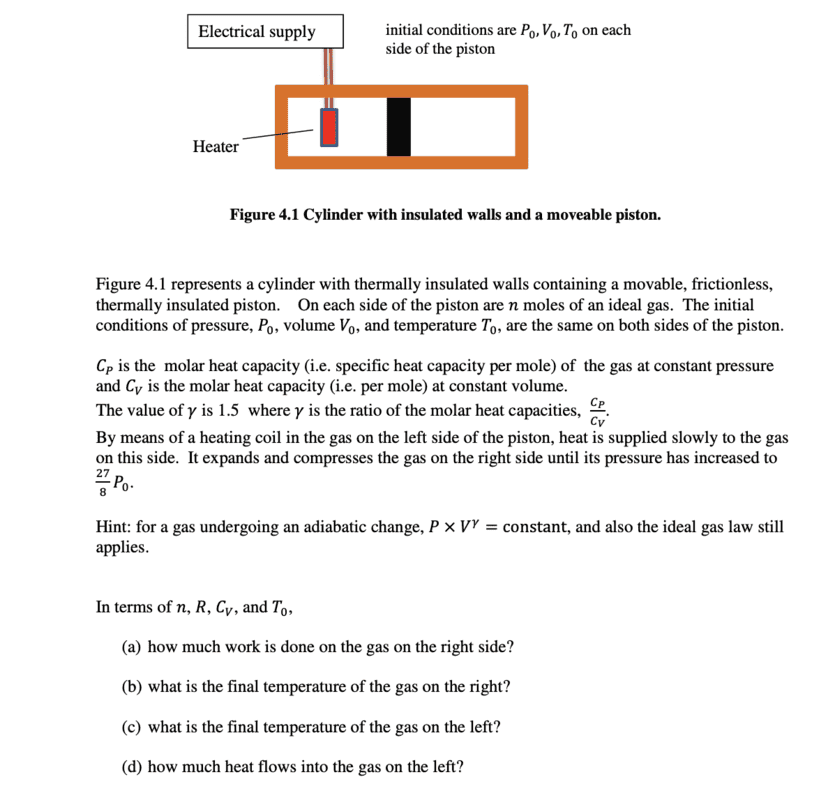
Screenshot 2019-12-31 at 16.20.46.png

Since it is stated that the heating is slow, I thought it was reasonable to assume the process is reversible which means that the pressure in both sides should be equal. Consequently, $$W = - \int_{V_{0}}^{V_{1}} P dV = - \int_{V_{0}}^{V_{1}} kV^{- \gamma} dV = \frac{1}{\gamma-1}(P_{1}V_{1} - P_{0}V_{0})$$ For ##\gamma = 1.5##, the outside coefficient is ##2##.

However, if I use the first law (with ##Q=0## due to the insulated/adiabatic condition), I get $$W = \Delta U = \frac{3}{2}(nRT_{1} - nRT_{0}) = \frac{3}{2}(P_{1}V_{1} - P_{0}V_{0})$$I can't figure out why the two coefficients of ##(P_{1}V_{1} - P_{0}V_{0})## are different!

After this is sorted out, I assume it will just be a case of doing some rearrangement (i.e. w/ ##\frac{P_{0}V_{0}}{T_{0}} = \frac{P_{1}V_{1}}{T_{1}}## etc.) to get it into the required form?
 
Last edited by a moderator:
Physics news on Phys.org
etotheipi said:
However, if I use the first law (with ##Q=0## due to the insulated/adiabatic condition), I get $$W = \Delta U = \frac{3}{2}(nRT_{1} - nRT_{0}) = \frac{3}{2}(P_{1}V_{1} - P_{0}V_{0})$$I can't figure out why the two coefficients of ##(P_{1}V_{1} - P_{0}V_{0})## are different!
The coefficient ##\frac{3}{2}## in ##\Delta U## is only for a monatomic ideal gas. Is the gas monatomic in this problem?
 
  • Like
Likes etotheipi
TSny said:
The coefficient ##\frac{3}{2}## in ##\Delta U## is only for a monatomic ideal gas. Is the gas monatomic in this problem?

Thank you, I just googled ##\gamma## for an ideal monatomic gas (it turns out to be roughly 1.66), which gives ##\frac{1}{\gamma-1} \approx 1.5##, as was obtained via the other method!
 
etotheipi said:
Thank you, I just googled ##\gamma## for an ideal monatomic gas (it turns out to be roughly 1.66), which gives ##\frac{1}{\gamma-1} \approx 1.5##, as was obtained via the other method!
Is everything OK now?

For a general ideal gas, ##U = nC_VT## and ##C_V = \frac{R}{\gamma - 1}##.
 
  • Like
Likes etotheipi
The book claims the answer is that all the magnitudes are the same because "the gravitational force on the penguin is the same". I'm having trouble understanding this. I thought the buoyant force was equal to the weight of the fluid displaced. Weight depends on mass which depends on density. Therefore, due to the differing densities the buoyant force will be different in each case? Is this incorrect?

Similar threads

  • · Replies 11 ·
Replies
11
Views
1K
  • · Replies 9 ·
Replies
9
Views
1K
Replies
27
Views
1K
Replies
10
Views
3K
Replies
15
Views
2K
Replies
49
Views
3K
  • · Replies 3 ·
Replies
3
Views
2K
Replies
42
Views
3K
Replies
6
Views
2K
  • · Replies 9 ·
Replies
9
Views
1K