Two Questions on Waves and Polarised Light

  • Thread starter Thread starter Air
  • Start date Start date
  • Tags Tags
    Light Waves
Click For Summary
SUMMARY

This discussion addresses two key concepts in wave physics: the distinction between pulses and continuous waves, and the characteristics of polarized versus unpolarized light. Pulses are defined as discrete packets of energy, contrasting with continuous wave-trains that can experience interference. The conversation also emphasizes the importance of illustrating vibrations and oscillations in diagrams of polarized light, which is crucial for achieving full marks in assessments.

PREREQUISITES
  • Understanding of wave mechanics
  • Familiarity with the concept of polarization in light
  • Basic knowledge of diagrammatic representation in physics
  • Experience with radio wave applications
NEXT STEPS
  • Research the mathematical representation of wave functions and pulses
  • Explore the principles of light polarization and its applications in optics
  • Learn about interference patterns in wave phenomena
  • Study the practical applications of pulses in communication technologies
USEFUL FOR

Students studying physics, educators teaching wave mechanics, and professionals in optics or telecommunications who require a deeper understanding of wave behavior and light polarization.

Air
Messages
202
Reaction score
0
I have two questions that are slightly unrelated to each other which has confused me while I was doing revision.


So I understand that if waves are transmitted (e.g. radio waves) then some interference would occur and not be able to give perfect result for any experiment conduced so pulses are used. What are pulses? How do they differ to a wave?


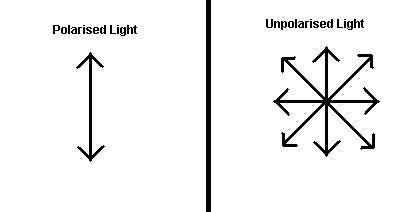
Also, when talking about polarised light, many question ask to draw how polarised light differs from unpolarised light and I draw it like this:
Light.jpg

But one mark is awarded for showing vibration and oscillations on the diagram, how do I do that?
 
Physics news on Phys.org
Air said:
So I understand that if waves are transmitted (e.g. radio waves) then some interference would occur and not be able to give perfect result for any experiment conduced so pulses are used. What are pulses? How do they differ to a wave?

That's a little ambiguous to answer.. what kind of experiments are we talking about here? Pulses of light are essentially packets as opposed to a continuous wave-train.

Air said:
But one mark is awarded for showing vibration and oscillations on the diagram, how do I do that?

You have already shown that in your diagram by having arrowheads at each end. Most diagrams I have seen display unpolarised light as you have drawn.

EDIT: I suppose you could say that the centre of your diagram is the propagation axis, that may clarify it further.
 
astrorob said:
That's a little ambiguous to answer.. what kind of experiments are we talking about here? Pulses of light are essentially packets as opposed to a continuous wave-train.

Not experiment. I meant that in any system using waves for example radio waves, they would use pulses to avoid interference if they used waves. What I didn't understand was the difference between pulse and waves. You said they are packets, what do you mean by that? :confused:
 

Similar threads

  • · Replies 5 ·
Replies
5
Views
2K
  • · Replies 9 ·
Replies
9
Views
2K
  • · Replies 17 ·
Replies
17
Views
3K
  • · Replies 1 ·
Replies
1
Views
1K
  • · Replies 6 ·
Replies
6
Views
2K
Replies
1
Views
2K
  • · Replies 35 ·
2
Replies
35
Views
4K
Replies
5
Views
3K
  • · Replies 1 ·
Replies
1
Views
2K
  • · Replies 6 ·
Replies
6
Views
2K