Two roads meeting a river at different angles (heights and distances)

Click For Summary
SUMMARY

The discussion centers on a geometry problem involving two roads meeting a river at angles of 60° and 30°, with the longer road (CB) measuring 3 miles. Using the law of sines, the calculated length of the shorter road (AC) is approximately 1.73 miles, while the perpendicular distance from C to the river (CD) is 1.5 miles. Participants express confusion over discrepancies between their calculations and textbook answers, suggesting potential errors in the textbook or misinterpretation of the problem's wording.

PREREQUISITES
  • Understanding of the law of sines in trigonometry
  • Familiarity with basic geometry concepts, including angles and triangles
  • Ability to interpret mathematical problem statements accurately
  • Knowledge of right triangle properties and calculations
NEXT STEPS
  • Review the law of sines and its applications in solving triangle problems
  • Study the properties of right triangles and their relationships
  • Examine common pitfalls in interpreting geometry problems
  • Investigate potential errors in textbook solutions and how to verify them
USEFUL FOR

Students studying geometry, educators teaching trigonometry, and anyone involved in mathematical problem-solving who seeks to clarify concepts related to angles and distances in geometric contexts.

brotherbobby
Messages
755
Reaction score
170
Homework Statement
Two straight roads, which cross one another, meet a river with straight course at angles ##60^{\circ}## and ##30^{\circ}##, respectively. If it be 3 miles by the longer of the two roads, from the crossing to the river, how far is it by the ##\text{shortest}## (or the shorter of the two?)? If there be a foot-path which goes the shortest way from the crossing to the river, what is the distance by it?
Relevant Equations
1. In a right-angled triangle, ##\sin\theta = \frac{\text{opposite}}{\text{hypotenuse}}##.
2. For a triangle ##\text{ABC}##, ##\frac{a}{\sin A} = \frac{b}{\sin B}##. (The Law of Sines)
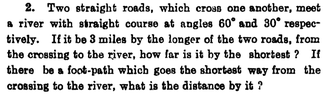
1678645745230.pngProblem statement : I copy and paste the problem as it appears in the text. I hope am understanding its wording correctly.
1678647136482.png
Diagram :
The river is shown in blue. The two roads start from the crossing C and end in A and B, making angles ##60^{\circ}## and ##30^{\circ}## resectively. The longer of the two roads CB is given to be 3 miles. Question is, how long is the shorter of the two roads AC, assuming my understanding of the problem is correct. Additionally, how long is the shortest way from C to the river, that is CD, where CD is ##\perp^r## to BA produced.

Solution : Using the law of sines (see Relevant Equations above), ##\text{AC} = \text{BC}\times \frac{\sin 30^{\circ}}{\sin 60^{\circ}} = 3\times \frac{1}{2}\times \frac{2}{\sqrt 3} = \sqrt 3 = \boxed{1.73\,\, \text{miles}}##.
The distance CD = ##BC\, \sin 30^{\circ} = 3\times\frac{1}{2} = \boxed{1.5\,\text{miles}}##.Issue : The answers don't match with those in the text. I copy and paste the text answers below.
1678648034873.png

A hint or help would be welcome. I am perplexed at the moment, given the simplicity of the problem. Or am I deceiving myself?
 
Physics news on Phys.org
I get the same answer as you got. For the pasted textbook answer, I don't know how they got ##2 \frac 1 2## miles, and I don't understand the first part, which is unclear. It says either "##2 \cdot 89##... miles" or "##2 \cdot 80##... miles".
 
Mark44 said:
I get the same answer as you got. For the pasted textbook answer, I don't know how they got ##2 \frac 1 2## miles, and I don't understand the first part, which is unclear. It says either "##2 \cdot 89##... miles" or "##2 \cdot 80##... miles".
I think I have an idea. I assumed (naively) that the two roads "meet" the river bank on the same side as that of the perpendicular (CD). Is it possible that they meet on opposite sides of D? I should carry out the solution if that is what the authors mean by "crossing".

All the same, the wording is ambiguous, if you'll agree.
 
brotherbobby said:
Is it possible that they meet on opposite sides of D?
I thought of that, too, but I don't think it makes a difference in the length of AC.
 
Yes, forgive me. AC remains the same on either side. It is a puzzle. I think I have to accept the book being mistaken here.
 
brotherbobby said:
Yes, forgive me. AC remains the same on either side. It is a puzzle. I think I have to accept the book being mistaken here.
It's been known to happen that the posted answers in a textbook are wrong ...
 
brotherbobby said:
Yes, forgive me. AC remains the same on either side. It is a puzzle. I think I have to accept the book being mistaken here.
I believe the mistake is in the 3 miles distance.
For the values of the response to be correct, the distance from crossing to river via BC should have been 5.0 miles.
 
  • Like
Likes   Reactions: neilparker62
You don't even need the sine rule to solve this problem since we are dealing with right triangles.
 
Last edited:
  • Like
Likes   Reactions: Lnewqban

Similar threads

Replies
12
Views
2K
  • · Replies 20 ·
Replies
20
Views
3K
  • · Replies 7 ·
Replies
7
Views
2K
  • · Replies 11 ·
Replies
11
Views
2K
Replies
7
Views
2K
Replies
2
Views
2K
  • · Replies 8 ·
Replies
8
Views
2K
  • · Replies 2 ·
Replies
2
Views
2K
Replies
15
Views
2K
  • · Replies 3 ·
Replies
3
Views
2K