Two rotating masses balanced by a third mass (rotational dynamics)

Click For Summary
SUMMARY

The discussion focuses on the dynamics of a system involving two rotating masses balanced by a third mass, specifically addressing the conservation of angular momentum and the equations governing the system's motion. The initial angular velocity is calculated as ##\omega_0 = \sqrt{\frac{Mg}{2mR_0}}##, with the moment of inertia given by ##I_0=2mR_0^2##. Participants worked through the equations for angular momentum and acceleration, ultimately deriving the differential equation for ##\ddot R## as ##\ddot R + \frac{M}{M+2m}g - \frac{\frac{2mR_0^4\omega_0^2}{M+2m}}{R^3}=0##. The discussion emphasizes the importance of sign conventions and the correct application of forces in rotational dynamics.

PREREQUISITES
  • Understanding of rotational dynamics and angular momentum
  • Familiarity with differential equations and their applications in physics
  • Knowledge of moment of inertia calculations
  • Proficiency in algebraic manipulation of physical equations
NEXT STEPS
  • Study the principles of conservation of angular momentum in rotating systems
  • Learn about moment of inertia for various shapes and configurations
  • Explore differential equations in the context of mechanical systems
  • Investigate the effects of varying mass distributions on rotational dynamics
USEFUL FOR

Students and professionals in physics, mechanical engineering, and applied mathematics, particularly those focusing on rotational dynamics and system stability analysis.

Eirik
Messages
12
Reaction score
2
Homework Statement
Hi! This isn't really homework, but I'm practicing for my exam in mechanical physics and I'm really struggling with this one question!

Two masses, m, are rotating around the z axis as shown in the figure on a frictionless surface, but are being pulled down by a third mass, M. Find the differential equation for the movement of the system. The masses should be considered point masses and the system initially has ##R=R_0## and ##\omega=\omega_0## It should be on the following form, where ##\alpha## and ##\beta## are constants you need to find:
Relevant Equations
##\ddot R + \alpha g - \frac{\beta}{R^3}=0##, differential equation I need to find

##a_r = \ddot R -\omega^2R##, acceleration of mass m in the circle, given in task
Here's a diagram of what the system looks like:
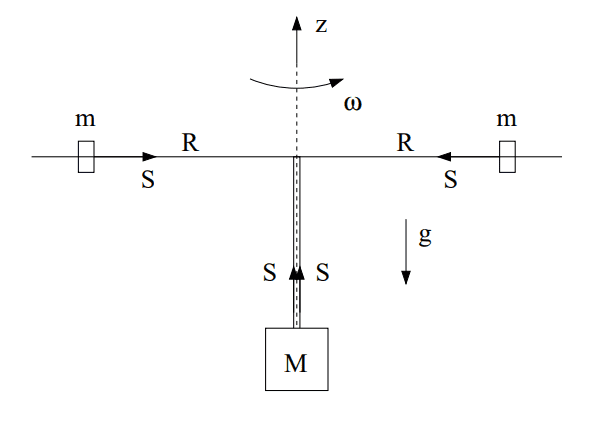
Skjermbilde.PNG

So far I have figured out what the initial angular velocity is, if the system is balanced (no movement):

## \sum F_m = m*\frac{v^2}{R_0}-\frac{Mg}{2}=0 ##
##m \frac{v^2}{R_0}-\frac{Mg}{2}=0 ## divide both sides by m
##\omega_0 = \sqrt{\frac{Mg}{2mR_0}}##

One of the hints given for the task, was that we should consider the conservation of angular momentum:
Moment of inerty, start: ##I_0=2mR_0^2##
Angular momentum, start: ##L_0=I_0\omega_0=2mR_0^2 \sqrt{\frac{Mg}{2mR_0}} ##

I am struggling to find the equation for the angular momentum after that, however. I know that the moment of inertia should still be ##I=2mR^2##, and that ##L=I\omega##. How do I find \omega?

I also have this:
## \sum F_M = Mg-2S=M*\ddot R##
##S=m* (\ddot R -\omega^2R)## Really not sure if this one is correct

Any help would be very greatly appreciated!
 
Physics news on Phys.org
Eirik said:
Homework Statement::
So far I have figured out what the initial angular velocity is, if the system is balanced (no movement):
If the system were to start out in the balanced state, then it would remain in this state. I don't think they want you to assume the system is in the balanced state initially. I think they want you to express the differential equation for ##\ddot R## in terms of ##R_0## and ##\omega_0##.

One of the hints given for the task, was that we should consider the conservation of angular momentum:
Moment of inerty, start: ##I_0=2mR_0^2##
Angular momentum, start: ##L_0=I_0\omega_0=2mR_0^2 \sqrt{\frac{Mg}{2mR_0}} ##
Since the system does not necessarily start in the balanced state, you cannot assume that ##\omega_0=\sqrt{\frac{Mg}{2mR_0}} ##. Just express ##L_0## in terms of ##m##, ##R_0##, and ##\omega_0##.

I am struggling to find the equation for the angular momentum after that, however. I know that the moment of inertia should still be ##I=2mR^2##, and that ##L=I\omega##.
Yes.

How do I find ##\omega##?
You can use the expression for the angular momentum to find ##\omega## as a function of ##R##.

I also have this:
## \sum F_M = Mg-2S=M*\ddot R##
Be careful with signs. The left side expresses the net downward force on ##M##. So, the acceleration on the right should be the downward acceleration of ##M##. Does the downward acceleration of ##M## equal ##\ddot R## or ##-\ddot R##?

##S=m* (\ddot R -\omega^2R)##
You have a sign error in this equation. Does the force ##S## on ##m## act in the radially outward direction or the radially inward direction?
 
Thank you so much @TSny ! That was really, really helpful!

Then we have
##L_i=L##
##2mR_0^2\omega_0=2mR^2\omega##
Solving for ##\omega## gives us ##\omega=\frac{R_0^2\omega_0}{R^2}##

And if we choose the positive direction for the accelaration along -z, it should be ##S=m*(\omega^2R-\ddot R)## instead, as the direction for m's acceleration will be radially inward. If I now substitute ##\omega## in this expression, I get:

##S=m*((\frac{R_0^2\omega_0}{R^2})^2R-\ddot R) = m(\frac{R_0^4\omega_0^2}{R^3}-\ddot R)##

Substitution in ##Mg-2S=M\ddot R## gives us:

##Mg-2(m(\frac{R_0^4\omega_0^2}{R^3}-\ddot R))=M\ddot R##

And after doing some algebra I get:

##\ddot R - \frac{M}{M-2m}g + \frac{\frac{2mR_0^4\omega_0^2}{M-2m}}{R^3}=0##

Meaning that ##\alpha = \frac{M}{M-2m}## and ##\beta = \frac{2mR_0^4\omega_0^2}{M-2m}##

Yay!:biggrin: Does that look right?
 
Everything looks good up to here:
Eirik said:
Substitution in ##Mg - 2S = M \ddot R##
This equation has a sign error. Review the comments near the end of post #2. This will alter your final result. Otherwise, I think you have it.
 
@TSny Yes, of course! 🤦‍♂️ I thought ##\ddot R## would be M's downward acceleration, but R will get smaller over time, so it has to be ##Mg-2S=-M\ddot R##

That finally gives me

##\ddot R + \frac{M}{M+2m}g - \frac{\frac{2mR_0^4\omega_0^2}{M+2m}}{R^3}=0##

with ##\alpha = \frac{M}{M+2m}## and ##\beta = \frac{2mR_0^4\omega_0^2}{M+2m}##

That also checks out with the signs the task said I was supposed to end up with lol

Thank you again so, so much for all the help!
 
  • Like
Likes TSny
The book claims the answer is that all the magnitudes are the same because "the gravitational force on the penguin is the same". I'm having trouble understanding this. I thought the buoyant force was equal to the weight of the fluid displaced. Weight depends on mass which depends on density. Therefore, due to the differing densities the buoyant force will be different in each case? Is this incorrect?

Similar threads

  • · Replies 17 ·
Replies
17
Views
3K
  • · Replies 27 ·
Replies
27
Views
3K
  • · Replies 8 ·
Replies
8
Views
2K
  • · Replies 6 ·
Replies
6
Views
2K
Replies
2
Views
1K
Replies
2
Views
792
  • · Replies 11 ·
Replies
11
Views
2K
  • · Replies 24 ·
Replies
24
Views
1K
  • · Replies 17 ·
Replies
17
Views
910
  • · Replies 13 ·
Replies
13
Views
2K