Two rotating masses balanced by a third mass (rotational dynamics)

Click For Summary

Homework Help Overview

The discussion revolves around a problem in rotational dynamics involving two rotating masses balanced by a third mass. Participants are exploring the relationships between angular momentum, moment of inertia, and the forces acting on the system as it transitions from a balanced state.

Discussion Character

  • Exploratory, Conceptual clarification, Mathematical reasoning, Problem interpretation, Assumption checking

Approaches and Questions Raised

  • Participants discuss the initial conditions of the system, including the calculation of initial angular velocity and the implications of conservation of angular momentum. There are attempts to derive equations for angular momentum and acceleration, with some questioning the assumptions about the system's state and the signs in their equations.

Discussion Status

Several participants have provided insights and corrections regarding the equations and assumptions being used. There is an ongoing exploration of the relationships between variables, with some participants expressing confidence in their derived equations while others suggest reviewing specific aspects for accuracy.

Contextual Notes

Participants note the importance of correctly interpreting the forces and accelerations involved, particularly regarding the direction of acceleration and the implications of the system not starting in a balanced state. There is an acknowledgment of potential sign errors in the equations being discussed.

Eirik
Messages
12
Reaction score
2
Homework Statement
Hi! This isn't really homework, but I'm practicing for my exam in mechanical physics and I'm really struggling with this one question!

Two masses, m, are rotating around the z axis as shown in the figure on a frictionless surface, but are being pulled down by a third mass, M. Find the differential equation for the movement of the system. The masses should be considered point masses and the system initially has ##R=R_0## and ##\omega=\omega_0## It should be on the following form, where ##\alpha## and ##\beta## are constants you need to find:
Relevant Equations
##\ddot R + \alpha g - \frac{\beta}{R^3}=0##, differential equation I need to find

##a_r = \ddot R -\omega^2R##, acceleration of mass m in the circle, given in task
Here's a diagram of what the system looks like:
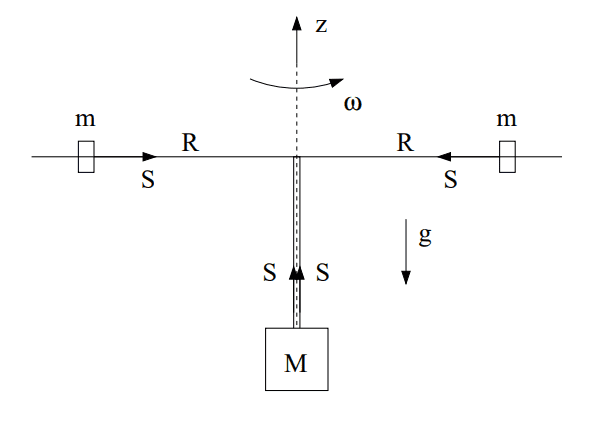
Skjermbilde.PNG

So far I have figured out what the initial angular velocity is, if the system is balanced (no movement):

## \sum F_m = m*\frac{v^2}{R_0}-\frac{Mg}{2}=0 ##
##m \frac{v^2}{R_0}-\frac{Mg}{2}=0 ## divide both sides by m
##\omega_0 = \sqrt{\frac{Mg}{2mR_0}}##

One of the hints given for the task, was that we should consider the conservation of angular momentum:
Moment of inerty, start: ##I_0=2mR_0^2##
Angular momentum, start: ##L_0=I_0\omega_0=2mR_0^2 \sqrt{\frac{Mg}{2mR_0}} ##

I am struggling to find the equation for the angular momentum after that, however. I know that the moment of inertia should still be ##I=2mR^2##, and that ##L=I\omega##. How do I find \omega?

I also have this:
## \sum F_M = Mg-2S=M*\ddot R##
##S=m* (\ddot R -\omega^2R)## Really not sure if this one is correct

Any help would be very greatly appreciated!
 
Physics news on Phys.org
Eirik said:
Homework Statement::
So far I have figured out what the initial angular velocity is, if the system is balanced (no movement):
If the system were to start out in the balanced state, then it would remain in this state. I don't think they want you to assume the system is in the balanced state initially. I think they want you to express the differential equation for ##\ddot R## in terms of ##R_0## and ##\omega_0##.

One of the hints given for the task, was that we should consider the conservation of angular momentum:
Moment of inerty, start: ##I_0=2mR_0^2##
Angular momentum, start: ##L_0=I_0\omega_0=2mR_0^2 \sqrt{\frac{Mg}{2mR_0}} ##
Since the system does not necessarily start in the balanced state, you cannot assume that ##\omega_0=\sqrt{\frac{Mg}{2mR_0}} ##. Just express ##L_0## in terms of ##m##, ##R_0##, and ##\omega_0##.

I am struggling to find the equation for the angular momentum after that, however. I know that the moment of inertia should still be ##I=2mR^2##, and that ##L=I\omega##.
Yes.

How do I find ##\omega##?
You can use the expression for the angular momentum to find ##\omega## as a function of ##R##.

I also have this:
## \sum F_M = Mg-2S=M*\ddot R##
Be careful with signs. The left side expresses the net downward force on ##M##. So, the acceleration on the right should be the downward acceleration of ##M##. Does the downward acceleration of ##M## equal ##\ddot R## or ##-\ddot R##?

##S=m* (\ddot R -\omega^2R)##
You have a sign error in this equation. Does the force ##S## on ##m## act in the radially outward direction or the radially inward direction?
 
Thank you so much @TSny ! That was really, really helpful!

Then we have
##L_i=L##
##2mR_0^2\omega_0=2mR^2\omega##
Solving for ##\omega## gives us ##\omega=\frac{R_0^2\omega_0}{R^2}##

And if we choose the positive direction for the accelaration along -z, it should be ##S=m*(\omega^2R-\ddot R)## instead, as the direction for m's acceleration will be radially inward. If I now substitute ##\omega## in this expression, I get:

##S=m*((\frac{R_0^2\omega_0}{R^2})^2R-\ddot R) = m(\frac{R_0^4\omega_0^2}{R^3}-\ddot R)##

Substitution in ##Mg-2S=M\ddot R## gives us:

##Mg-2(m(\frac{R_0^4\omega_0^2}{R^3}-\ddot R))=M\ddot R##

And after doing some algebra I get:

##\ddot R - \frac{M}{M-2m}g + \frac{\frac{2mR_0^4\omega_0^2}{M-2m}}{R^3}=0##

Meaning that ##\alpha = \frac{M}{M-2m}## and ##\beta = \frac{2mR_0^4\omega_0^2}{M-2m}##

Yay!:biggrin: Does that look right?
 
Everything looks good up to here:
Eirik said:
Substitution in ##Mg - 2S = M \ddot R##
This equation has a sign error. Review the comments near the end of post #2. This will alter your final result. Otherwise, I think you have it.
 
@TSny Yes, of course! 🤦‍♂️ I thought ##\ddot R## would be M's downward acceleration, but R will get smaller over time, so it has to be ##Mg-2S=-M\ddot R##

That finally gives me

##\ddot R + \frac{M}{M+2m}g - \frac{\frac{2mR_0^4\omega_0^2}{M+2m}}{R^3}=0##

with ##\alpha = \frac{M}{M+2m}## and ##\beta = \frac{2mR_0^4\omega_0^2}{M+2m}##

That also checks out with the signs the task said I was supposed to end up with lol

Thank you again so, so much for all the help!
 
  • Like
Likes   Reactions: TSny

Similar threads

  • · Replies 17 ·
Replies
17
Views
4K
  • · Replies 27 ·
Replies
27
Views
4K
  • · Replies 8 ·
Replies
8
Views
2K
  • · Replies 6 ·
Replies
6
Views
2K
Replies
2
Views
1K
Replies
2
Views
845
  • · Replies 11 ·
Replies
11
Views
2K
  • · Replies 24 ·
Replies
24
Views
1K
  • · Replies 17 ·
Replies
17
Views
1K
  • · Replies 13 ·
Replies
13
Views
2K