Two States of Polarization of EM Waves

Click For Summary
SUMMARY

The discussion centers on the two independent states of polarization of electromagnetic waves within a cavity resonator, specifically in the context of a metallic cube as described in "Quantum Physics of Atoms, Molecules, Solids, Nuclei, and Particles" by Eisberg R. and Resnick R. The two polarizations, often referred to as vertical and horizontal, can exist simultaneously, each containing half of the total energy in the cavity. The geometry of the cavity restricts the supported frequency bands, leading to a limited number of modes, each with an orthogonal partner. This understanding clarifies the significance of polarization in communication systems utilizing waveguides.

PREREQUISITES
  • Understanding of electromagnetic wave polarization
  • Familiarity with cavity resonators and their geometry
  • Knowledge of waveguide communication principles
  • Basic concepts of quantum physics as applied to electromagnetic theory
NEXT STEPS
  • Study the principles of cavity resonators in detail
  • Explore the mathematical formulation of electromagnetic wave polarization
  • Learn about the modes of propagation in waveguides
  • Investigate the implications of polarization in communication systems
USEFUL FOR

Physicists, electrical engineers, and communication system designers interested in the principles of electromagnetic wave behavior and polarization in cavity resonators.

inticore
Messages
2
Reaction score
0
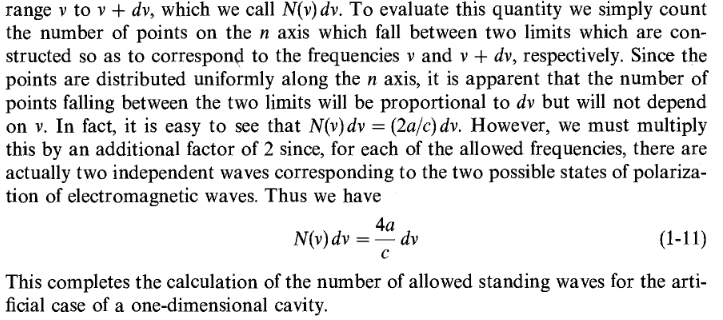
I am studying about the cavity radiation inside a metallic cube. In the textbook it states that there are two independent waves corresponding to the two possible states of polarization of electromagnetic waves. What does it mean by this? (My current assumption is the phase change of the waves)
upload_2018-1-28_23-1-15.png


It's stated in the last sentence before the equation (1-11). The textbook is "Quantum Physics of Atoms, Molecules, Solids, Nuclei, and Particles" by Eisberg R. and Resnick R. if it helps. I'm don't understand on the need to multiply by a factor of 2.
 

Attachments

  • upload_2018-1-28_23-1-15.png
    upload_2018-1-28_23-1-15.png
    35.7 KB · Views: 702
Physics news on Phys.org
If you imagine communication via a square waveguide, it is possible to use, say, either vertically polarised waves or horizontally polarised waves. These have a separate existence and we can send different messages on either one and they can also have different frequencies. If we put metal plates on either end of the square waveguide, we have a cavity resonator, and two polarisations can still exist inside it. But now, due to the geometry, only certain narrow frequency bands can be supported.
Although I said horizontal and vertical, this is a simplification, as a very large number of modes can exist, but each one has its orthogonal, or cross polarised, partner. Each polarisation contains half the total energy in the cavity.
 
tech99 said:
If you imagine communication via a square waveguide, it is possible to use, say, either vertically polarised waves or horizontally polarised waves. These have a separate existence and we can send different messages on either one and they can also have different frequencies. If we put metal plates on either end of the square waveguide, we have a cavity resonator, and two polarisations can still exist inside it. But now, due to the geometry, only certain narrow frequency bands can be supported.
Although I said horizontal and vertical, this is a simplification, as a very large number of modes can exist, but each one has its orthogonal, or cross polarised, partner. Each polarisation contains half the total energy in the cavity.

So, what I understand is that the cavity resonator limits the polarization to 2 states and also narrows the allowed frequencies. This explains so much, thanks.
 

Similar threads

  • · Replies 21 ·
Replies
21
Views
2K
  • · Replies 6 ·
Replies
6
Views
2K
  • · Replies 26 ·
Replies
26
Views
3K
Replies
9
Views
6K
  • · Replies 0 ·
Replies
0
Views
1K
  • · Replies 18 ·
Replies
18
Views
4K
  • · Replies 1 ·
Replies
1
Views
1K
  • · Replies 6 ·
Replies
6
Views
2K
  • · Replies 7 ·
Replies
7
Views
2K
Replies
2
Views
2K