How can we solve for both T₂ and m in a system with multiple unknowns?

  • Thread starter Thread starter rtareen
  • Start date Start date
  • Tags Tags
    Unknowns
Click For Summary
SUMMARY

The discussion focuses on solving for the unknown tensions T₂ and mass m in a physics problem involving equilibrium and force balance equations. The participant successfully calculated T₁ as 60N using the equation ΣFₓ = -30N + T₁cos(60) = 0. To find T₂ and m, the participant learned that the force balance must consider the knot separately from the mass, clarifying that mg should not be included in the vertical force balance on the junction. This understanding is crucial for accurately applying the equations of motion in static systems.

PREREQUISITES
  • Understanding of free body diagrams
  • Knowledge of equilibrium conditions in physics
  • Familiarity with tension forces in static systems
  • Ability to apply Newton's second law (ΣF = ma = 0)
NEXT STEPS
  • Study the concept of force balance in static equilibrium systems
  • Learn how to draw and analyze free body diagrams effectively
  • Explore the role of tension in different types of pulleys and strings
  • Investigate the implications of separating forces acting on junctions versus masses
USEFUL FOR

Students studying physics, particularly those focusing on mechanics and equilibrium, as well as educators looking for examples of problem-solving in static systems.

rtareen
Messages
162
Reaction score
32
Homework Statement
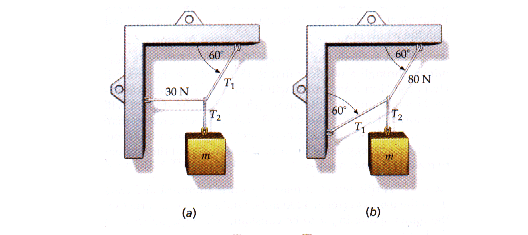
For the systems in equilibrium in the figure below, find the unknown tensions and masses
Relevant Equations
ΣF = ma = 0
Here are two questions for my online homework. In part (a) we have to find T₁, T₂, and m.
For part a, I drew a free body diagram and used that ΣFₓ = -30N +T₁cos(60) = 0 To find T₁ = 60N. The software accepted my answer. Now we have to find T₂ and m. We have ΣFᵧ = T₂ + T₁sin(60) + mg = 0. We do not know T₂ and we do not know m. So how can we solve for both?
1582575672724.png
 
Physics news on Phys.org
You need to be clear about what your force balance equation represents. ΣFy on what, exactly? Since you have the three tensions in there, it must be the force balance on the knot. The knot doesn't "know" anything about m - that's somewhere else.
To get mg into it you need to consider the force balance on the vertical string.
 
rtareen said:
Homework Statement:: For the systems in equilibrium in the figure below, find the unknown tensions and masses
Relevant Equations:: ΣF = ma = 0

Here are two questions for my online homework. In part (a) we have to find T₁, T₂, and m.
For part a, I drew a free body diagram and used that ΣFₓ = -30N +T₁cos(60) = 0 To find T₁ = 60N. The software accepted my answer. Now we have to find T₂ and m. We have ΣFᵧ = T₂ + T₁sin(60) + mg = 0. We do not know T₂ and we do not know m. So how can we solve for both?View attachment 257619
mg should not be in the vertical force balance on the junction.
 
Chestermiller said:
mg should not be in the vertical force balance on the junction.
I didnt know we had to consider the junction separately from the mass. Now I can probably do it myself. Thank you
 
haruspex said:
You need to be clear about what your force balance equation represents. ΣFy on what, exactly? Since you have the three tensions in there, it must be the force balance on the knot. The knot doesn't "know" anything about m - that's somewhere else.
To get mg into it you need to consider the force balance on the vertical string.
Thank you. I now know to consider the knot separately from the hanging mass.
 
rtareen said:
I didnt know we had to consider the junction separately from the mass. Now I can probably do it myself. Thank you
The question is, do you know why?
 
Chestermiller said:
The question is, do you know why?

I think I do. It is because all of the tensions are actually acting on the junction, not the mass itselfwhile only one of those tensions are acting on the mass. Am I right?
 
  • Like
Likes   Reactions: Chestermiller
rtareen said:
I think I do. It is because all of the tensions are actually acting on the junction, not the mass itselfwhile only one of those tensions are acting on the mass. Am I right?
Yes.
 
  • Like
Likes   Reactions: rtareen

Similar threads

  • · Replies 22 ·
Replies
22
Views
1K
Replies
2
Views
1K
  • · Replies 3 ·
Replies
3
Views
1K
Replies
2
Views
2K
  • · Replies 9 ·
Replies
9
Views
1K
Replies
1
Views
1K
  • · Replies 5 ·
Replies
5
Views
1K
Replies
6
Views
1K
Replies
3
Views
2K
Replies
10
Views
2K