UK School Physics Exam from 1967

Click For Summary

Discussion Overview

The discussion revolves around the historical context of UK A-level physics exams, particularly focusing on a 1967 exam paper. Participants reflect on the differences in examination formats, tools used, and the evolution of educational practices over time.

Discussion Character

  • Historical, Meta-discussion

Main Points Raised

  • One participant shares a 1967 A-level physics exam paper, noting the absence of diagrams and the reliance on reading and writing skills, as well as the use of log tables instead of calculators.
  • Another participant recalls their experience in the mid-90s, where older A-level papers were used for practice, suggesting a philosophy of making training more challenging than actual exams.
  • A classmate's humorous incident involving a request for log tables during a mid-90s exam highlights the unexpected challenges faced by teachers in locating outdated materials.
  • Another participant mentions a late 1970s test where slide rules were prohibited, but graph paper was permitted, indicating variations in exam requirements over the years.

Areas of Agreement / Disagreement

Participants share personal anecdotes and observations about past examination practices, but there is no explicit agreement or disagreement on any particular point. The discussion remains largely anecdotal and reflective.

Contextual Notes

Participants reference different time periods and practices in UK education, indicating a lack of consensus on the evolution of examination standards and tools. Specific details about the requirements and formats of exams are not fully resolved.

Who May Find This Useful

Individuals interested in the history of education, particularly in the context of physics and mathematics examinations, as well as those curious about the evolution of assessment methods in the UK educational system.

Steve4Physics
Homework Helper
Gold Member
Messages
2,813
Reaction score
2,532
For anyone interested in ‘what it used to be like’…

Sifting through some old paperwork, I found one of my 1967 A-level physics exam’ papers.

For those unfamiliar with UK ‘A-levels’ in 1967, they were national examinations generally taken in school at about age 18. Students typically studied 3 or 4 different subjects at A-level. Back then, entry to university required getting adequate grades at A-level.

Things have changed a lot since 1967 but A-levels (though looking very different) still exist.

As you see from the attached paper, the old questions were diagram-free and the candidate needed pretty good reading and writing skills! And of course calculators didn't exist - we used log tables (or sometimes a slide rule)!
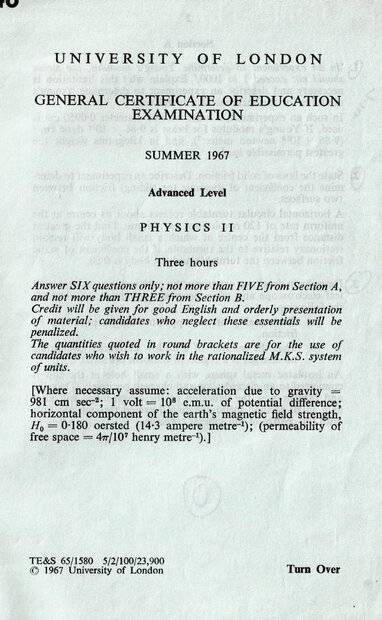
physics1.jpeg

physics2.jpeg

physics3.jpeg
 
  • Like
Likes   Reactions: Math100 and Ibix
Science news on Phys.org
My school (in the mid 90s) used to give us what were then ten-to-fifteen year old A level papers for practice. Partly I think it was just to supply the volume of questions needed, but there was definitely an element of "training should be tougher than reality" to it.

One classmate finished his maths exam early, but we weren't allowed to leave. Reading the blurb on the front he discovered he was allowed to request log tables, which he did. In the mid 1990s. Cue panicked maths teachers searching the backs of their cupboards for something they hadn't used in many years but the exam board technically required them to supply on request...
 
Ibix said:
Cue panicked maths teachers searching the backs of their cupboards for something they hadn't used in many years but the exam board technically required them to supply on request...
It's a good thing that he didn't request an abacus . . .
 
I remember a test from the late 1970's where slide rules were not allowed. Graph paper, however was - including semi-log paper. Problem solved!
 
  • Like
Likes   Reactions: BillTre and Ibix

Similar threads

Replies
4
Views
3K
  • · Replies 3 ·
Replies
3
Views
4K
  • · Replies 61 ·
3
Replies
61
Views
10K
  • · Replies 6 ·
Replies
6
Views
4K
Replies
6
Views
5K
  • · Replies 15 ·
Replies
15
Views
3K
  • · Replies 7 ·
Replies
7
Views
4K
  • · Replies 20 ·
Replies
20
Views
4K
Replies
14
Views
772
  • · Replies 9 ·
Replies
9
Views
3K