Undergrad How can I calculate uncertainty in my lab report data?

Click For Summary
To calculate uncertainty in lab report data, the square root of the measurement is often used, particularly when applying the square root rule. This method suggests that if you have a count per minute (CPM), the uncertainty for a measurement over a period can be expressed as the square root of twice the CPM. It's important to consider the source of uncertainty, which can arise from measurement tools or the experimental process itself. Different methods may apply depending on the context of the data and the relationships involved. Understanding these principles will help ensure accurate uncertainty calculations in lab reports.
Hayool
Messages
14
Reaction score
0
Hi,

I'm doing a lab report and for every number we need to calculate the uncertainty. I tried to calculate by using the SQRT of the number but i didn't get the same answer as my partner had?
could you help me!

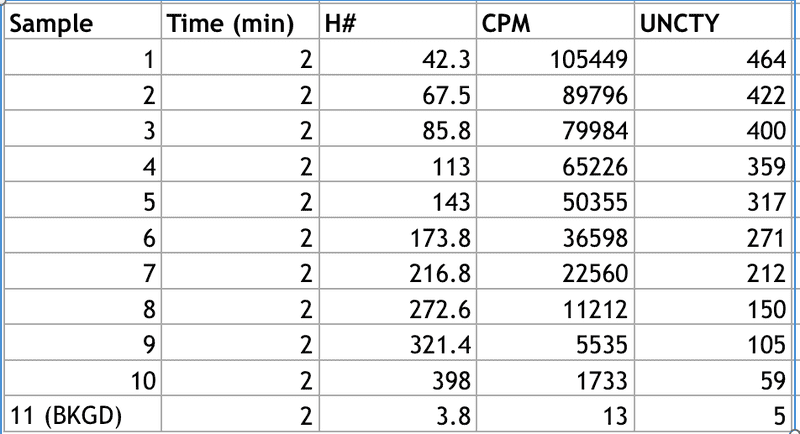
These are the numbers and the uncertainty of my partner which i could not figure out how it was done!
upload_2016-3-1_14-1-27.png
 
Physics news on Phys.org
It appears the uncertainty was calculated as
##\sqrt{2CPM}##.
 
RUber said:
It appears the uncertainty was calculated as
Thanks RUber for the fast reply.

Are there any other way to calculate the uncertainty ?
And how can i know I'm using that right way?
 
Normally, the uncertainty comes from your measurement tool, or from the process itself.
Without more information about the expected relationships between your data, I am not sure why you would choose one method over another for uncertainty estimation.

In this document (http://instructor.physics.lsa.umich.edu/int-labs/Statistics.pdf) there is a reference to the "square root rule," which generally says if you know nothing else about a number (large integer), the standard deviation is the square root of the number.

Assuming CPM is a measure of some C per minute, then it might make sense that your count for 2 minutes was 2*CPM.
Then the uncertainty in that measurement would be (using square root rule) ##\sqrt{2 CPM}##.
 
I do not have a good working knowledge of physics yet. I tried to piece this together but after researching this, I couldn’t figure out the correct laws of physics to combine to develop a formula to answer this question. Ex. 1 - A moving object impacts a static object at a constant velocity. Ex. 2 - A moving object impacts a static object at the same velocity but is accelerating at the moment of impact. Assuming the mass of the objects is the same and the velocity at the moment of impact...

Similar threads

  • · Replies 1 ·
Replies
1
Views
1K
  • · Replies 5 ·
Replies
5
Views
2K
  • · Replies 6 ·
Replies
6
Views
3K
  • · Replies 1 ·
Replies
1
Views
2K
  • · Replies 13 ·
Replies
13
Views
3K
  • · Replies 1 ·
Replies
1
Views
1K
  • · Replies 13 ·
Replies
13
Views
4K
  • · Replies 4 ·
Replies
4
Views
2K
  • · Replies 6 ·
Replies
6
Views
2K
  • · Replies 16 ·
Replies
16
Views
2K