Understanding Angular Magnification in Simple Magnifiers and Telescopes

  • Thread starter Thread starter ThatDude
  • Start date Start date
  • Tags Tags
    Telescope
Click For Summary
Maximum angular magnification in simple magnifiers occurs when the object is placed 25 cm from the eye, while minimum magnification is at the focal length. In telescopes, maximum angular magnification is achieved when the image is at infinity, meaning the object must be at the focal length. This distinction highlights the difference between how telescopes and magnifiers operate regarding angular magnification. Additionally, real lenses experience aberrations, and higher-quality telescopes often use parabolic reflectors to mitigate these issues. Understanding these concepts requires considering special scenarios and applying geometric principles like the small angle approximation.
ThatDude
Messages
33
Reaction score
0
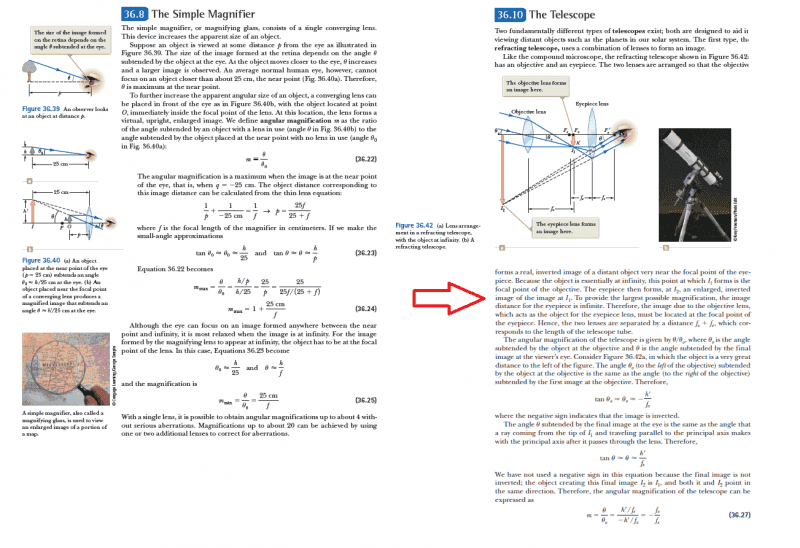
So basically, in the text below, they say that maximum angular magnification is achieved when the object is placed 25 cm from the eye, i.e. at the near point. The minimum angular magnification is achieved when the object is placed at the focal length.

However, for the chapter on the telescope, they explain that to achieve maximum angular magnification, you need the image at infinity, therefore the object must be at the focal length!

Is this not contradictory?
upload_2015-3-15_13-24-33.png
 

Attachments

  • tele.png
    tele.png
    109.1 KB · Views: 523
Last edited by a moderator:
Science news on Phys.org
I think you may be confused on the difference between the telescope and the magnifier. The highest angular magnification still occurs at the eye's focal point, which would be at the focal point of the eye piece of the telescope, the object lens on the telescope is what needs to see the image at infinity. Please note that these are also "Mickey Mouse" equations that only deal with special scenarios and thin lens, because a real lens will have some type of aberration, and the better telescopes will use a parabolic-reflector which offers no aberration (a simple derivation of this would be a good exercise as I did it yesterday and was quite fun!)
 
Also think about what happens when an image is infinitely far away, using Pythagoras theorem we see that the object is very very tall, but judging it from very far we can also use a small angle approximation.
 

Similar threads

  • · Replies 11 ·
Replies
11
Views
2K
  • · Replies 10 ·
Replies
10
Views
2K
  • · Replies 7 ·
Replies
7
Views
4K
  • · Replies 1 ·
Replies
1
Views
2K
  • · Replies 13 ·
Replies
13
Views
3K
  • · Replies 7 ·
Replies
7
Views
2K
  • · Replies 2 ·
Replies
2
Views
1K
  • · Replies 1 ·
Replies
1
Views
4K
  • · Replies 12 ·
Replies
12
Views
3K
  • · Replies 1 ·
Replies
1
Views
2K