Understanding Friction Graph: Identify Segments

Click For Summary

Homework Help Overview

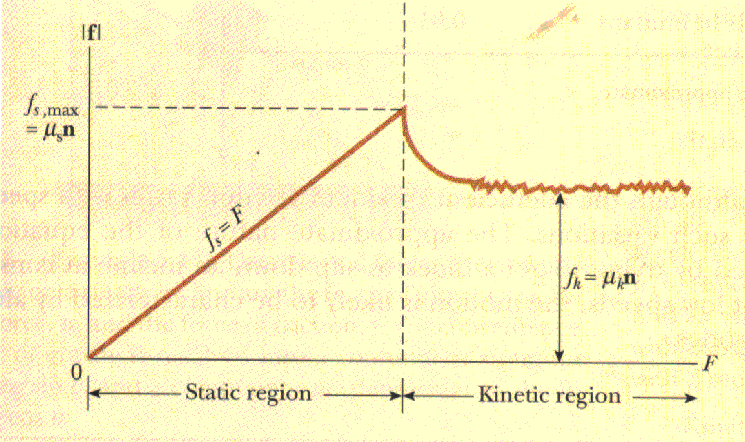
The discussion revolves around interpreting a friction graph with four segments, focusing on the relationships between tension and friction forces. Participants are particularly interested in understanding the transition from static to kinetic friction and how this affects the graph's segments.

Discussion Character

  • Conceptual clarification, Assumption checking

Approaches and Questions Raised

  • Participants are attempting to identify which segments correspond to specific conditions regarding tension and friction forces. Questions are raised about the nature of static versus kinetic friction and the implications of the graph's behavior, especially the sudden drop in the third segment.

Discussion Status

Some participants have provided explanations regarding the transition from static to kinetic friction and its representation on the graph. There is an ongoing exploration of the correct identification of segments related to tension and friction forces, with some attempts being marked incorrect, leading to further questioning of the reasoning behind those evaluations.

Contextual Notes

Participants are encouraged to show their reasoning and attempts at answering the questions posed, but there is a noted frustration regarding the marking of their answers as incorrect despite their explanations. This indicates a potential gap in understanding the criteria for correct responses.

petern
Messages
89
Reaction score
0
Here is a pic of the graph:

2h7pfn4.gif


Can someone explain to me what each of the four segments represents (not shown but assume there is a horizontal line at 0 for the first few seconds)? I am especially confused about the third segment where it suddenly drops from the peak.

Then, please answer and explain:

Identify the segment(s) where the tension was greater than the friction force. (I chose 3rd and 4th but it's wrong)

Identify the segment(s) where kinetic friction was opposing the motion. (I chose 4th but it's wrong)

Identify the segment(s) where the tension force equaled the friction force. (I chose 2nd but it was wrong)
 
Physics news on Phys.org
You are supposed to show an attempt at the answers, but I'll answer one part for you.

The reason that the graph suddenly drops from the peak is because the force on the object has reached the peak of the static friction which then converts to kinetic friction when it starts moving. Static friction will be equal to the amount of force that you apply to the object until you reach its peak. That is why it is called static friction, because the object won't move. Kinetic friction is the friction after static friction is peaked and the object is moving. Because the more force you apply on the object, the faster it goes, it is reasonable to suggest that the kinetic friction is nearly constant.

Suppose you have a big textbook lying on a table. You will notice that when you push on the textbook lightly, it will not move, however, if you keep pushing harder, eventually you will notice that the book will jolt forward and move smoothly as long as you don't stop it again. When it jolts, you have overcome the static friction, and the now weaker force against your pushing is kinetic friction.
 
Math Jeans said:
You are supposed to show an attempt at the answers, but I'll answer one part for you.

The reason that the graph suddenly drops from the peak is because the force on the object has reached the peak of the static friction which then converts to kinetic friction when it starts moving. Static friction will be equal to the amount of force that you apply to the object until you reach its peak. That is why it is called static friction, because the object won't move. Kinetic friction is the friction after static friction is peaked and the object is moving. Because the more force you apply on the object, the faster it goes, it is reasonable to suggest that the kinetic friction is nearly constant.

Suppose you have a big textbook lying on a table. You will notice that when you push on the textbook lightly, it will not move, however, if you keep pushing harder, eventually you will notice that the book will jolt forward and move smoothly as long as you don't stop it again. When it jolts, you have overcome the static friction, and the now weaker force against your pushing is kinetic friction.

Thanks for the reply, but I did show an attempt. I put in parenthesis the answers I chose but they were wrong. According to your explanation, the second segment (where there is static friction) would have tension that is equal to the friction force. I don't understand why this was marked wrong.
 
Delete. I accidentally posted twice.
 

Similar threads

  • · Replies 9 ·
Replies
9
Views
1K
Replies
1
Views
3K
Replies
13
Views
2K
  • · Replies 7 ·
Replies
7
Views
8K
Replies
29
Views
3K
Replies
6
Views
2K
  • · Replies 2 ·
Replies
2
Views
6K
  • · Replies 13 ·
Replies
13
Views
8K
  • · Replies 6 ·
Replies
6
Views
3K
  • · Replies 8 ·
Replies
8
Views
3K