Understanding Hammerthrow Forces, (no friction with ground)

  • Context: Undergrad 
  • Thread starter Thread starter ultrauser
  • Start date Start date
  • Tags Tags
    Forces Friction Ground
Click For Summary
SUMMARY

The discussion centers on the dynamics of hammer throw forces, specifically the interaction between an athlete and a hammer in a frictionless environment. Participants clarify that while an athlete can rotate their body in midair, they cannot achieve translational movement without a surface to push against. The concept of angular momentum is emphasized, with the understanding that when the hammer is thrown, the athlete's body rotates in the opposite direction to conserve momentum. The conversation concludes that the mechanics of the hammer throw rely heavily on ground friction, which is essential for the athlete's rotation and stability.

PREREQUISITES
  • Understanding of angular momentum and its conservation principles
  • Familiarity with the mechanics of the hammer throw event
  • Knowledge of forces such as centripetal and centrifugal forces
  • Basic physics of motion in zero-gravity environments
NEXT STEPS
  • Research the principles of angular momentum in sports dynamics
  • Explore the mechanics of the hammer throw technique and athlete positioning
  • Study the effects of friction on rotational motion in athletic performance
  • Investigate the physics of motion in microgravity and its applications
USEFUL FOR

Athletes, coaches, sports scientists, and physics enthusiasts interested in the mechanics of throwing sports and the effects of forces on motion.

ultrauser
Messages
23
Reaction score
0
If I understand it correct during hammerthrow an athlete muscles cause Fcentripetal force on a ball and ball cause reaction Fcentrifual force on athlete.
The athlete also cause Frotation on ball by rotating his body and ball cause Freaction on athlete.

What would happen if athlete would try to throw the heavier ball than himself being in the air - by rotating his body (no friction between athlete and the Earth - I mean the athlete and the ball are both in the air) ? Would it be even possible or would athlete rotate himself around ball(cause ball is heavier) ?
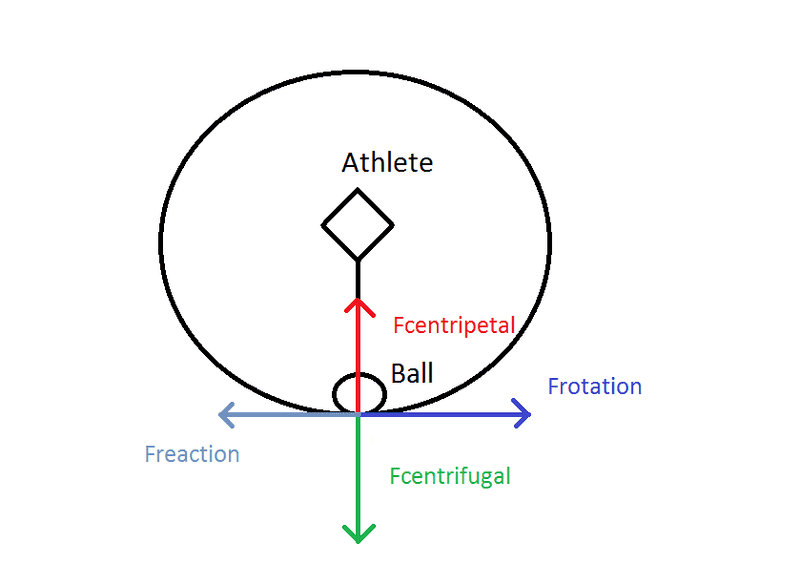
xt94B9x.png
 
Physics news on Phys.org
Hint: One of the basics of the hammer throw event is for the athlete to keep both feet in contact with the ground for as much time as possible. If you see a hammer throw in slow motion, notice how quick they are to put their feet back on the ground in the moments where they have to lift one of them.
 
Friction on the ground (or something) is required in order for the athlete to spin the ball around himself. With no friction the athlete cannot even spin himself around.
 
Drakkith said:
With no friction the athlete cannot even spin himself around.
I can spin myself around in the air when I jump
 
ultrauser said:
I can spin myself around in the air when I jump

Sure, by pushing off the ground in a certain way. If I place you into zero g and you have nothing to push off of, you will not be able to turn around.
 
Drakkith said:
Sure, by pushing off the ground in a certain way. If I place you into zero g and you have nothing to push off of, you will not be able to turn around.
Translation is not be possible, but rotation is possible because a person can rotate / swivel their arms and/or legs, and since the total angular momentum remains zero, the persons body rotates / swivels in the opposite direction. Once the person stops moving their arms and/or legs they will end up facing in a new direction (but no translation has occurred). If this method were used with a hammer, then the hammer could be released and thrown, but the person would end up traveling in the opposite direction (and with opposing angular momentum), and the center of mass of person and hammer would not move.
 
rcgldr said:
Translation is not be possible, but rotation is possible because a person can rotate / swivel their arms and/or legs, and since the total angular momentum remains zero, the persons body rotates / swivels in the opposite direction. Once the person stops moving their arms and/or legs they will end up facing in a new direction (but no translation has occurred). If this method were used with a hammer, then the hammer could be released and thrown, but the person would end up traveling in the opposite direction (and with opposing angular momentum), and the center of mass of person and hammer would not move.

Of course, but I don't consider this to be anything like what the OP was imagining in their original post with the athlete swinging the ball around themselves in midair. Unless I misunderstood the question.
 
Drakkith said:
Of course, but I don't consider this to be anything like what the OP was imagining in their original post with the athlete swinging the ball around themselves in midair.
But that's the situation I had in mind. The person in midair, pushes the ball away from themselves, then starts swinging the ball in a circle while the persons body would rotate in the opposite direction. Swiveling of the legs could be used to reduce the person's rate of rotation and increase the hammer's rate of rotation. The person then releases the hammer and they both move away from each other, while the center of mass of person and hammer remains motionless, and angular momentum of person and hammer remains at zero.
 
Last edited:
Okay, I can see that working. I was imagining both the athlete and the ball rotating with each other, which isn't possible given conservation of angular momentum.
 
  • #10
It will work to get the ball away, yes. Unfortunately, it is also quite unrelated to how the hammer throw event is performed where the thrower is actually rotating along with the hammer.
 
  • #11
Drakkith said:
Sure, by pushing off the ground in a certain way. If I place you into zero g and you have nothing to push off of, you will not be able to turn around.

Not on-topic for this thread, but even with zero angular momentum throughout the exercise, one can contort and uncontort the body and thereby change orientation.
 
  • #12
jbriggs444 said:
Not on-topic for this thread, but even with zero angular momentum throughout the exercise, one can contort and uncontort the body and thereby change orientation.
It's how a cat can be dropped a short distance while initially paws up and manage to rotate it's body by swiveling about it's mid section so that it lands paws down.
 

Similar threads

  • · Replies 5 ·
Replies
5
Views
3K
  • · Replies 7 ·
Replies
7
Views
5K
  • · Replies 77 ·
3
Replies
77
Views
5K
  • · Replies 4 ·
Replies
4
Views
2K
  • · Replies 8 ·
Replies
8
Views
2K
Replies
2
Views
2K
  • · Replies 35 ·
2
Replies
35
Views
4K
  • · Replies 14 ·
Replies
14
Views
2K
  • · Replies 6 ·
Replies
6
Views
3K
  • · Replies 8 ·
Replies
8
Views
2K