Understanding how to calculate power from force

  • Thread starter Thread starter pslarsen
  • Start date Start date
  • Tags Tags
    Force Power
Click For Summary
SUMMARY

This discussion centers on the calculation of power generated by a kite, emphasizing the importance of relative velocities in energy generation. Peter initially miscalculated the force due to not considering the kite's movement, which is crucial for power generation. The conversation highlights that power is defined as force multiplied by speed, and that continuous power generation requires the kite to sail at an angle to the wind, similar to techniques used in sailing for thousands of years. The discussion also introduces the concept of rotor-kites, which can generate power while tethered, providing a modern approach to kite power generation.

PREREQUISITES
  • Understanding of basic physics concepts such as force, work, and power.
  • Familiarity with relative velocity and its impact on energy generation.
  • Knowledge of kite dynamics and aerodynamics.
  • Awareness of historical sailing techniques and their application to modern energy generation.
NEXT STEPS
  • Research "kite power generation" techniques and advancements.
  • Explore the principles of "force times speed equals power" in practical applications.
  • Investigate "rotor-kite" designs and their efficiency in energy generation.
  • Study the paper "Power Maximization of a Closed-orbit Kite Generator System" for in-depth analysis.
USEFUL FOR

Engineers, renewable energy researchers, and enthusiasts interested in innovative energy generation methods using kites and aerodynamics.

pslarsen
Messages
23
Reaction score
1
Hi all
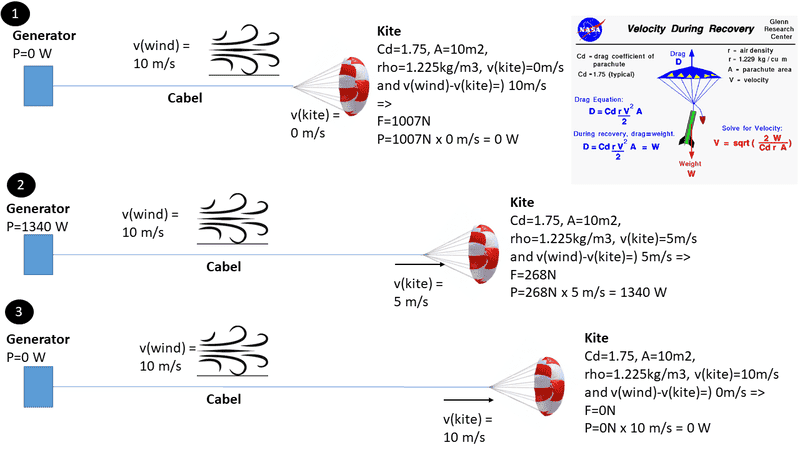
I have been looking at understanding power for a simple energy generation concept, and I think that I originally made an error in my calculations because I wasn't considering the relative velocities. So I basically generated the force made by a kite in static conditions, but if I need to generate power the kite needs to move which reduces the velocity that the kite experiences and can use to generator force.

Using relative velocities I have made the calculations as per the attachment. Could someone please confirm that they are correct.

Kind Regards,
Peter
power question.png
 

Attachments

  • power question.png
    power question.png
    40.7 KB · Views: 713
Engineering news on Phys.org
Good for you. Sitting on dry land, you have discovered a principle that sailors have been learning for 20000 years. When you sail into the wind, the apparent velocity is wind speed plus boat speed. When you sail directly away from the wind, the apparent velocity is wind speed minus boat speed; and if boat speed equals wind speed, there is no apparent wind at all.

You also want your power generation to be continuous. If you allow the kite to blow away from the wind making power, you come to the end of the rope. Then you must collapse the kite and reel in the rope to start again.

Your solution should be the same as sailors have used for 20000 years. Never sail directly into the wind or away from the wind, sail at an angle. That is continuous power as long as the wind blows. That is what wind turbines do. The motion of the wind turbine blade is at angle 90 degrees relative to the wind.
 
  • Like
Likes   Reactions: russ_watters
Yeah that's what I figured. That means that I need to move towards some type of kite design that loops in figures 8's as there are a ton of people who already does. I guess I can't use the simple drag equation to calculate the force made by a kite..

I need to think about this..

Thanks a lot
Br, Peter
 
  • Like
Likes   Reactions: russ_watters
So something that I am not sure I understand - and that the work performed...

If the kite moves nearly infinitely slow over 100 meter (case 0), then it will have performed 1007x100 Joule but if it moves at the speed of the wind it will have performed ZERO Joule due to the force being zero. Does this make sense?

Kind Regards,
Peter
 
pslarsen said:
If the kite moves nearly infinitely slow over 100 meter (case 0), then it will have performed 1007x100 Joule but if it moves at the speed of the wind it will have performed ZERO Joule due to the force being zero. Does this make sense?
Yes. No force, no work. Such a kite is more commonly referred to as a balloon (or perhaps a piece of paper blowing in the wind). It just drifts with the air, neither getting nor losing any work/energy from the wind.
 
pslarsen said:
So something that I am not sure I understand - and that the work performed...

If the kite moves nearly infinitely slow over 100 meter (case 0), then it will have performed 1007x100 Joule but if it moves at the speed of the wind it will have performed ZERO Joule due to the force being zero. Does this make sense?

Kind Regards,
Peter

Work is force times distance. We can call the work power. Energy is the integral of power.

When the kite sits still, there is no power (because distance=0)
When the kite moves at wind speed there is no power (because force=0)
 
Last edited:
anorlunda said:
Work is force times distance. We can call the work power. Energy is the integral of power.

When the kite sits still, there is no power (because distance=0)
When the kike moves at wind speed there is no power (because force=0)
Did you mean we can call the rate of doing work power?
 
bob012345 said:
Did you mean we can call the rate of doing work power?

No, I said it wrong. force*distance=work=energy. force*speed=power.

Note my signature, "Power is to Energy as Speed is to Distance"
 
  • Like
Likes   Reactions: bob012345
Sorry about this slight deflection of the topic, but there is a type of kite that employs rotors that makes it look like a helicopter. As air flows up through the rotors, they autorotate, so it is really a tethered form of autogyro.
https://en.wikipedia.org/wiki/Autogyro

Because they have no propulsion motor they are called a rotor-kite or gyrokite.
https://en.wikipedia.org/wiki/Rotor_kite

They work well as an observation post when flown from ships at sea, as they fly higher, with less drag than a normal kite. A good example is the German designed Wagtail;
https://en.wikipedia.org/wiki/Focke-Achgelis_Fa_330

Such a kite can generate power while it is flying, held by a tether that can also be used as the powerline.
http://skywindpower.com/#files_WWO__homepage_36_0

No pilots license is required to fly on a tethered kite, but there are national altitude restrictions on kites.
 
  • Like
Likes   Reactions: russ_watters
  • #11
bob012345 said:
Did you mean we can call the rate of doing work power?
You are exactly right. That is in fact the most fundamental definition of power.
 
  • Like
Likes   Reactions: bob012345

Similar threads

Replies
8
Views
3K
  • · Replies 6 ·
Replies
6
Views
2K
  • · Replies 4 ·
Replies
4
Views
3K
Replies
34
Views
5K
  • · Replies 21 ·
Replies
21
Views
4K
  • · Replies 1 ·
Replies
1
Views
1K
  • · Replies 8 ·
Replies
8
Views
2K
  • · Replies 6 ·
Replies
6
Views
3K
Replies
1
Views
1K
Replies
3
Views
2K