Understanding killing vectors and transformations of metric

Click For Summary

Discussion Overview

The discussion revolves around understanding Killing vectors and the transformations of metrics in the context of general relativity. Participants seek clarification on specific equations and concepts related to coordinate transformations and the implications of Killing vectors.

Discussion Character

  • Exploratory
  • Technical explanation
  • Debate/contested

Main Points Raised

  • One participant asks how to transition from ##\tilde{g}_{uv}## to ##g_{uv}## and seeks clarification on the expression involving ##-\xi^{\lambda}\partial_{\lambda} g_{uv}##.
  • Another participant questions the difference between ##\tilde{g}_{uv}## and ##g_{uv}##, particularly regarding the nature of prime and un-primed functions.
  • A participant notes that the equation ##\xi^{\lambda}\partial_{\lambda} g_{uv} = 0## raises questions about its implications.
  • There is a discussion about the need for references to the lecture notes being used, with some participants emphasizing the importance of context for understanding the material.
  • One participant explains that the relationship between ##\tilde{g}_{\mu \nu}## and ##g_{\mu \nu}## is defined by the coordinate transformation, referencing specific equations from the notes.
  • Another participant expresses uncertainty about whether ##\tilde{g}_{\mu \nu}## and ##g_{\mu \nu}## are the same function in different coordinates or entirely different functions.

Areas of Agreement / Disagreement

Participants generally agree on the need for clarity regarding the lecture notes and the definitions of the terms involved. However, there is no consensus on the implications of the equations discussed or the nature of the functions ##\tilde{g}_{\mu \nu}## and ##g_{\mu \nu}##.

Contextual Notes

Participants reference specific equations (e.g., equations 2.4 and 2.25) from the lecture notes, but the discussion lacks a complete understanding of the assumptions and definitions used in those equations. The context of the lecture notes is not fully accessible to all participants.

dwd40physics
Messages
32
Reaction score
0
TL;DR
understanding coordinate transformations of metric and killing vectors
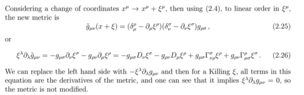
Hi, I am reading through my lecture notes - I haven't formally covered killing vectors but it was introduced briefly in lectures.

Reading through the notes has highlighted something I am not sure about when it comes to co-ordinate transformations.

Q1.Can someone explain how to go from ##\tilde{g}_{uv}## to ##g_{uv} ##

The bit where it says: we can replace the left hand side with ##-\xi^{\lambda}\partial_{\lambda} g_{uv}##

Q2. more basic question how does ##\tilde{g}_{uv}## differ to ##g_{uv} ## ? how does a prime function differ from un-primed functions ?

Q3. what does ##\xi^{\lambda}\partial_{\lambda} g_{uv} = 0 ## tell us ?

thanks :-)
 

Attachments
  • 1677272190985.png
    1677272190985.png
    28.3 KB · Views: 199
Last edited:
Physics news on Phys.org
dwd40physics said:
Reading through the notes
What notes? Please give a reference.
 
@dwd40physics I have fixed a number of issues with the LaTeX in your OP. Please consult the LaTeX Guide (there is a link at the bottom left of each post window) to help with LaTeX formatting.
 
  • Like
Likes   Reactions: dwd40physics
PeterDonis said:
What notes? Please give a reference.
the image I attached
 
In the notes it says it is a killing vector satisfying the killing equation.
 
dwd40physics said:
the image I attached
That's not a reference. We have no idea where that image came from. A reference means a title/chapter/section of a book or a published paper, or something similar, or a link to an online version of one of those.
 
It's from my university lecture notes... I don't see how a reference resolves this issue. But I can provide a screen shot of whole page if that helps.
 
dwd40physics said:
It's from my university lecture notes
Ok, what university, what course? Are the notes published online?

dwd40physics said:
I don't see how a reference resolves this issue.
First, that's irrelevant; when you are asked for a reference here, you provide it.

Second, whether you see its relevance is immaterial; others might even if you don't, and you can't judge that. For example, if we could read the entire notes instead of just the snippet you posted, we could get useful context about the general treatment of the subject in these notes.
 
PeterDonis said:
Ok, what university, what course? Are the notes published online?First, that's irrelevant; when you are asked for a reference here, you provide it.

Second, whether you see its relevance is immaterial; others might even if you don't, and you can't judge that. For example, if we could read the entire notes instead of just the snippet you posted, we could get useful context about the general treatment of the subject in these notes.
That's a fair challenge, regarding point 2. You're reply did appear to be pedantic rather than try to help with the information I provided. Point 1 comes across rude and unnecessary - people can't always provide a reference they should still be able to helped. The reason I didn't provide a reference is I doubt you would be able to get the lecture notes. To clarify the "reference" it is a course from King's College London 7CCMMS38 - Space-time Structure of Black Holes and the Universe.
 
  • #10
Here are the relevant pages attached from the lecture notes, thanks.
1677280242747.png
1677280301899.png
 
  • #11
dwd40physics said:
You're reply did appear to be pedantic rather than try to help with the information I provided.
I can't provide any useful response to your actual question unless and until I have the information I have asked for. That's why I asked for it.

dwd40physics said:
Point 1 comes across rude and unnecessary
No, it's a routine request in these forums. You are new here and might not realize that, which is why I am going to the trouble to point it out explicitly. Informing new members of the rules and norms of the forums is one of my jobs as a moderator.

dwd40physics said:
people can't always provide a reference
Sure they can. You could simply answer the questions I have asked.

dwd40physics said:
The reason I didn't provide a reference is I doubt you would be able to get the lecture notes.
Many universities provide copies of lecture notes online, so it's not at all an unreasonable expectation.

dwd40physics said:
To clarify the "reference" it is a course from King's College London 7CCMMS38 - Space-time Structure of Black Holes and the Universe.
That would be this, I take it:

https://www.kcl.ac.uk/abroad/module-options/module?id=79c2e2bd-f9d7-4a26-a4c9-ca16e53360ea
 
  • Like
Likes   Reactions: dwd40physics
  • #12
ok thanks for your response and clarification of the rules of the forumn. If you are happy with my reference being what course it is from that's fine by me - it isn't a textbook although we have been given wald et al. and Caroll as reco,mmended books but not sure if they will help in this specific example.
 
  • #13
yes you've found correct course - lecture notes have been produced this year.
 
  • #14
dwd40physics said:
Here are the relevant pages attached from the lecture notes
Ok, so seeing equation 2.4 it looks like you could invert the transformation ##x^\mu \to y^\mu = x^\mu + \xi^\mu## to obtain ##y^\mu \to x^\mu = y^\mu - \xi^\mu##, and then the inverted version of equation 2.4 should give you (to linear order in ##\xi^\mu##, the same way equation 2.25 was obtained for the forward transformation) the relation ##\xi^\lambda \partial_\lambda \tilde{g}_{\mu \nu} = - \xi^\lambda \partial_\lambda g_{\mu \nu}## (because of the sign change in the ##\xi## term in the inverse transformation). At least, that seems to me to be what the notes are doing.

As for how ##\tilde{g}_{\mu \nu}## differs from ##g_{\mu \nu}##, that's defined by the coordinate transformation; the general form of the relationship is equation 2.4, and equation 2.25 is just equation 2.4 to linear order in ##\xi^\mu## for the particular transformation ##y^\mu = x^\mu + \xi^\mu##.
 
  • Like
Likes   Reactions: dwd40physics
  • #15
dwd40physics said:
If you are happy with my reference being what course it is from that's fine by me
Yes, that's ok since it appears from the course website that the notes are not available online (which is disappointing given how common that is now, but it is what it is). Posting the additional screenshots giving more context was helpful.

dwd40physics said:
ok thanks for your response and clarification of the rules of the forumn. If you are happy with my reference being what course it is from that's fine by me - it isn't a textbook although we have been given wald et al. and Caroll as reco,mmended books but not sure if they will help in this specific example.
Wald's discussion of Killing vector fields is more abstract, and I think his proof that the metric does not change along integral curves of a KVF is different. I don't remember how Carroll treats the subject.
 
  • #16
yeah I think lots of Uk universities are more tight with uploading accessible content, yeah I wasn't sure if I could have help on the screenshots - I know other books go more abstract as you've said. how does $$\tilde{g}_{uv}$$ differ from $${g}_{\rho\sigma}$$
 
  • #17
dwd40physics said:
how does $$\tilde{g}_{uv}$$ differ from $${g}_{\rho\sigma}$$
I already answered that in post #14.
 
  • Like
Likes   Reactions: dwd40physics
  • #18
PeterDonis said:
Ok, so seeing equation 2.4 it looks like you could invert the transformation ##x^\mu \to y^\mu = x^\mu + \xi^\mu## to obtain ##y^\mu \to x^\mu = y^\mu - \xi^\mu##, and then the inverted version of equation 2.4 should give you (to linear order in ##\xi^\mu##, the same way equation 2.25 was obtained for the forward transformation) the relation ##\xi^\lambda \partial_\lambda \tilde{g}_{\mu \nu} = - \xi^\lambda \partial_\lambda g_{\mu \nu}## (because of the sign change in the ##\xi## term in the inverse transformation). At least, that seems to me to be what the notes are doing.

As for how ##\tilde{g}_{\mu \nu}## differs from ##g_{\mu \nu}##, that's defined by the coordinate transformation; the general form of the relationship is equation 2.4, and equation 2.25 is just equation 2.4 to linear order in ##\xi^\mu## for the particular transformation ##y^\mu = x^\mu + \xi^\mu##.

is ##\tilde{g}_{\mu \nu}## different from ##g_{\mu \nu}## in terms of it is the same function but expressed in different co-ordinates or are they completely different functions ?
 
  • #19
PeterDonis said:
Ok, so seeing equation 2.4 it looks like you could invert the transformation ##x^\mu \to y^\mu = x^\mu + \xi^\mu## to obtain ##y^\mu \to x^\mu = y^\mu - \xi^\mu##, and then the inverted version of equation 2.4 should give you (to linear order in ##\xi^\mu##, the same way equation 2.25 was obtained for the forward transformation) the relation ##\xi^\lambda \partial_\lambda \tilde{g}_{\mu \nu} = - \xi^\lambda \partial_\lambda g_{\mu \nu}## (because of the sign change in the ##\xi## term in the inverse transformation). At least, that seems to me to be what the notes are doing.

As for how ##\tilde{g}_{\mu \nu}## differs from ##g_{\mu \nu}##, that's defined by the coordinate transformation; the general form of the relationship is equation 2.4, and equation 2.25 is just equation 2.4 to linear order in ##\xi^\mu## for the particular transformation ##y^\mu = x^\mu + \xi^\mu##.
 
  • #20
i don't get this part:
the relation ##\xi^\lambda \partial_\lambda \tilde{g}_{\mu \nu} = - \xi^\lambda \partial_\lambda g_{\mu \nu}## (because of the sign change in the ##\xi## term in the inverse transformation).
 
  • #21
dwd40physics said:
is ##\tilde{g}_{\mu \nu}## different from ##g_{\mu \nu}## in terms of it is the same function but expressed in different co-ordinates or are they completely different functions ?
For a general coordinate transformation they would be different functions. For this particular case, where ##\xi^\mu## is a Killing vector field and the transformation is as given, it turns out that ##\tilde{g}## is the same function of the new coordinates as ##g## is of the old coordinates; that is what it means to say that the coordinate transformation does not change the metric.

dwd40physics said:
i don't get this part:
Start with the inverse transformation; apply equation 2.4 to it; then apply the same process that is used to go from equation 2.4 to equation 2.25 for the forward transformation, to come up with the version of equation 2.25 that applies to the inverse transformation. You should find that the signs of the ##\xi## terms are reversed.

Now think about how the LHS of equation 2.26 was obtained from equation 2.25, and how you would obtain a corresponding LHS for the inverse version of 2.26, and what the corresponding LHS looks like.
 
  • Like
Likes   Reactions: dwd40physics
  • #22
How do I apply inverse to 2.4, I tried but couldn't do it
 
  • #23
dwd40physics said:
How do I apply inverse to 2.4
Just interchange ##x## and ##y##, since the inverse transformation gives ##x## in terms of ##y## instead of ##y## in terms of ##x##.
 
  • #24
Still not sure would this be ##g_{\mu\nu}(x) = \frac{\partial{y_\rho}}{\partial{x_\mu}}\frac{\partial{y_\sigma}}{\partial{x_\nu}}\tilde{g}_{\rho\sigma} (y)## ?
 
  • #25
@dwd40physics you really need to double check your LaTeX when posting. There is a time window in which you can edit a post once you've made it; please check to see that the LaTeX renders correctly and fix it if it doesn't. I've fixed post #24.
 
  • #26
sorry i think my computer is bugging apologies
 
  • #27
dwd40physics said:
Still not sure
Work it out in detail. To start with, you need to understand how they got from equation 2.4 to equation 2.25 for the forward transformation. Do you understand how they did that?
 
  • #28
PeterDonis said:
Work it out in detail. To start with, you need to understand how they got from equation 2.4 to equation 2.25 for the forward transformation. Do you understand how they did that?
yes I see how you get the forward one, I did the forward one already and you get the kronecka deltas and minus partial derivatives, still not sure how to do LHS
 
  • #29
dwd40physics said:
I see how you get the forward one
Ok, then do you see how to get from equation 2.25 to equation 2.26 for the forward transformation?
 
  • #30
do you mean the RHS ?if so yes
 

Similar threads

  • · Replies 1 ·
Replies
1
Views
1K
  • · Replies 10 ·
Replies
10
Views
2K
  • · Replies 9 ·
Replies
9
Views
2K
  • · Replies 4 ·
Replies
4
Views
2K
Replies
9
Views
2K
  • · Replies 7 ·
Replies
7
Views
2K
  • · Replies 16 ·
Replies
16
Views
2K
  • · Replies 5 ·
Replies
5
Views
2K
  • · Replies 2 ·
Replies
2
Views
2K
  • · Replies 7 ·
Replies
7
Views
7K