Understanding Motor Data Sheets

  • Thread starter Thread starter PhysicsTest
  • Start date Start date
  • Tags Tags
    Data Motor
Click For Summary
The discussion focuses on understanding the Hurst motor data sheet, particularly the discrepancies in power calculations. Users express confusion over why the specified Watts differ from the calculated values based on voltage and current measurements. It is clarified that the differences arise from factors like non-unity power factor due to inductance and the nature of RMS values. The conversation also touches on the methods for measuring power, including sampling instantaneous voltage and current, and emphasizes that the angle of impedance should not be used directly in total power calculations due to the influence of back EMF. Overall, accurate power calculations require considering both inductance and the specific conditions of motor operation.
PhysicsTest
Messages
254
Reaction score
27
TL;DR
I am trying to understand the motor data sheet and not clear on the data provided
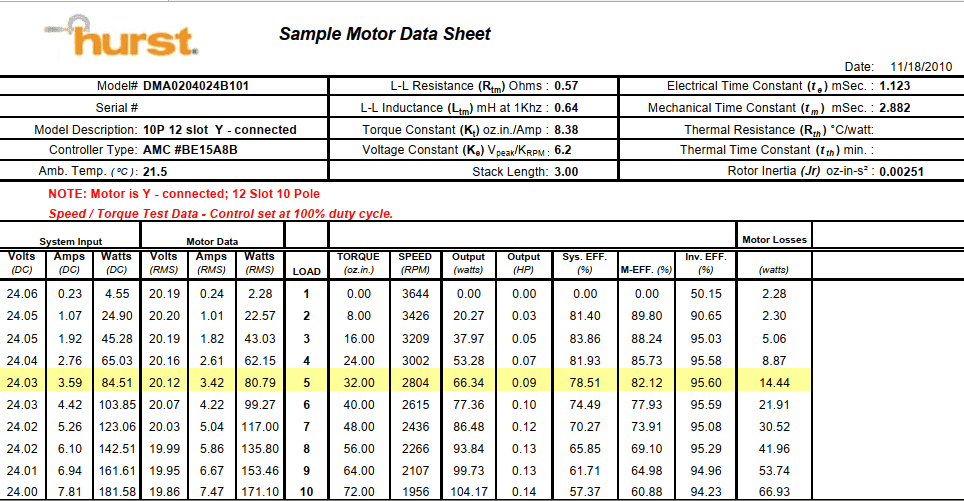
I am trying to understand the Hurst motor data sheet, but i am not clear on the table provided, please help me to understand the data provided
1604417445990.png


System Input: Volts is all in the range of 24V, so it is 24V BLDC motor, i understand.
Amps: It is the current drawn from the DC source i understand.
Watts: I am having slight confusion here, if i take any value say Load2 Volts = 24.05V and the current is 1.07 amps. Then the Watts or the power input should be V*I = 24.05 * 1.07 = 25.7335 but the value specified is 24.90. Why is this difference?
Motor Data: What exactly is the Motor Data? I assume they are the 3 phase signals we apply to the motor. How the values of Volts(RMS), Amps(RMS) Watts(RMS) are derived?
 

Attachments

Engineering news on Phys.org
PhysicsTest said:
Then the Watts or the power input should be V*I = 24.05 * 1.07 = 25.7335 but the value specified is 24.90. Why is this difference?
Non-unity power factor because the motor has some inductance, even in the case of nonsinusoidal signals.
 
  • Like
Likes Twigg and PhysicsTest
The RMS (root mean square) values and peak values are determined by observation over time under varying conditions ##-## for practical purposes, RMS may be viewed as the normal operating value.
 
  • Like
Likes PhysicsTest
So, my understanding is for the system input they measure the input volts and currents and using a tool they calculate the power factor, based on that they arrive at the System input watts. Am I correct? Similarly for the Motor data, they calculate the ##V_{rms}, I_{rms} ## and calculate the output. So it is all measured data.
 
Yes it is probably all measured data. There are many methods of measurement including RMS power meters, and VAR meters.

You can also calculate it if you sample instantaneous voltage and current. At any instant, P=V*I. If you sum many instant samples over a period you can sum them to get average power, avoiding power factor. AC quantities, AC power, reactive power, and power factor are defined for an integer number of whole cycles. But they do not invalidate instantaneous measurements.

To be clear, suppose the signals to the motor are pulses roughly 240 Hertz. If you sample V and I 10000 times per second, calculate P=V*I 10000 times and find the average of those, you get the correct answer for that second.
 
Any ideas about the columns Motor Data; Volts, Amps, Watts?

The last line (and many others) show Watts > V x I.
V= 19.86, I= 7.47
19.86 x 7.47 = 148, but Watts is listed as 171.
 
  • Like
Likes jim mcnamara and Guineafowl
Tom.G said:
Any ideas about the columns Motor Data; Volts, Amps, Watts?

The last line (and many others) show Watts > V x I.
V= 19.86, I= 7.47
19.86 x 7.47 = 148, but Watts is listed as 171.
Could this be down to efficiency, or perhaps calculating the motor supply as three phase power?
 
  • Like
Likes jim mcnamara
I surprised myself by getting the answer for the motor data. Top of the table resistance and inductance is mentioned ##R = 0.57 ; L = 0.64 ##. The impedance is then ##Z = 0.57 +j*0.64##. The angle of impedance is
##\theta = tan^{-1}(\frac{0.64} {0.57}) = 48.3 ##Degrees. The formula for the power of the 3 phase is
##P = \sqrt3 *V_L*I_L*\cos(\phi) ; V_L = 19.86; I_L=7.47 ##. Substituting the values I get ##170.9##, it almost matches with what is mentioned ##171.10##. I hope my calculations are correct?
 
Now i got one confusion, the reactance of inductance is ##X_L = \omega L, Z = R + jX_L##. But i have considered only inductance, is it correct? Please help.
 
  • #10
  • #11
Sorry for the delay, yes i understand that the only reactance is the inductance, but the reactance is given by
##X_L = \omega L## in that case the power calculation does not match with the data sheet, but if i take reactance equal to inductance i.e. ## X_L = L ## then the power data calculation matches with the data sheet. I don't understand what is the mistake.
 
  • #12
PhysicsTest said:
I surprised myself by getting the answer for the motor data. Top of the table resistance and inductance is mentioned ##R = 0.57 ; L = 0.64 ##. The impedance is then ##Z = 0.57 +j*0.64##. The angle of impedance is
##\theta = tan^{-1}(\frac{0.64} {0.57}) = 48.3 ##Degrees. The formula for the power of the 3 phase is
##P = \sqrt3 *V_L*I_L*\cos(\phi) ; V_L = 19.86; I_L=7.47 ##. Substituting the values I get ##170.9##, it almost matches with what is mentioned ##171.10##. I hope my calculations are correct?

the angle of 48.3 degrees should not be used in the calculation of total power, as doing this neglects the existence of back emf of the motor. that 48.3 degrees would be sufficient as power factor in calculating copper losses, but then you'll have to use voltage drop instead of voltage rating in the power calculation.
 
  • Like
Likes PhysicsTest

Similar threads

  • · Replies 7 ·
Replies
7
Views
2K
  • · Replies 3 ·
Replies
3
Views
3K
Replies
7
Views
2K
Replies
6
Views
2K
  • · Replies 9 ·
Replies
9
Views
2K
  • · Replies 19 ·
Replies
19
Views
3K
  • · Replies 9 ·
Replies
9
Views
3K
  • · Replies 12 ·
Replies
12
Views
3K
  • · Replies 1 ·
Replies
1
Views
2K
  • · Replies 9 ·
Replies
9
Views
4K