What does this DC motor supply do?

Click For Summary

Discussion Overview

The discussion revolves around the functionality of a circuit board connected to a DC motor in a solar-powered weather station. Participants explore the purpose of the circuit, which includes a transistor, capacitors, and a resistor, and its role in controlling the motor that drives a fan for temperature measurement. The conversation includes technical details about the circuit's components and their potential effects on motor operation.

Discussion Character

  • Technical explanation
  • Debate/contested
  • Exploratory

Main Points Raised

  • One participant describes the circuit as possibly limiting current to the motor or using the thermal characteristics of the transistor for more accurate control.
  • Another participant questions the presence of a base resistor and the placement of the capacitors in the circuit.
  • A different viewpoint suggests that the circuit may shut off the motor when the solar cell output is insufficient, potentially protecting the motor from overheating.
  • Some participants propose that the circuit could be a voltage regulator, with one suggesting it might be a 3-terminal voltage regulator based on the markings.
  • There is a suggestion that the motor operates based on Vbe, which could stabilize RPM during sunlight exposure.
  • Concerns are raised about the complexity of the circuit, with one participant suggesting that the motor might work directly with the solar cell without issues.
  • Another participant notes the possibility of the circuit being designed to inhibit the fan on colder days, although this is questioned.
  • Participants discuss the potential for the circuit to affect temperature readings, with one expressing skepticism about the accuracy of the temperature measurement.
  • One participant mentions sourcing a replacement chip that matches the identified specifications of a voltage regulator.

Areas of Agreement / Disagreement

Participants express multiple competing views regarding the purpose and functionality of the circuit, with no consensus reached on its exact role or necessity.

Contextual Notes

Participants note limitations in understanding due to unclear markings on the circuit components and the potential for variations in circuit behavior based on environmental conditions.

sophiecentaur
Science Advisor
Homework Helper
Messages
30,406
Reaction score
7,471
TL;DR
A small fan in my Weather Station unit stopped working.
A few years ago, I bought a Accurite weather station which has a wireless connection (not wifi) to a unit in doors. I was standing near it on a quiet sunny day and I heard a motor running. It turns out that is's a fan that blows over the temperature sensor to make sure it measures the actual air temperature. There is a small PV panel on top of the unit which provides the electric power when it's needed - smart, eh?
I found out about this in a forum or group. Someone mentioned having replaced the fan bearing so, when the fan stopped running a few weeks ago, I thought I would get inside and fix it mechanically. But the PV works and the Motor works when connected directly to the PV. There is a small circuit board between the two which seems to consist of a transistor, a resistor and two capacitors. The transistor number is too short to make sense of but the circuit seems to be as in the sketch. I am assuming the transistor is pnp. The question is what does the circuit actually do? Is it to limit the current to the motor or to use the thermal characteristics of the transistor to control more accurately when the motor starts driving the fan? There are capacitors at input and output too. The maximum output volts of the PV in the brightest sun I can find is just over 1.5V so the transistor is operating with low volts across it and those approximations that I remember using will not apply.
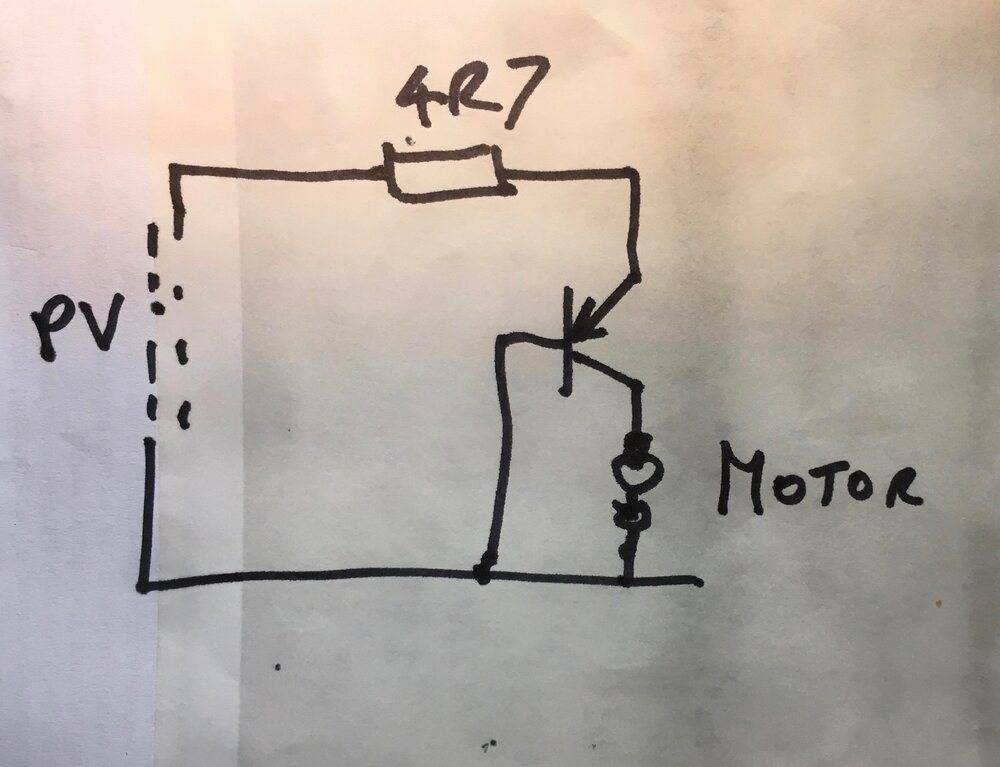
Motor Supply.jpg
 
Engineering news on Phys.org
Are you sure there is no base resistor? And where are the two capacitors you mention?
 
This circuit will shut off the motor when the solar cell outputs less than -Vbe(on) volts.

They could be protecting the motor from heating when the voltage is too small to run it. It could also be a vestige from a battery backed model.

BoB
 
Probably the wrong schematic. That transistor will behave the same as a diode. Perhaps a 3-terminal voltage regulator? Which would limit the voltage applied to the motor.

edit: Look for markings like 7805, 7812, etc. LM78xx is by far the most common series of voltage regulators out there. Even though the markings are "short" if you post them we may be able to make sense of them.
 
  • Like
Likes   Reactions: dlgoff and berkeman
sophiecentaur said:
The question is what does the circuit actually do?
As you have drawn it, it is a voltage regulator.
The series resistor is to current limit the base current.

The motor runs on Vbe which fixes the motor RPM while the Sun is up.
The motor current as needed by the motor, the remainder is shunted as base current.

I would expect it to be a darlington pair, maybe better suited to PV.
Measure the motor operating voltage to identify configuration.
 
  • Like
Likes   Reactions: rbelli1
This seems awfully complicated. It will almost certainly work without problems with the cell connected directly to the motor. You probably want to keep the capacitor across the motor to eliminate high voltage spikes from the commutator.

sophiecentaur said:
The maximum output volts of the PV in the brightest sun I can find is just over 1.5V
Is that connected to the circuit open circuit?

It the motor situated where heat from it will effect the sensor? If so that may be why they implemented regulation and under voltage control.

BoB
 
The only mark on the chip is 65e9 and an illegible icon. The 100 mFd Cs are across inputs and outputs.
Is it possibly there to inhibit the fan on a cold day? But that wouldn’t make sense afaics. The air temperature would always be good to know.
I can’t imagine the PV could fry the motor . I could go for the ‘heritage’ explanation.
I must say I’m inclined to leave the circuit out and connect motor direct (or with 4R7 resistor perhaps). Something has to be done as the temperature reading has always agreed with the BBC. Today it said 26C. Nonsense!
The manufacturers have no UK presence as I found once I bought it so they seem to be no help are all.
but thanks for the opinions.
Baluncore said:
Measure the motor operating voltage to identify configuration.
The motor rotates when the sun iOS bright enough to produce just over 1.5V (with the 'unknown circuit' not connected. I can measure no volts around the circuit except for at the emitter. If I could find a suitable replacement chip then that would be good but I can't see why the 4R7 resistor would not be enough current limiting.
 
  • Like
Likes   Reactions: dlgoff, davenn and berkeman
rbelli1 said:
It the motor situated where heat from it will effect the sensor? If so that may be why they implemented regulation and under voltage control.
Reverse Engineering is a devil. The motor is not near the sensor and when it's running, air hits the sensor before the motor so heat wouldn't be a likely problem. But you never know. Anyway, if I keep the 4R7 resistor always in series, I cannot see it can do much harm to the motor - except perhaps shorten the bearing life. I'll rebuild it and see what effect that has on the registered temperature.

rbelli1 said:
https://www.yoycart.com/Product/617239016673/

Like this? If so then it is a 1.5V regulator.

BoB
Well blow me down! Just the same. Thanks. I will try to source one in the UK.
 
  • Like
  • Love
Likes   Reactions: dlgoff, rbelli1 and berkeman
  • #10
sophiecentaur said:
I will try to source one in the UK.
I have just launched $6 into an online purchase from China. Easy come easy go.
 
  • Like
Likes   Reactions: rbelli1

Similar threads

Replies
2
Views
2K
  • · Replies 7 ·
Replies
7
Views
2K
  • · Replies 8 ·
Replies
8
Views
3K
Replies
5
Views
6K
Replies
21
Views
8K
  • · Replies 11 ·
Replies
11
Views
2K
  • · Replies 8 ·
Replies
8
Views
3K
  • · Replies 3 ·
Replies
3
Views
2K
  • · Replies 12 ·
Replies
12
Views
10K
Replies
33
Views
5K