What is causing the strange ground current loop in this motor circuit?

Click For Summary

Discussion Overview

The discussion revolves around a perplexing issue with ground current in a motor circuit involving three motors fed from switchgear. Participants explore potential causes for the observed ground current loop, the implications of ground and neutral connections, and the possibility of faults within the motors or wiring. The scope includes technical explanations and exploratory reasoning related to electrical engineering and motor operation.

Discussion Character

  • Exploratory
  • Technical explanation
  • Debate/contested

Main Points Raised

  • One participant describes a motor circuit with unusual ground current readings, noting discrepancies between measurements at different points in the circuit.
  • Another participant questions the nature of the ground connection, suggesting it may not be an earthed neutral and raises concerns about the configuration of the motor connections.
  • A possibility is proposed that the motor may have a winding-to-frame short, although the leakage test results do not confirm this.
  • Clarification is provided that all three motors are experiencing current imbalances, but only one motor is suspected of having a fault.
  • Concerns are raised about the implications of ground currents flowing during operation, suggesting a potential starter fault or wiring error.
  • One participant emphasizes the importance of methodically checking wiring connections and documenting them against installation diagrams to identify any discrepancies.
  • There is a suggestion to isolate each motor to observe changes in ground current, which could help pinpoint the source of the issue.

Areas of Agreement / Disagreement

Participants express various theories and concerns regarding the ground current issue, but there is no consensus on the exact cause or resolution. Multiple competing views remain regarding the nature of the ground connection and the potential faults in the motors or wiring.

Contextual Notes

Participants note limitations in their understanding of harmonics and the specific electrical characteristics of the motors, which may affect their interpretations of the ground current readings.

kenneth edmiston
Messages
45
Reaction score
2
TL;DR
Need help understanding ground current loop in motor circuit
In the attached picture, I’ve drawn a crude schematic of the motor circuit. It is fed from a switchgear feeding 3 total motors.
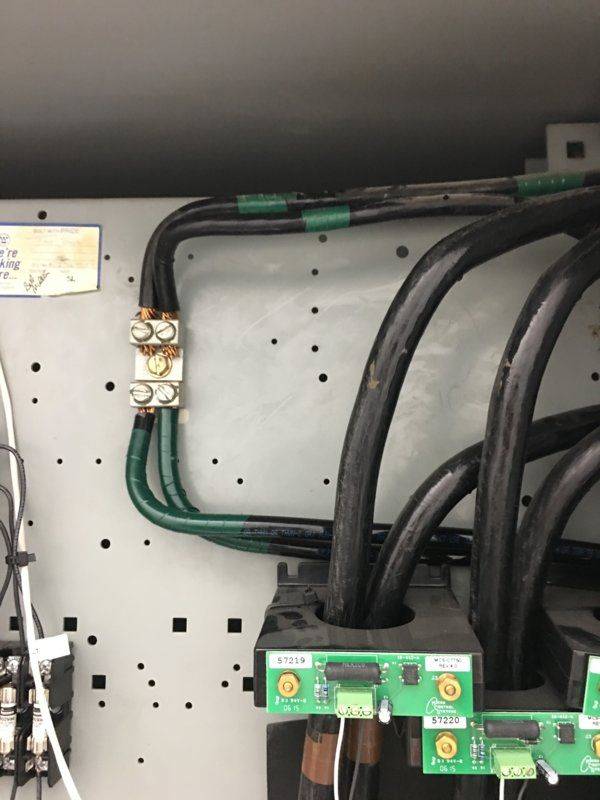
The feed contains 2 parallel conductors on each phase and ground. The equipment ground reads 12a going back to the switchgear, 6a per conductor. From the starter to the motor each ground conductor measures 36a, and 6-7a when measures on both. There are 2 conduits with 1 ground each. Each conduit contains 1,2,3 and 4,5,6 motor leads. (6 lead motor)
4826B163-D838-4C23-ADCC-CB9273E244FC.jpeg
849D6B3D-C11C-45F7-8E10-7A6C70F36CC8.jpeg
It seems to cancel out like there is a loop there. The grounds are tied on to the same lug, so it’s like it’s only on half of the ground circuit.

I know it’s strange. And I’ve never seen it before. I’ll also attach the data I collected with a fluke logger. The ground current was only measured on 1 conductor during that acquisition to read the 36 amps.

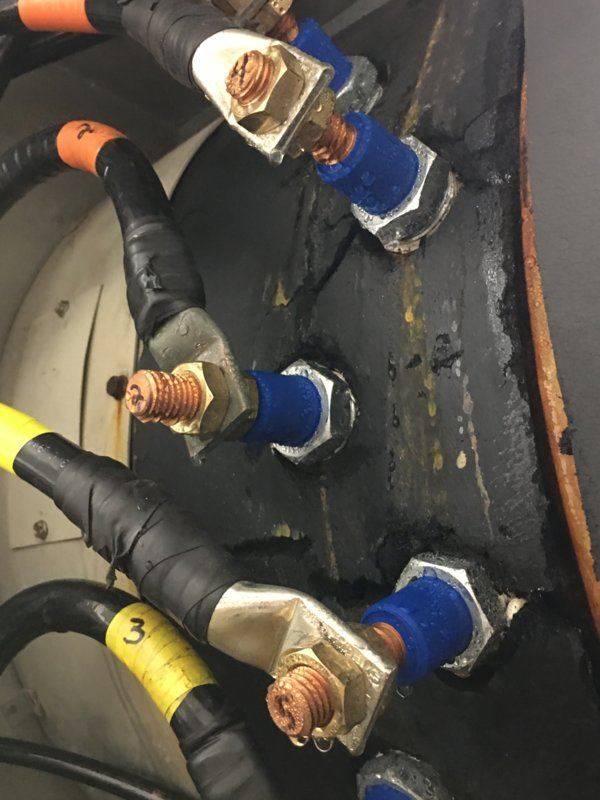
The motor terminals (on a hermetic motor) have a lot of water on them, and my boss believes that is causing it. But that doesn’t explain the ground loop. We also ran a 500vdc meg test and saw >1ma of leakage to ground. I believe we would see more like 36amps if that was the case.
3E93D074-52C5-437D-A1B8-4C35C117645F.jpeg


I’m stumped. Any theories would be appreciated. The job is done, they are having the utility company do some testing on the service. I just want to understand what is happening.

Ground current is also 180hz. That indicates all three phases are contributing. 3rd order harmonics are high. But I have a lot more to learn about harmonics, so that could be irrelevant. The data for phase to ground voltage/ and ground current is attached. I have a full report but it is too large to attach

If I have left out any details please let me know and I will do my best to provide them.

Thanks
 

Attachments

Engineering news on Phys.org
AE2CDF06-A353-473D-B96D-F915551F55BA.jpeg
 
You call it ground because it is connected to the metal chassis. But is it actually an earthed neutral?
How can a neutral be connected to a delta connected motor?
Is the ground/neutral current only present during starting in star configuration?
 
  • Like
Likes   Reactions: kenneth edmiston
A possibility.
The motor may have a winding-to-frame short. But since the leakage test passes, there may also be an open.
 
  • Like
Likes   Reactions: kenneth edmiston
This needs to be broken down a bit more. You mention switchgear feeding three motors but you seem to imply that only one motor is suspect of a fault. Is this correct? Parallel conductors should not do what you described. Maybe if they are terminated together on one end they could, but not both ends.
 
  • Like
Likes   Reactions: kenneth edmiston and Tom.G
To answer the questions top to bottom, it is not an earthed neutal. It is on an equipment ground. the current is constant during operation. The ground is terminated in the peckerhead and does not enter the motor.

If the grounds were open between the motor starter and switchgear I would expect to see no current, instead I am reading 12a back to the switchgear.

You are right, all three motors are experiencing current imbalances and excessive ground current. None that I saw had this strange issue. The grounds terminate in the switchgear on a common ground buss. And are terminated together at the starter.

I know it seems very unlikely that there is a loop like that, and I agree. But I tried everything I could think to disprove that theory and couldn’t. The only thing I was unable to do was open one of the parallel grounds to observe what happened to the current with one conductor. I didn’t want to send the current back to the starter and trip the ground fault relay. This is in a hospital

Thanks for the input gentlemen
 
kenneth edmiston said:
I’m stumped. Any theories would be appreciated. The job is done, they are having the utility company do some testing on the service. I just want to understand what is happening.
In every big installation you can expect to find perplexing things that don't quite make sense, but it works. Most contractors walk away with a statement like “It works, the job is done”. But if someone does not identify and rectify the cause of the discrepancy there will be an ongoing safety liability. You are right to be concerned.

Once the motors are running in delta there should be no neutral or ground current.
There is a real problem if the ground currrents flow when running.
I strongly suspect there is a starter fault, an error in the wiring connections.

I would check every wire end was clearly and uniquely tagged, then trace continuity to check that end tags match. Document the connections and then compare with original installation diagrams. Be determined and methodical, like an accountant, looking for fraud. Verify everything, especially assumptions about terminal identification.

If that process does not identify the error I would isolate one motor at the time, watching for changes in ground current. You are then looking for a motor fault or internal terminal wiring error.

You have not indicated the motor voltage, power or phase current expected, or if each motor has an individual starter, or what switch controls they share. A cross connected wiring error could be anywhere in that maze.

Management is always conflicted. Quality control leads to education, economy and safe practice.
Don't walk away. Learn by finding other's mistakes.
Don't criticize those who got it wrong, criticize yourself for not identifying the "system failure" quicker.
 
  • Informative
  • Like
Likes   Reactions: Klystron, Tom.G and Averagesupernova

Similar threads

  • · Replies 12 ·
Replies
12
Views
5K
  • · Replies 8 ·
Replies
8
Views
1K
  • · Replies 4 ·
Replies
4
Views
5K
Replies
13
Views
4K
  • · Replies 79 ·
3
Replies
79
Views
7K
  • · Replies 5 ·
Replies
5
Views
3K
  • · Replies 8 ·
Replies
8
Views
2K
  • · Replies 17 ·
Replies
17
Views
4K
  • · Replies 1 ·
Replies
1
Views
9K
  • · Replies 4 ·
Replies
4
Views
9K