Understanding Part (b) of a Charge Distribution Problem

Click For Summary
SUMMARY

The discussion focuses on solving part (b) of a charge distribution problem involving electric fields and potential energy. The electric field equations provided are E = (ρ0 * r^4) / (6 * ε0 * a^3) for r < a and E = (ρ0 * a^3) / (6 * ε0 * r^2) for r ≥ a. A key point of confusion arises from the integration of the electric field to find the potential, where discrepancies in coefficients lead to misunderstandings. Participants emphasize the importance of correctly using the density function ρ(r) = ρ0 * (r/a)^3 and maintaining consistent variable notation throughout the problem.

PREREQUISITES
  • Understanding of electric fields and potentials in electrostatics
  • Familiarity with integration techniques in physics
  • Knowledge of charge density functions, specifically ρ(r) = ρ0 * (r/a)^3
  • Proficiency in LaTeX for clear mathematical communication
NEXT STEPS
  • Review the derivation of electric fields from charge distributions using Gauss's Law
  • Study the process of integrating electric fields to find electric potential
  • Learn about common pitfalls in typesetting and notation in physics problems
  • Explore advanced topics in electrostatics, such as potential energy in non-uniform fields
USEFUL FOR

Students and educators in physics, particularly those studying electrostatics, as well as anyone involved in solving complex charge distribution problems.

L_ucifer
Messages
12
Reaction score
0
Homework Statement
A solid, nonconducting sphere of radius a has a volume charge density given by the equation ρ(r) = ρ0(r/a)^3, where r is the distance from the sphere’s centre.
(a) Determine the electric field magnitude, E(r), as a function of r.
(b) Determine the potential, V(r), as a function of r. Take the zero of potential at r = ∞.
Relevant Equations
E = -dV/dr
V = -W/q
I understand part (a) of this question, and my answer for that part is:

*For r < a*
E = (ρ0 * r4) / (6 * ε0 * a3)
* For r ≥ a*
E = (ρ0 * a3) / (6 * ε0 * r2)

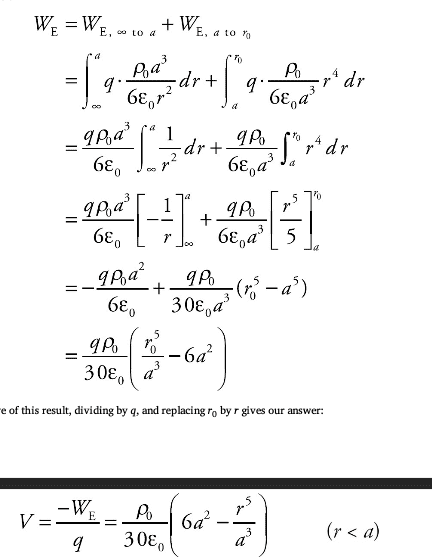
Now, for part (b), I understand one solution is, for r < a, find the work done to bring a point charge q from infinity to a and then from a to r and divide the work by q. This solution is attached below:
Screenshot 2022-05-08 at 12.53.57 AM.png
Now, we also know that E = -dV/dr. This checks out because when we take the negative derivative of V found in the solution, we get the equation for E when r < a. This derivative can also be written as: V = -∫E*dr; however, when I integrate the equation of E for r < a, I get a different solution. Specifically, my solution is the same as the given solution except it doesn't have 6 as a coefficient for a2. Is there a gap in my understanding? What have I done wrong? I appreciate the support.

EDIT: Updated the variables and fixed the typesetting.
 
Last edited:
Physics news on Phys.org
L_ucifer said:
I understand part (a) of this question, and my answer for that part is:

*For r < a*
E = (ρ0 * r4) / (6 * ε0 * a3)
* For r ≥ a*
E = (ρ0 * R3) / (6 * ε0 * r2)
This does not seem correct to me. Please show your work.
 
Orodruin said:
This does not seem correct to me. Please show your work.
I apologise, I meant E = (ρ0 * a3) / (6 * ε0 * r2) for r ≥ a
Screenshot 2022-05-08 at 1.47.05 AM.png
Screenshot 2022-05-08 at 1.47.11 AM.png
 
Still incorrect with the problem as stated. You are not using the density quoted in the problem statement.
 
Orodruin said:
Still incorrect with the problem as stated. You are not using the density quoted in the problem statement.
I got the same fields as OP with ##\rho(r)=\rho_0\left(\dfrac{r}{a}\right)^3##. Maybe the discrepancy is due to careless typesetting in the statement of the problem in which the radius of the distribution appears ##R## instead of ##a##. The ratio ##r/a## is cubed in the solution, not multiplied by 3.
 
kuruman said:
I got the same fields as OP with ##\rho(r)=\rho_0\left(\dfrac{r}{a}\right)^3##. Maybe the discrepancy is due to careless typesetting in the statement of the problem in which the radius of the distribution appears ##R## instead of ##a##. The ratio ##r/a## is cubed in the solution, not multiplied by 3.
Yes, I am not sure why R and a have been switched, but the radius of the sphere is a.
 
L_ucifer said:
Yes, I am not sure why R and a have been switched, but the radius of the sphere is a.
Welcome to PF. Please learn to post using LaTeX here -- it makes it much easier to quote and edit your posts. See the "LaTeX Guide" link at the lower left of the Edit window. Thanks.
 
kuruman said:
I got the same fields as OP with ##\rho(r)=\rho_0\left(\dfrac{r}{a}\right)^3##. Maybe the discrepancy is due to careless typesetting in the statement of the problem in which the radius of the distribution appears ##R## instead of ##a##. The ratio ##r/a## is cubed in the solution, not multiplied by 3.
The exponent is not the issue. The issue is ##a## or ##R## appearing in the ratio in the OP (which OP has now edited) and subsequently in the solution.

@L_ucifer Please do not edit your OP after replies are in place. It only serves to confuse people who are coming into the thread what the previous posts are about. If you need to correct the statement, do so in a follow-up post.
 
  • Like
Likes   Reactions: SammyS and berkeman
Orodruin said:
The exponent is not the issue. The issue is ##a## or ##R## appearing in the ratio in the OP (which OP has now edited) and subsequently in the solution.

@L_ucifer Please do not edit your OP after replies are in place. It only serves to confuse people who are coming into the thread what the previous posts are about. If you need to correct the statement, do so in a follow-up post.
Well, this has gone horrendously for me and I do apologise for these silly errors. You live you learn, I guess. Ignoring all my logistical errors, is there any solution to my question?
 
  • #10
Where in your solution for the potential for r<a do you not agree with the provided solution?
 

Similar threads

  • · Replies 11 ·
Replies
11
Views
1K
  • · Replies 1 ·
Replies
1
Views
2K
Replies
6
Views
1K
  • · Replies 18 ·
Replies
18
Views
3K
  • · Replies 1 ·
Replies
1
Views
2K
Replies
6
Views
1K
  • · Replies 7 ·
Replies
7
Views
1K
  • · Replies 7 ·
Replies
7
Views
2K
Replies
14
Views
2K