Understanding Skeet Thrower Mechanics: Spring Selection and Release Velocity

  • Thread starter Thread starter Cam_P
  • Start date Start date
Click For Summary
SUMMARY

This discussion focuses on selecting the appropriate spring for a DIY skeet thrower, emphasizing the relationship between spring energy storage, Hooke's law, and the release velocity of clay pigeons. The participants recommend using the conservation of energy principle to equate the potential energy stored in the spring with the kinetic energy of the clay and the arm at the point of release. A target release velocity of 15 m/s is specified, and the mass of the clay pigeon is noted as 0.12 kg. Key calculations involve determining spring constant values and expected spring stretch during loading.

PREREQUISITES
  • Understanding of Hooke's Law and spring mechanics
  • Familiarity with conservation of energy principles
  • Basic knowledge of kinetic and potential energy equations
  • Experience with DIY mechanical projects
NEXT STEPS
  • Research spring constant (k) values for various spring types
  • Learn about energy conservation in mechanical systems
  • Explore the dynamics of angular motion in mechanical devices
  • Investigate the effects of friction on mechanical energy transfer
USEFUL FOR

This discussion is beneficial for DIY enthusiasts, mechanical engineers, and hobbyists interested in building and optimizing skeet throwers or similar mechanical devices.

Cam_P
Hi guys!

I'm struggling to select a spring for a DIY skeet thrower i am making, it'll probably be a similar design to the one pictured.

I just don't understand how to relate the spring energy storage and the tension force from Hooke's law to the release velocity of the clay. or even the angular velocity of the spring arm.
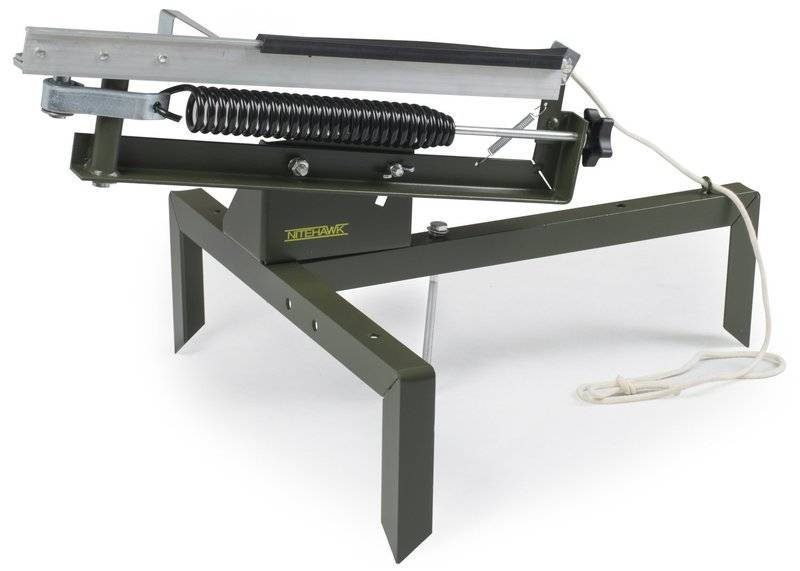
612gdv%2BJI3L._SL1500_.jpg
 
Engineering news on Phys.org
This is essentially a machine dynamics question, and should not be too difficult (I think). I'm not personally familiar with this device, so I'm not entirely clear as to what I'm seeing in the picture. Do you have a top view or a schematic showing clearly how the device works? If so, I'm pretty sure I can help you.
 
  • Like
Likes Cam_P
this link may help

https://www.amazon.com/dp/B0714QHJ32/?tag=pfamazon01-20
 
https://outlook.office.com/owa/service.svc/s/GetFileAttachment?id=AAMkAGJiNGYzMzE2LTE2ZjctNDkwZS04YWU2LTFiZGNiNDZiNWExNABGAAAAAAAMsBEqZjKgS4Lp2EQQihiyBwBl1JHdDzN4S7H4NHxB29OKAAAAAAEMAABl1JHdDzN4S7H4NHxB29OKAAELotnqAAABEgAQAPHu44w2Xx9Gpbb%2BstqU2bw%3D&X-OWA-CANARY=rmkzbi613ESb6tabf406umDXG_7FFNUYjZegY9kXdkzDw3wdLWrlKiWqNFQngyKrC5VpkSAT5zA.&isImagePreview=True
 
Above is the sketch i have of the moving parts and relevant lengths
 
Cam_P said:
I just don't understand how to relate the spring energy storage and the tension force from Hooke's law to the release velocity of the clay. or even the angular velocity of the spring arm.
For a first cut, assume about 75% of the stored energy in the spring goes into the launch velocity of the pigeon. Do you know about what you want for the Vo of the pigeon? Then just use 1/2 mv^2 for the KE of the pigeon compared to 1/2 kx^2 for the PE stored in the taut spring.
 
  • Like
Likes DoctorPhysics
Cam_P said:
Above is the sketch i have of the moving parts and relevant lengths
Not working so far... Are you using the Upload button? What is the file type?
 
You ask about determining the release velocity. I suggest to you that the simplest approach is to employ conservation of energy.

1. Determine the energy stored in the spring with the system cocked.
2. Express the system energy at the point of release. This will include (a) the kinetic energy of the arm, (b) the kinetic energy of the clay, and (c) any remaining energy stored in the spring.
3. Set these two energies equal and solve for the final velocity.
This approach neglects friction, but that may not be too important in this application. The resulting velocity will be a little bit higher than actual for that reason.
 
I want the release velocity to be about 15ms-1
 
  • #10
What is the mass of the pigeon?
 
  • #11
0.12kg
 
  • #12
Well, what are the typical k values for the springs you are considering using? What is the amount of stretch you expect for your spring when in the loaded position.

Please show your work with the equations that Dr.D and I have been suggesting for you to use.
 
  • #13
I cannot see any sketch with dimensions; all I see is . I'd be very interested in seeing what you have designed here. In particular, I'd like to know what causes the actual launch to occur? Does the arm hit a stop, allowing the clay to continue on, or is it some other mechanism?

If you use the energy approach that I suggested, you can assign the release velocity and solve for the spring constant K, and you can play games with the free length of the spring (all in a simple computer code).

In addition to the mass of the clay, you will need the mass moment of inertia of the clay about the spin axis. A substantial part of the kinetic energy of the clay will reside in the spin, so this is an important term.
 

Similar threads

  • · Replies 5 ·
Replies
5
Views
4K
Replies
52
Views
13K
Replies
7
Views
3K
  • · Replies 13 ·
Replies
13
Views
2K
Replies
10
Views
2K
  • · Replies 1 ·
Replies
1
Views
6K
  • · Replies 2 ·
Replies
2
Views
3K
  • · Replies 3 ·
Replies
3
Views
2K
  • · Replies 9 ·
Replies
9
Views
2K
  • · Replies 5 ·
Replies
5
Views
2K