Understanding square root of a polynomial

Click For Summary

Discussion Overview

The discussion centers around the process of finding the square root of polynomials, particularly perfect squares, as described in an old algebra book. Participants explore the algebraic method presented in the book and its application to numerical examples, raising questions about specific steps and the reasoning behind them.

Discussion Character

  • Exploratory
  • Technical explanation
  • Debate/contested
  • Mathematical reasoning

Main Points Raised

  • One participant questions how the author derived the value of b = 30 in a numerical example, indicating a lack of clarity in the explanation provided in the book.
  • Another participant critiques the author's approach, suggesting that the method used to find b is not rigorous, as it relies on estimating b rather than calculating it directly.
  • A different viewpoint asserts that the author is not actually finding the square root but is instead verifying known roots through division.
  • Some participants discuss the algorithm for polynomial square roots, noting that it does not require prior knowledge of the roots and can be applied generally.
  • Participants share their own examples and methods for estimating b, emphasizing the trial-and-error nature of the process and the importance of making good guesses.
  • There is a discussion about the perception of the method as guessing versus calculating, with some arguing that it is reasonable to describe the process as guessing.
  • One participant references an external article that discusses a similar method, suggesting historical connections to the work of Bombelli.

Areas of Agreement / Disagreement

Participants express differing views on the rigor of the author's method and the nature of the process for finding square roots. There is no consensus on whether the method is valid or how to interpret the steps involved.

Contextual Notes

Some participants note that the examples provided in the book may not fully explain the steps taken, leading to confusion about the application of the algebraic method to numerical problems.

issacnewton
Messages
1,035
Reaction score
37
Hello

This is not exactly a homework problem. I was browsing through an old book, "Elementary Algebra for Schools"
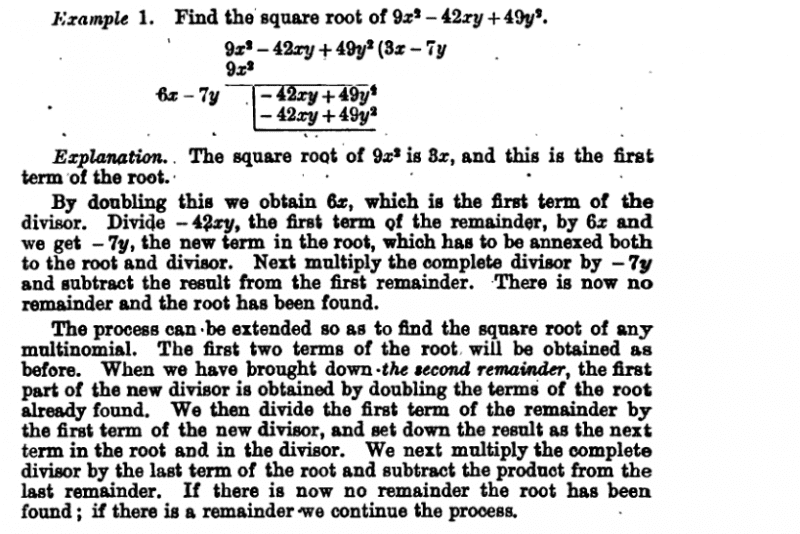
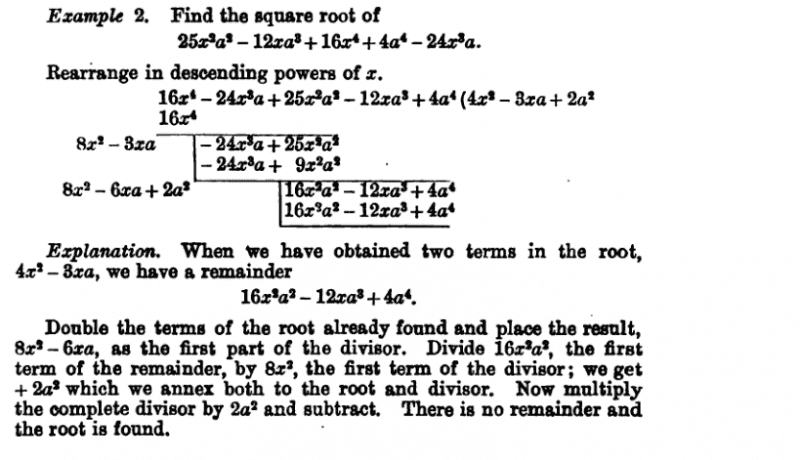
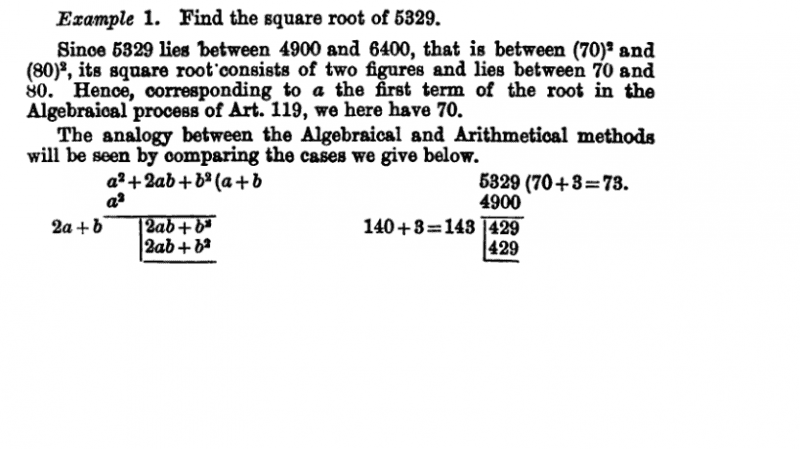
by Hall and Knight, first published in England in 1885. The book can be found online at https://archive.org/details/elementaryalgeb00kniggoog . I was studying the process of finding the square root of the polynomial which is a perfect square. I have attached some snapshots from the book here. This process is explained in the file "squareroot" . The files "example1" and "example2" give two examples of using this process. I have understood so far. Now later in the chapter, the author is using this algebraical method to find the square root of the whole numbers which are perfect squares. I have attached some examples in the files "numerical1" and "numerical2".
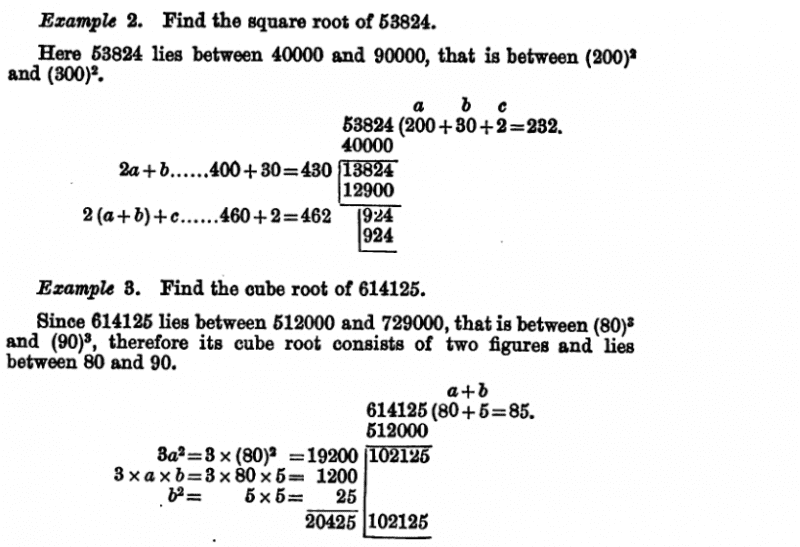
Now I have question regarding example 2 given in the file numerical2. How did the author get the value of b = 30.
In the algebraical method, its clear that to get the next term in the root, we divide the first term in the remainder with the twice the first term in the root. But in the case of numerical examples, its not clear how he got b = 30 in the example 2 in the file numerical2. If anybody can explain this it would be nice. Since this is an old book, author doesn't explain in great detail. So understanding it is difficult.

Thanks
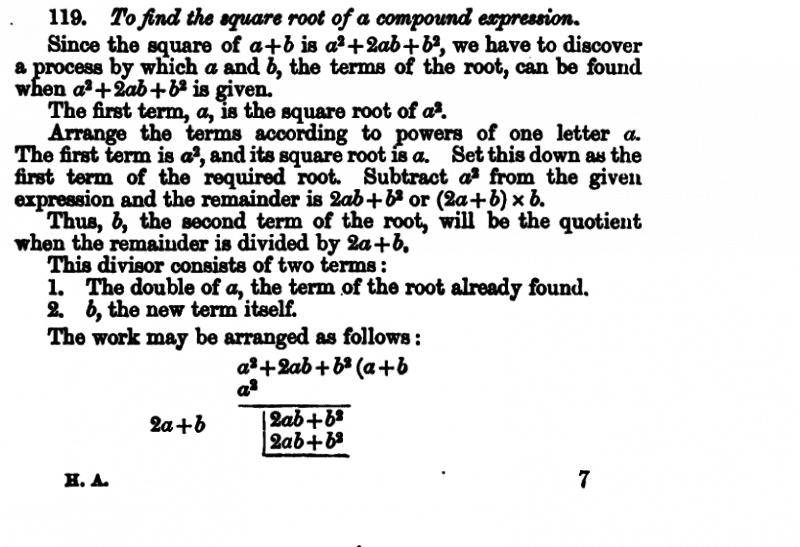
square root.png
example1.png
example2.png
numerical1.png
numerical2.png
 
Mathematics news on Phys.org
In the tekst he says the remainder after the first step is ##(2a+b)\times b##, so he sort of writes 'divide by 2a+b to get b'. That's cheating ! b is unknown.
Best you can do is divide by 2a plus an estimate for b. So it takes some practice to build experience.

Worst that can happen is you miss and guess b too high. Well, then you get a negative remainder and try again.

For an estimate, you can divide the remainder by 2a, giving ##(1+{b\over 2a}) \times b##. This isn't waterproof:

if a = 100 and b = 90, it doesn't work very well. On the other hand, you know that b is 90 or smaller.
if a = 100 and b = 80, it doesn't work very well either. Suppose you try 90, then you get a negative remainder and have to try again.
But if b/2a is small enough (< 1/8 I would guess), the first digit already gives the right value for b.
 
In NONE of these examples is the author actually finding the square root. In each case, the expression happens to be a "perfect square" and he already knows the root. All he is doing is using division to show that his root is actually correct.
 
Bvu, thanks for reply. Well in the beginning its confusing what he is saying but in the algebraical examples its clear to me. He is not dividing (2ab+ b^2) by (2a+b) to get b. He is dividing the first term in the remainder 2ab by the twice of the first term in the root , which is 2a , to get b. Then he adds this to the root. His algebraical method is very clear to me. I just don't understand his application to the numerical problems.
 
Thread moved to the Gen. Math section.
 
HallsofIvy said:
In NONE of these examples is the author actually finding the square root. In each case, the expression happens to be a "perfect square" and he already knows the root. All he is doing is using division to show that his root is actually correct.
Not true polynomial square root takes a polynomial of degree 2n and decomposes it
p=q^2+r
where degree(q)=n and degree(q)>degree(r)

The algorithm does not require knowing q or r in advance

As for an example like sqrt(5329)
it is a matter of writing
5329-a^2=(a+b)^2-a^2=b(2a+b)=a^2+2ab+b^2
let a=70
5329-4900=429
470=140*3+9
b=3 and we are done
 
Hi lurf, I didn't quite get how you would calculate b = 3 ? My impression still is that you have to make a good guess.

For example ##\sqrt {158404}##: subtract ##300^2##, end up with ##68404##. Now what ?
 
It is very similar to long division. You can think of it as guessing, but there are only two possible guesses.
b=470/(140+b)
how can we divide by 140+b when we do not know b? Because we know 0<b<10
429=3*140+3^2=3(140+3)
429=2*140+2^2+145
If we chose b=2 we might realize it is too small if not we can just do one more step
429-72^2=145=2*72b+b^2
is b 0 or 1? obviously 1
429-73^2=0
the idea is
p=q^2+r
we start out with q=0 r=p
each step we move a chunk from r to q until there is not enough left in r
q'=q+b
r'=r-2qb-b^2
mostly we pick b by dividing r by 2q we just have to watch out for mistakes

This is where we have to decide if we try to be fancy
Usually we only try for one digit per step
if we try for more each step is harder so there is a trade off
sqrt(158404)
158404-300^2=68404>(2*300+100)*90
lets pick b=90
158404-390^2=68404-90*(2*300+90)=6304>(2*390+10)*7
lets pick b=7
158404-397^2=6304-7*(390*2+7)=795=(397*2+1)*1
lets pick b=1
158404-398^2=795-(397*2+1)=0
 
  • Like
Likes   Reactions: BvU
I see what you mean. I like the way the 8 comes about. It means the process/algorithm works.
And indeed, the role of a and b can shift from step to step (original article has an a, b and c here).

It's just that I would describe this picking as guessing and not as calculating. Matter of perception ?
 
  • #10
It is reasonable to call it guessing. The usual method for division has the same problem. Just as in division the guess is just between two digits. If a gues is bad it gets fixed in the next step.
 
  • #11
lurfflurf, it seems I understand what you are doing. Its clear now. I was just looking around the net for this particular way of getting square root of a polynomial. I found a good article discribing this exact method here http://planetmath.org/squarerootofpolynomial ... In this link, the author refers to BombellisMethodOfComputingSquareRoots
in the references. So may be Mr Bombelli came up with this method...
 

Similar threads

  • · Replies 1 ·
Replies
1
Views
2K
Replies
14
Views
2K
  • · Replies 30 ·
2
Replies
30
Views
7K
  • · Replies 2 ·
Replies
2
Views
2K
  • · Replies 0 ·
Replies
0
Views
3K
  • · Replies 3 ·
Replies
3
Views
3K
  • · Replies 21 ·
Replies
21
Views
2K
Replies
3
Views
2K
  • · Replies 1 ·
Replies
1
Views
2K
  • · Replies 3 ·
Replies
3
Views
2K