Understanding the Arctan Identity: Solving for Inverse Trigonometric Functions

  • Thread starter Thread starter ali PMPAINT
  • Start date Start date
  • Tags Tags
    Identity
Click For Summary
The discussion centers on solving the arctan identity using the equation tan(a) + tan(b) + tan(c) = tan(a) * tan(b) * tan(c), where a + b + c = π. Participants express uncertainty about applying this equation to inverse trigonometric functions and consider using alternative equations like tan(a ± b). There is a request for clarification on how to use the π symbol in typesetting. One participant shares insights from a solution book involving right triangles to illustrate the relationship between angles. The conversation concludes with a participant expressing newfound understanding of the geometric relationships involved.
ali PMPAINT
Messages
44
Reaction score
8
Homework Statement
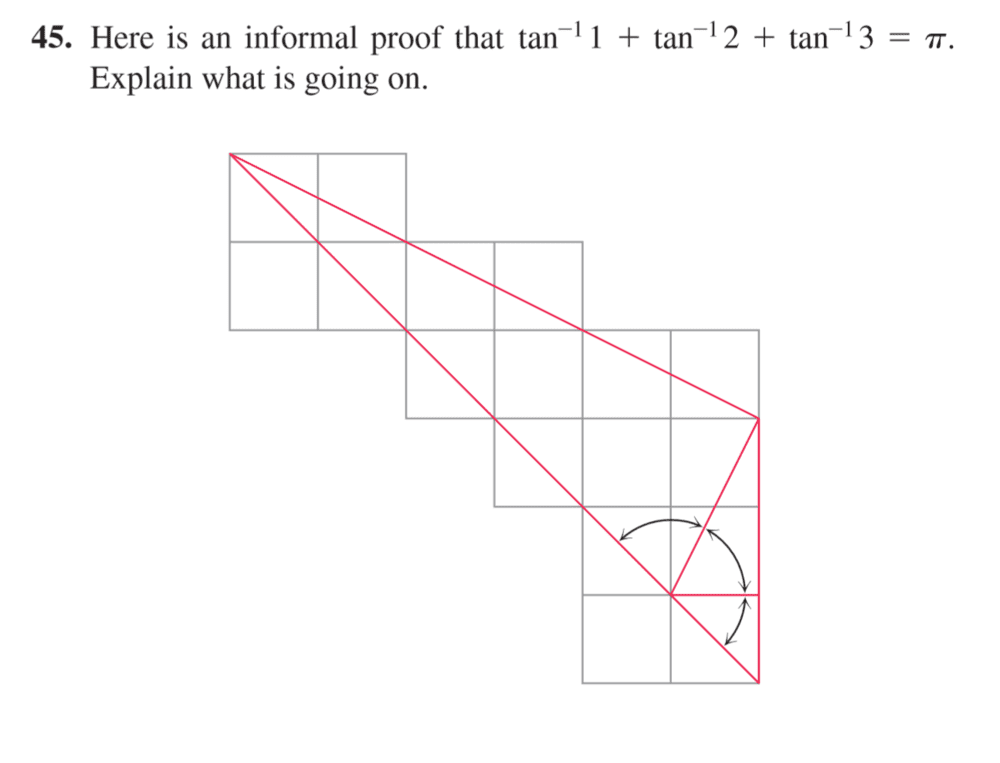
arctan(1)+arctan(2)+arctan(3)=Pi
Relevant Equations
I think tan(a)+tab(b)+tan(c)=tan(a)*tan(b)*tan(c)
So, I saw the answer but I couldn't understand it. But I think it can be solved by tan(a)+tab(b)+tan(c)=tan(a)*tan(b)*tan(c) (where a+b+c=Pi) , but I don't know how to transfer it to its inverse.
Capture.png


The answer:
242905
 
Physics news on Phys.org
Hello ali, ##\qquad## :welcome: ##\qquad## !
ali PMPAINT said:
I think it can be solved by ##\tan a +\tan b + \tan c =\tan a * \tan b * \tan c ## (where ## a+b+c=\pi ##)
Thanks for that equation -- I didn't know about it.
But: wouldn't it be easier to use some other equations, e.g. the expressions for ##\ \tan (a\pm b) ## ?
 
  • Like
Likes ali PMPAINT
BvU said:
Hello ali, ##\qquad## :welcome: ##\qquad## !
Thanks
But: wouldn't it be easier to use some other equations, e.g. the expressions for ##\ \tan (a\pm b) ## ?
[/QUOTE]
I think it would, but I don't know how to use these expressions for arctan.
And if you understood the solution book mentioned, could you explain it to me?
and how did you use "Pi" symbol?
 
But: wouldn't it be easier to use some other equations, e.g. the expressions for ##\ \tan (a\pm b) ## ?
[/QUOTE]
Akshely(Sorry for my English, I don't know how to spell it correctly), yes! Thanks for your advice. for anyone interested for the proof:

242926
 
  • Like
Likes BvU
ali PMPAINT said:
how did you use "Pi" symbol?
I type ## \pi ## and get ##\pi##

How to typeset equations is described in this tutorial (from point 7 in the guidelines)

ali PMPAINT said:
solution book mentioned
On the lower right you see a triangle with a top left angle a that has tangent 1.
242925

On top of that angle is a triangle with a lower left angle b that has tangent 2.
And c has tangent 3.

ali PMPAINT said:
spell it correctly
that would be: actually
 
  • Informative
Likes ali PMPAINT
BvU said:
I type ## \pi ## and get ##\pi##
On the lower right you see a triangle with a top left angle a that has tangent 1.
View attachment 242925
On top of that angle is a triangle with a lower left angle b that has tangent 2.
And c has tangent 3.

that would be: actually
Oh! Now I got it! Thank you very much!
 
arctan.jpg


From the right triangles ABC, CBD, CDE, and AFE, the length of AE is the same as the length of AC + length of CE, so the line ACE is a straight line, the angle C is 180°.
 
  • Like
Likes ali PMPAINT and YoungPhysicist

Similar threads

  • · Replies 17 ·
Replies
17
Views
4K
  • · Replies 2 ·
Replies
2
Views
2K
Replies
15
Views
2K
  • · Replies 7 ·
Replies
7
Views
2K
  • · Replies 11 ·
Replies
11
Views
3K
Replies
5
Views
2K
  • · Replies 6 ·
Replies
6
Views
3K
Replies
17
Views
2K
  • · Replies 15 ·
Replies
15
Views
3K
  • · Replies 10 ·
Replies
10
Views
3K

