Understanding the Behavior of Inductors in AC Circuits

Click For Summary

Homework Help Overview

The discussion revolves around the behavior of inductors in AC circuits, particularly focusing on the relationship between voltage and current when an alternating voltage source is applied. Participants explore the implications of initial conditions on current at time t=0 and how this relates to the transient behavior of inductors.

Discussion Character

  • Exploratory, Conceptual clarification, Assumption checking

Approaches and Questions Raised

  • Participants discuss the nature of inductors as reactive components and the significance of the rate of change of current. Questions arise regarding the initial conditions and their effect on the voltage-current relationship, particularly at t=0. Some participants express confusion about the transient behavior and the implications of resistance in real circuits.

Discussion Status

The conversation is ongoing, with various interpretations being explored. Some participants have provided insights into the mathematical relationships governing the behavior of inductors, while others are questioning the assumptions made regarding initial conditions and the nature of the circuits being analyzed.

Contextual Notes

There are discussions about the ideal versus real behavior of inductors, including the effects of resistance and the concept of superconductors. Participants note the importance of understanding transient responses in circuits containing inductors and capacitors.

MotoPayton
Messages
96
Reaction score
0
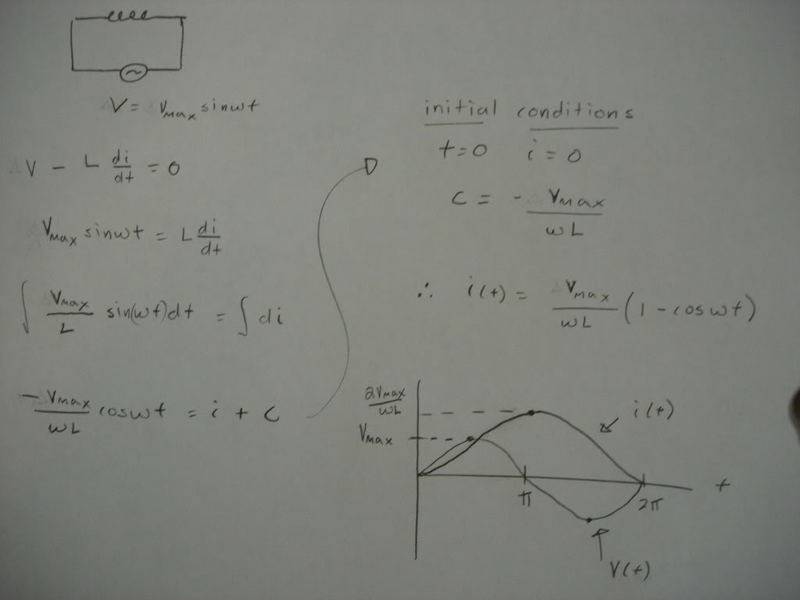
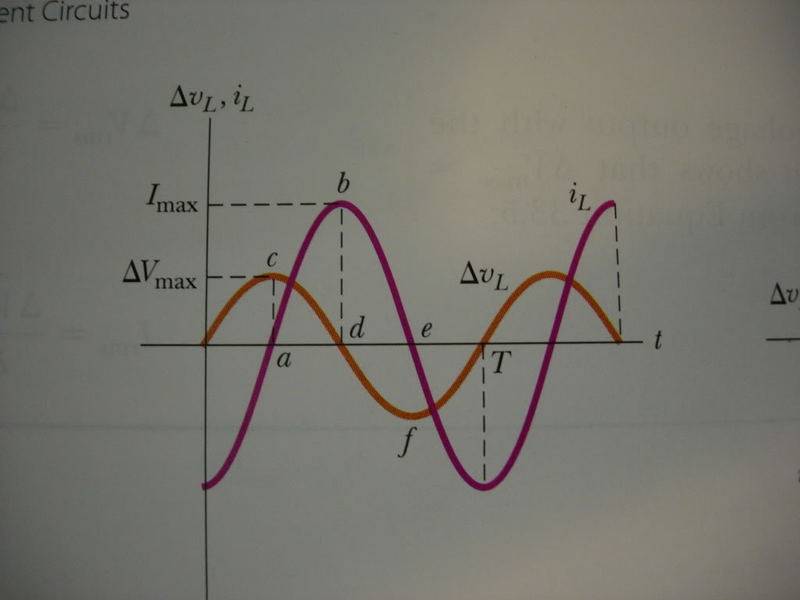
If you have an alternating voltage source in series with one inductor what happens? The book has a graph of the alternating voltage source and the current through the inductor. What I don't understand is how there is current in the inductor at t=0. If you look at how I solved the problem I provided initial conditions that makes the current 0 at t=0. The book solved it without initial conditions for some reason and obtained the voltage current relationship in the graph below.

I believe the book is just trying to demonstrate that the current will always come after the voltage in an AC inductor circuit but that doesn't explain why you would ever have negative current.

You have to flip the switch and turn on the circuit at some point and I believe my answer is what would happen..

I'm confused

DSCN8294.jpg
DSCN8293.jpg
 
Physics news on Phys.org
Inductors (and capacitors) are 'reactive' components in electrical circuits. This means that their behaviour depends on rate of change of a quantity rather than a value of voltage or current.
If you look at the graph you should see that V is a maximum when the rate of change of current (slope of current graph) is a maximum.
This means that the equations linking voltage and current are differential equations.

e = -Ldi/dt
 
technician said:
Inductors (and capacitors) are 'reactive' components in electrical circuits. This means that their behaviour depends on rate of change of a quantity rather than a value of voltage or current.
If you look at the graph you should see that V is a maximum when the rate of change of current (slope of current graph) is a maximum.
This means that the equations linking voltage and current are differential equations.

e = -Ldi/dt

Yes I agree with you but that doesn't answer my question
 
I would say that at t=0 the rate of change of current = 0 therefore, at this instant, the V = 0.
These are instantaneous values and will change.
To find an expression for the voltage across the coil I start with I = Imax Sin(ωt)
Then E = -LdI/dt = - LωImax Cos(ωt)
Hope this links to your equations.
 
The book shows the situation when the switch has been closed for some time.

There is a transient in every circuit that contains capacitors/inductors when the current and voltage changes according to the own frequency of the circuit. As there are resistances in every circuit, this transient is extinct in a short time, and the current and voltage will oscillate with the frequency of the source, and you get a steady phase difference between current and voltage.

ehild
 
With sinusoidal voltages/currents the voltage and current through a pure inductor will always be out of phase by 90 because V is proportional to the rate of change of current.
 
ehild said:
The book shows the situation when the switch has been closed for some time.

There is a transient in every circuit that contains capacitors/inductors when the current and voltage changes according to the own frequency of the circuit. As there are resistances in every circuit, this transient is extinct in a short time, and the current and voltage will oscillate with the frequency of the source, and you get a steady phase difference between current and voltage.

ehild

So does this transient resemble the graph I obtained when setting current to 0 at t=0?

Why after a long time would it deviate from the graph I obtained? It seems that that solution works fine...
 
technician said:
With sinusoidal voltages/currents the voltage and current through a pure inductor will always be out of phase by 90 because V is proportional to the rate of change of current.

I completely understand the difference in phase between current in voltage. It's the initial conditions that's confusing.
 
Your graph does not show any transient behavior, it shows a continuos AC current and a continuous AC voltage.
Choosing when to have t =0 is arbitrary.I personally like to look at your graphs with t =0 at point 'a' because I like to write I = IMAX Sinwt
 
  • #10
ehild said:
Your solution is not the general solution of the differential equation of the circuit. The general solution includes an exponential term. You can fit the initial condition to the general solution only.
Have you learned about linear differential equations? The general solution is the sum of the general solution of the homogeneous equation (without AC source) and a particular solution of the inhomogeneous equation (with source). You used the particular solution only.

ehild

No, I am taking differential equations next semester. Thanks for your answer I guess I will have to learn some differential equation if I want to fully understand this problem.
 
  • #11
So my particular solution would never occur in a circuit?
 
  • #12
Your result for the current would be true for a completely lossless circuit. But such one simply does not exist. An inductor is made of a wire coil: it has resistance. In case it is an ideal inductor (made from superconductor) the resistance of the source counts. The book shows a figure which is true for the voltage across and the current through an ideal inductor in a circuit that have losses.

The current you got never becomes negative. That means that you can have zero current at t=0 if there was a direct current flowing in the circuit before the source was switched on.
Assuming lossless circuits leads to untrue result which are against reality. Losses are always present. If it is not because of resistance, the loss can arise by radiation. The windings of the coil with the spaces between them serve as tiny capacitors, making the circuit a resonant one with very high own frequency. The circuit will radiate energy. Loss again, and extinction of the transient.

ehild
 
  • #13
ehild said:
That means that you can have zero current at t=0 if there was a direct current flowing in the circuit before the source was switched on.

ehild

Your the man, but I'm confused by this.
 
  • #14
Also, what is in the math of the "general solution" that includes the "losses" of the circuit.
Where in the math is the resistance of the circuit coming in that gives rise to the steady state solution?
 
  • #15
MotoPayton said:
Your the man, but I'm confused by this.

I know. It is a hard problem, and confused me, too, when I was young. Accept that you do not use initial condition in an AC circuit.


ehild
 
  • #16
If a resistor R connected in series, the general solution would look


[tex]I(t)=Ae^{-t(R/L)}+B(cos\omega t +\phi)[/tex]

I try to explain it tomorrow, I am too sleepy now...

ehild
 
  • #17
I found this great link.

http://www.physics.byu.edu/faculty/berrondo/su442/ac.pdf

After line 75 in the link they write..

In this case the physical meaning of the constant of integration is a steady DC current, and
since there is no source for such a current in our system, the constant must be zero.

Can you explain that sentence when you wake up?
 
  • #18
Nvm, you actually all ready told me that.
 
  • #19
I think I got it now..

So there is the ideal case where the inductor is ideal and the current will reach a maximum as if there was no resistance. This is what they have in the book.

And then there is the superconducting case that I was trying to prove was right. In this case the current never goes negative and kind of floats above the x axis. Which you would need a superconductor to achieve.

And if you did want the current to stay above the x-axis in a real circuit you would need a DC supply to keep it positive.

I just needed a better feel for what resistance is.
thanks
 
  • #20
You did a good job while I was sleeping, congratulation! So you assumed a superconducting coil driven with an ideal source.

Having a closed loop of superconducting wire, and keeping it at appropriate low temperature, and starting current in it by a magnet from outside - just pushing the electrons a bit- the current will flow -not really forever- but so long that we can say that it never stops.
In case of real materials, all currents decay if there is no source to keep it flowing. The free electrons of the conductor gain some velocity in the electric field built up by the source, but loose it when colliding with the ions of the conductor or with the other electrons. Their excess energy adds then to the thermal energy, it increases the average energy of the particles in the conductor, which means increasing temperature.
So you need to know that there is some loss in every circuit, and it can be represented by a resistor. This resistor is connected in series with the coil in your circuit.

You have not run into this problem if you assumed that the generator voltage is Vmaxcos(ωt). This would mean a high current started by the generator at t=0, but this means an infinite dI/dt, that is a high counter-emf in the coil, which would allow zero current flowing initially, and a solution I=-Vmax/(ωL)sin(ωt).
Or even better, you could have used a current generator with current I=I(max)sin(ωt). Than the voltage across the inductor is simply VL=LdI/dt=Lωcos(ωt). No trouble with integration constant.

Now I outline the solution of the real case. I do not go into the details. You will learn them from Maths.

So you have an inductor L and a series resistor R and a source with emf Vmsin(ωt) (m means max).

The equation of the circuit is
[tex]L\frac{dI}{dt}+RI=V_m \sin(\omega t)[/tex]
This is a first-order inhomogeneous differential equation, and the assigned homogeneous one is that with zero on the right-hand side:
[tex]L\frac{dI}{dt} +RI=0[/tex]

General solution means such solution of a differential equation which can be fitted to arbitrary initial condition. You will learn that the general solution of a linear differential equation the general solution of the homogeneous equation + a particular solution of the original inhomogeneous one.
You will learn methods of solving differential equations. Now just accept that the general solution of [itex]L\frac{dI}{dt} +RI=0[/itex] is

[tex]I_h=A\exp(-\frac{R}{L}t)[/tex]
where A is an arbitrary constant.

If you substitute it for I in the homogeneous equation you will see that it is really a solution.

The next step is to find a particular solution of the original inhomogeneous equation. One method is guessing the form of the function using free parameters which you choose so that the function satisfies the equation.

Try to find the particular solution Ip in the form

[tex]I_p=B\cos(\omega t) + C\sin(\omega t)[/tex], and substitute back into the original equation.

[tex]L(-B\omega \sin(\omega t) + C\omega \cos(\omega t))+R(B\cos(\omega t) + C\sin(\omega t))=V_m \sin(\omega t)[/tex]

Collect the cos(ωt) and sin(ωt) terms

[tex](-BL\omega +CR-V_m)\sin(\omega t) + (CL \omega +RB)\cos(\omega t)=0[/tex]

This equation is valid for any time t. That implies that the coefficients of both cos(ωt) and sin(ωt) are zero. (You can think that the equation is true for t=0. Then cos(ωt)=1 and sin(ωt)=0, so the coefficient of the cosine term has to vanish. In case if t=pi/(2ω), cos(ωt)=0 so the coefficient of the sine term has to vanish, too.) This results in two equations for the constants B and C.

[tex]-BL \omega +CR-V_m=0[/tex]

[tex]CL \omega +RB=0[/tex]

The solution is
[tex]B=-\frac{U_m L \omega}{L^2\omega^2+R^2}[/tex]
[tex]C=\frac{U_m R }{L^2\omega^2+R^2}[/tex]

So

[tex]I_p=-\frac{U_m L \omega}{L^2\omega^2+R^2}\sin(\omega t)+frac{U_m R }{L^2\omega^2+R^2}\cos(\omega t)[/tex]

and the general solution is

[tex]I=A\exp{(-\frac{R}{L}t)}+B\cos(\omega t)+C\sin(\omega t)[/tex]

You can fit A to the initial condition. You can choose I(0)=0, then A=-B, and

[tex]I=B(-\exp{(-\frac{R}{L}t)}+\cos(\omega t))+C\sin(\omega t)[/tex]

Let's investigate this function: The exponential term will decay after some time, and the current will oscillate with the frequency of the generator forever with the "stationary" AC current

[tex]I=B\cos(\omega t)+C\sin(\omega t)=I _{max}sin(\omega t+\phi)[/tex]

where Imax is the amplitude and φ is the phase with respect to the generator voltage.

[tex]I _{max}=\sqrt{B^2+A^2}=\frac{U_m}{\sqrt{L^2\omega^2+R^2}}[/tex]
and
[tex]\phi=\arctan{B/C}=\arctan\frac{-L\omega}{R}[/tex]

The voltage across the inductor is LdI/dT,

[tex]U_L=I_{max}\omega cos (\omega t+\phi)=I _{max}\omega sin (\omega t+\phi+\pi/2)[/tex]

the voltage across the inductor leads he current by pi/2.

Consider the almost lossless case: R<<ωL. Then

[tex]I_{max}=\frac{U_m }{L\omega}[/tex]

and

[tex]\phi=-\pi/2[/tex]

The current lags the generator voltage by pi/2.
ehild
 
Last edited:
  • #21
Thanks for the help, hopefully someone else has that question because they're set.
 
Last edited:

Similar threads

  • · Replies 10 ·
Replies
10
Views
1K
  • · Replies 3 ·
Replies
3
Views
1K
  • · Replies 5 ·
Replies
5
Views
2K
  • · Replies 15 ·
Replies
15
Views
1K
  • · Replies 8 ·
Replies
8
Views
3K
  • · Replies 16 ·
Replies
16
Views
1K
  • · Replies 16 ·
Replies
16
Views
4K
  • · Replies 21 ·
Replies
21
Views
2K
  • · Replies 15 ·
Replies
15
Views
6K
Replies
5
Views
3K