Understanding the concept of Axial Loading/Force

  • Thread starter Thread starter tomtomtom1
  • Start date Start date
  • Tags Tags
    Axial Concept
Click For Summary
Axial loading refers to a load that passes through the center of gravity of a member's cross-section, resulting in either compression or tension. When a uniformly distributed load is applied to a column, it is essential to understand that the load will always pass through the column's center of gravity, regardless of the column's orientation. The discussion raises questions about identifying axial forces in different shapes and the relationship between axial forces and normal forces. Clarifications are provided that axial loads are specifically tension or compression forces applied parallel to the axis of a structural member. The conversation emphasizes the need for precise definitions in understanding axial loading concepts.
tomtomtom1
Messages
160
Reaction score
8
TL;DR
Understanding the concept of Axial Loading/Force.
Hello all

I was wondering if some could help me understand the concept of Axial Loading/Force.

From research Axial loading can be defined as a load that passes through the centre of gravity of a members cross section, this causes either compression or tension.

The bit I don't fully understand is that if I applied a uniformly distributed load on a column then regardless of which orientation the column is places and which direction the load it applied the load will always pass through the columns centre of gravity as shown below:-
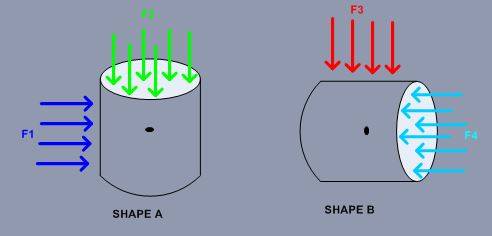
ALOADING.JPG


The black dot is meant to represent the centre of gravity.

From the two shapes shown can someone tell which forces are axial and why?

(I have assumed that gravity is acting downwards on both shapes)

Also on a side note are Axial forces and Normal Forces the same thing?

Thank you.
 
Engineering news on Phys.org
Where does it say that the axial load passes through the center of gravity? An axial load on a cylinder is simply a tension or compression force (distributed load as you have drawn it) on the end of the cylinder, parallel to the axis of the cylinder.
 
ttp://www.wikiengineer.com/Structural/Axial

"What is an Axial Force?
If the load on a column is applied through the center of gravity of its cross section, it is called an axial load."
 
tomtomtom1 said:
ttp://www.wikiengineer.com/Structural/Axial

"What is an Axial Force?
If the load on a column is applied through the center of gravity of its cross section, it is called an axial load."
This makes no sense to me, and, in my judgment, is inciorrect.
 
  • Like
Likes mfig
I agree with Chestermiller. I think a better definition is the following, from Structural and Stress Analysis by Megson:

"Axial loads are applied along the longitudinal or centroidal axis of a structural member."
 
Thank you all.
 
Had my central air system checked when it sortta wasn't working. I guess I hadn't replaced the filter. Guy suggested I might want to get a UV filter accessory. He said it would "kill bugs and particulates". I know UV can kill the former, not sure how he thinks it's gonna murder the latter. Now I'm finding out there's more than one type of UV filter: one for the air flow and one for the coil. He was suggesting we might get one for the air flow, but now we'll have to change the bulb...

Similar threads

Replies
2
Views
2K
  • · Replies 7 ·
Replies
7
Views
6K
  • · Replies 2 ·
Replies
2
Views
2K
Replies
2
Views
1K
  • · Replies 5 ·
Replies
5
Views
2K
  • · Replies 1 ·
Replies
1
Views
1K
  • · Replies 2 ·
Replies
2
Views
1K
  • · Replies 5 ·
Replies
5
Views
2K
  • · Replies 9 ·
Replies
9
Views
2K
  • · Replies 4 ·
Replies
4
Views
3K