Understanding the concept of Axial Loading/Force

  • Thread starter Thread starter tomtomtom1
  • Start date Start date
  • Tags Tags
    Axial Concept
Click For Summary

Discussion Overview

The discussion revolves around the concept of axial loading and axial forces, particularly in the context of structural engineering. Participants explore definitions, applications, and the relationship between axial forces and normal forces.

Discussion Character

  • Conceptual clarification
  • Debate/contested

Main Points Raised

  • One participant defines axial loading as a load that passes through the center of gravity of a member's cross-section, resulting in either compression or tension.
  • Another participant questions the assertion that axial loads must pass through the center of gravity, suggesting that an axial load is simply a tension or compression force applied parallel to the axis of a cylinder.
  • A reference is provided that states an axial load is defined as a load applied through the center of gravity, which some participants find unclear or incorrect.
  • One participant offers an alternative definition from a textbook, stating that axial loads are applied along the longitudinal or centroidal axis of a structural member.
  • A participant seeks clarification on whether axial forces and normal forces are the same, indicating a potential area of confusion.

Areas of Agreement / Disagreement

Participants express differing views on the definition of axial loading and whether it necessarily involves the center of gravity. There is no consensus on the definitions presented, and the discussion remains unresolved.

Contextual Notes

Participants reference different sources and definitions, highlighting potential discrepancies in terminology and understanding of axial loading concepts. The discussion reflects varying interpretations of axial forces and their application in structural analysis.

tomtomtom1
Messages
160
Reaction score
8
TL;DR
Understanding the concept of Axial Loading/Force.
Hello all

I was wondering if some could help me understand the concept of Axial Loading/Force.

From research Axial loading can be defined as a load that passes through the centre of gravity of a members cross section, this causes either compression or tension.

The bit I don't fully understand is that if I applied a uniformly distributed load on a column then regardless of which orientation the column is places and which direction the load it applied the load will always pass through the columns centre of gravity as shown below:-
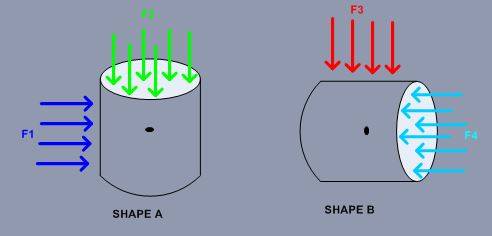
ALOADING.JPG


The black dot is meant to represent the centre of gravity.

From the two shapes shown can someone tell which forces are axial and why?

(I have assumed that gravity is acting downwards on both shapes)

Also on a side note are Axial forces and Normal Forces the same thing?

Thank you.
 
Engineering news on Phys.org
Where does it say that the axial load passes through the center of gravity? An axial load on a cylinder is simply a tension or compression force (distributed load as you have drawn it) on the end of the cylinder, parallel to the axis of the cylinder.
 
ttp://www.wikiengineer.com/Structural/Axial

"What is an Axial Force?
If the load on a column is applied through the center of gravity of its cross section, it is called an axial load."
 
tomtomtom1 said:
ttp://www.wikiengineer.com/Structural/Axial

"What is an Axial Force?
If the load on a column is applied through the center of gravity of its cross section, it is called an axial load."
This makes no sense to me, and, in my judgment, is inciorrect.
 
  • Like
Likes   Reactions: mfig
I agree with Chestermiller. I think a better definition is the following, from Structural and Stress Analysis by Megson:

"Axial loads are applied along the longitudinal or centroidal axis of a structural member."
 
Thank you all.
 

Similar threads

Replies
2
Views
2K
  • · Replies 7 ·
Replies
7
Views
6K
  • · Replies 2 ·
Replies
2
Views
2K
Replies
2
Views
2K
  • · Replies 5 ·
Replies
5
Views
2K
  • · Replies 1 ·
Replies
1
Views
2K
  • · Replies 2 ·
Replies
2
Views
1K
  • · Replies 5 ·
Replies
5
Views
2K
  • · Replies 9 ·
Replies
9
Views
2K
  • · Replies 4 ·
Replies
4
Views
3K