Understanding the concept of Axial Loading/Force

  • Thread starter Thread starter tomtomtom1
  • Start date Start date
  • Tags Tags
    Axial Concept
Click For Summary
SUMMARY

Axial loading refers to a load that is applied through the center of gravity of a structural member's cross-section, resulting in either compression or tension. It is essential to understand that an axial load on a cylinder is a force applied parallel to its axis, typically at the ends. The discussion clarifies that axial forces are indeed distinct from normal forces, with axial loads being specifically aligned along the longitudinal axis of a member, as defined in "Structural and Stress Analysis" by Megson. This precise understanding is crucial for accurate structural analysis and design.

PREREQUISITES
  • Understanding of basic structural mechanics
  • Familiarity with the concepts of tension and compression
  • Knowledge of the center of gravity in structural members
  • Basic principles of load distribution in engineering
NEXT STEPS
  • Study the principles of axial loading in structural engineering
  • Learn about the differences between axial forces and normal forces
  • Explore the application of axial loads in real-world structures
  • Review "Structural and Stress Analysis" by Megson for in-depth understanding
USEFUL FOR

Structural engineers, civil engineering students, and professionals involved in the design and analysis of load-bearing structures will benefit from this discussion.

tomtomtom1
Messages
160
Reaction score
8
TL;DR
Understanding the concept of Axial Loading/Force.
Hello all

I was wondering if some could help me understand the concept of Axial Loading/Force.

From research Axial loading can be defined as a load that passes through the centre of gravity of a members cross section, this causes either compression or tension.

The bit I don't fully understand is that if I applied a uniformly distributed load on a column then regardless of which orientation the column is places and which direction the load it applied the load will always pass through the columns centre of gravity as shown below:-
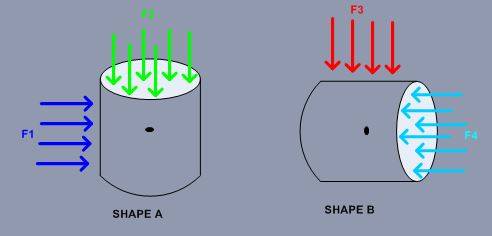
ALOADING.JPG


The black dot is meant to represent the centre of gravity.

From the two shapes shown can someone tell which forces are axial and why?

(I have assumed that gravity is acting downwards on both shapes)

Also on a side note are Axial forces and Normal Forces the same thing?

Thank you.
 
Engineering news on Phys.org
Where does it say that the axial load passes through the center of gravity? An axial load on a cylinder is simply a tension or compression force (distributed load as you have drawn it) on the end of the cylinder, parallel to the axis of the cylinder.
 
ttp://www.wikiengineer.com/Structural/Axial

"What is an Axial Force?
If the load on a column is applied through the center of gravity of its cross section, it is called an axial load."
 
tomtomtom1 said:
ttp://www.wikiengineer.com/Structural/Axial

"What is an Axial Force?
If the load on a column is applied through the center of gravity of its cross section, it is called an axial load."
This makes no sense to me, and, in my judgment, is inciorrect.
 
  • Like
Likes mfig
I agree with Chestermiller. I think a better definition is the following, from Structural and Stress Analysis by Megson:

"Axial loads are applied along the longitudinal or centroidal axis of a structural member."
 
Thank you all.
 
I have encountered a vertically oriented hydraulic cylinder that is designed to actuate and slice heavy cabling into sections with a blade. The cylinder is quite small (around 1.5 inches in diameter) and has an equally small stroke. The cylinder is single acting (i.e. it is pressurized from the bottom, and vented to atmosphere with a spring return, roughly 200lbs of force on the spring). The system operates at roughly 2500 psi. Interestingly, the cylinder has a pin that passes through its...

Similar threads

Replies
2
Views
2K
  • · Replies 7 ·
Replies
7
Views
6K
  • · Replies 2 ·
Replies
2
Views
2K
Replies
2
Views
1K
  • · Replies 5 ·
Replies
5
Views
2K
  • · Replies 1 ·
Replies
1
Views
1K
  • · Replies 2 ·
Replies
2
Views
1K
  • · Replies 5 ·
Replies
5
Views
2K
  • · Replies 9 ·
Replies
9
Views
2K
  • · Replies 4 ·
Replies
4
Views
3K