Understanding the Density Parameter in Cosmology: Matts Roos' Text Explanation

Click For Summary

Discussion Overview

The discussion revolves around the density parameter in cosmology as explained in Matts Roos' text. Participants are trying to understand specific mathematical steps and integrations related to equations in cosmology, particularly the transition between equations 1.35 and 1.36.

Discussion Character

  • Technical explanation
  • Mathematical reasoning
  • Debate/contested

Main Points Raised

  • One participant questions the origin of the term -a'^2(t0) in the integration process.
  • Another participant explains that it is a constant of integration, suggesting it is used for convenience in later calculations.
  • A different participant presents a definite integral approach to clarify the relationship between variables and equations.
  • Several participants express confusion about the progression from equations 1.35 to 1.36, indicating a lack of clarity in the algebraic steps involved.
  • One participant notes that the transition involves replacing terms with the density parameter relation, but questions the addition of a final +1 in equation 1.36.
  • Another participant connects the +1 to the constant of integration previously mentioned.

Areas of Agreement / Disagreement

Participants express varying levels of understanding regarding the mathematical transitions and integrations. There is no consensus on the clarity of the steps from 1.35 to 1.36, as multiple participants indicate confusion and seek further clarification.

Contextual Notes

Some discussions involve assumptions about definitions and the treatment of constants in integration, which may not be fully resolved within the thread.

robertjford80
Messages
388
Reaction score
0
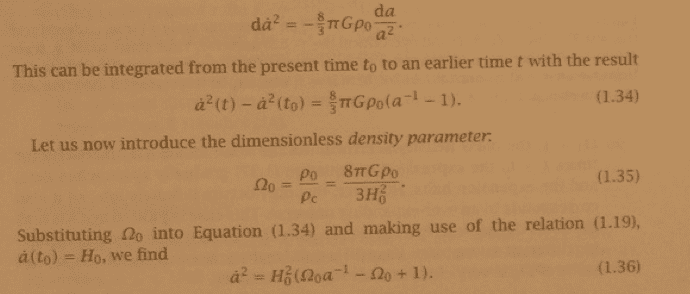
This is from Matts Roos' text on cosmology. I don't follow the final step and when he integrates I understand the first part of the left side, and the right side. But I don't see where -a'^2(t0) comes from
Screenshot2012-06-04at45600AM.png
 
Space news on Phys.org
It's a constant of integration. Since you can add an arbitrary constant and have the differential equation still work, instead of writing C, he writes the constant so that the numbers end up nice later.
 
Or you can view it as a definite integral with limits:
[tex]\int^t_{t_0}d(\dot a^2) = -{H_0}^2 \Omega_0\int^t_{t_0}\frac{da}{a^2}[/tex]

[tex]\dot a^2(t) - \dot a^2(t_0)={H_0}^2 \Omega_0(\frac{1}{a(t)}-\frac{1}{a(t_0)})[/tex]
[tex]\dot a^2(t) - {H_0}^2={H_0}^2 \Omega_0(\frac{1}{a(t)}-1)[/tex]
[tex]\dot a^2(t) ={H_0}^2( \frac{\Omega_0}{a(t)}-\Omega_0+1)[/tex]

Note that we define the current scale parameter a(t0) to be 1, and since the Hubble constant H is defined to be adot/a, that H(t0) = adot(t0)/a(t0) = adot(t0), since a(t0)=1.
 
Last edited:
i still don't understand the progression from 1.35 to 1.36
 
robertjford80 said:
i still don't understand the progression from 1.35 to 1.36

I edited my earlier post to add more detail. Does this clear it up?
 
i'm falling asleep so i'll look at it tomorrow
 
robertjford80 said:
i still don't understand the progression from 1.35 to 1.36

The progression from 1.35 to 1.36 is just algebra. Notice that if you take the leftmost side of 1.35, and the rightmost side of it, and you multiply them both by H02, then you end up with$$\Omega_0 H_0^2 = \frac{8\pi G}{3}\rho_0$$So, anywhere that you see ##8\pi G \rho_0 / 3## in 1.34, just replace it with ##\Omega_0 H_0^2##.
 
cepheid said:
The progression from 1.35 to 1.36 is just algebra. Notice that if you take the leftmost side of 1.35, and the rightmost side of it, and you multiply them both by H02, then you end up with$$\Omega_0 H_0^2 = \frac{8\pi G}{3}\rho_0$$So, anywhere that you see ##8\pi G \rho_0 / 3## in 1.34, just replace it with ##\Omega_0 H_0^2##.

If omega H20 = 8piGrho/3 then I don't see where the final +1 comes from in equation 1.36
 
robertjford80 said:
If omega H20 = 8piGrho/3 then I don't see where the final +1 comes from in equation 1.36

It comes from the very constant of integration that you were asking about before!

robertjford80's cosmology textbook said:
making use of the relation (1.19), ##\dot{a}(t_0) = H_0##, we find
 
  • #10
ok, thanks
 

Similar threads

  • · Replies 22 ·
Replies
22
Views
4K
  • · Replies 6 ·
Replies
6
Views
2K
  • · Replies 1 ·
Replies
1
Views
3K
  • · Replies 0 ·
Replies
0
Views
2K
  • · Replies 1 ·
Replies
1
Views
2K
  • · Replies 19 ·
Replies
19
Views
4K
  • · Replies 0 ·
Replies
0
Views
2K
  • · Replies 2 ·
Replies
2
Views
2K
  • · Replies 11 ·
Replies
11
Views
3K
  • · Replies 3 ·
Replies
3
Views
1K