Understanding the Derivation of the Quadratic Formula

Click For Summary
SUMMARY

The discussion centers on the derivation of the quadratic formula, specifically addressing the simplification steps involved. A participant, "sacred," seeks clarity on how to manipulate fractions and expand expressions to understand the derivation fully. Key contributions include the method of multiplying fractions by 4a to achieve a common denominator and the expansion of the perfect square (x + b/2a)². Additionally, the historical context of the quadratic formula's development is highlighted, tracing its origins back to Babylonian mathematics around 2000 BC.

PREREQUISITES
  • Understanding of basic algebraic manipulation
  • Familiarity with the concept of quadratic equations
  • Knowledge of perfect squares and their expansions
  • Basic fraction operations and finding common denominators
NEXT STEPS
  • Study the derivation of the quadratic formula in detail
  • Learn about the historical development of quadratic equations
  • Explore alternative methods for solving quadratic equations, such as completing the square
  • Practice algebraic simplification techniques with fractions and polynomials
USEFUL FOR

High school students, mathematics enthusiasts, educators teaching algebra, and anyone interested in the historical context and derivation of the quadratic formula.

sacred
Messages
4
Reaction score
0
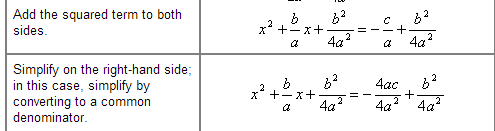
This could be seen as a rather "basic" math question, but it is a topic of curiosity for me. I'm currently a senior in high school, taking a pre-ap pre-cal/trig/AP-Calculus double blocked class. I'm absolutely fascinated by mathematics, and something of keen interest to me is the derivation of the quadratic formula. Not only do I wonder who originally derived it and how they did it, but I want to completely understand it. (Again, I can see how some people would laugh at this, because it's not that hard to understand) However, there is one part that completely blows my mind:
596WQ.png

597mw.png


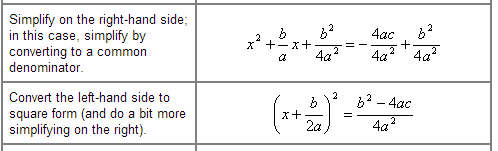
How exactly does this simplify? I've sat here staring at it, attempting to conceptualize it so I can continue... but I just can't. I don't understand it. Would someone care to explain?

Thank you,


sacred


edit: reading some other threads on this board... I feel like a complete idiot... bare with me
edit2: I can understand the right side, but not the left.
 

Attachments

  • 597mw.png
    597mw.png
    3.5 KB · Views: 445
  • 596WQ.png
    596WQ.png
    2.8 KB · Views: 483
Last edited:
Physics news on Phys.org
sacred said:
This could be seen as a rather "basic" math question, but it is a topic of curiosity for me. I'm currently a senior in high school, taking a pre-ap pre-cal/trig/AP-Calculus double blocked class. I'm absolutely fascinated by mathematics, and something of keen interest to me is the derivation of the quadratic formula. Not only do I wonder who originally derived it and how they did it, but I want to completely understand it. (Again, I can see how some people would laugh at this, because it's not that hard to understand) However, there is one part that completely blows my mind:


596WQ.png


How exactly does this simplify? I've sat here staring at it, attempting to conceptualize it so I can continue... but I just can't. I don't understand it. Would someone care to explain?

Thank you,

sacred

In the fraction ##-\frac c a## multiply the numerator and denominator by ##4a##. That makes the two fractions on the right have the same denominator so they can be added.
 

Attachments

  • 596WQ.png
    596WQ.png
    2.8 KB · Views: 455
LCKurtz said:
In the fraction ##-\frac c a## multiply the numerator and denominator by ##4a##. That makes the two fractions on the right have the same denominator so they can be added.

Thank you. :smile: What about the simplification of the otherside?

597mw.png
 

Attachments

  • 597mw.png
    597mw.png
    3.5 KB · Views: 438
Do you mean the lhs? It's a perfect square. Expand it.
 
sacred said:
Thank you. :smile: What about the simplification of the otherside?

597mw.png

Just square out ##\left(x+\frac b {2a}\right)^2## to see it agrees with the previous form.
 

Attachments

  • 597mw.png
    597mw.png
    3.5 KB · Views: 462
LCKurtz said:
Just square out ##\left(x+\frac b {2a}\right)^2## to see it agrees with the previous form.

I did this.

I don't understand how (b/2a)x + (b/2a)x simplifies to just bx/a
 
##\frac{b}{2a}x + \frac{b}{2a}x = \frac{1}{2}\frac{bx}{a} + \frac12\frac{bx}{a}##
 
pwsnafu said:
##\frac{b}{2a}x + \frac{b}{2a}x = \frac{1}{2}\frac{bx}{a} + \frac12\frac{bx}{a} = \frac{bx}{a}##

Fantastic. Thank you.
 
there is another method developed by sridhara(870-930)
ax2+bx+c=0
multiply both side by 4a
4a2x2+4abx+4ac=0
transposing 4ac
4a2x2+4abx=-4ac
add b2 to both sides
4a2x2+4abx+b2=-4ac+b2
then
(2ax+b)2=b2-4ac
2ax+b=√b2-4ac
2ax=-b(plus or minus)√(b2-4ac)
x=(-b(plus or minus)√(b2-4ac))/2a

i don't know why this is not taught in most schools,not having too many fractions this is more easier to understand since you don't take LCM
 
  • #10
The solution of quadratic equations can be traced as far back as 2000 BC in Babylonian mathematics and has developed apparently independently in several other parts of the world at much later dates.

http://en.wikipedia.org/wiki/Quadratic_equation
 

Similar threads

  • · Replies 3 ·
Replies
3
Views
4K
Replies
1
Views
10K
  • · Replies 6 ·
Replies
6
Views
4K
  • · Replies 2 ·
Replies
2
Views
3K
  • · Replies 13 ·
Replies
13
Views
3K
  • · Replies 7 ·
Replies
7
Views
3K
  • · Replies 12 ·
Replies
12
Views
3K
  • · Replies 1 ·
Replies
1
Views
2K
  • · Replies 45 ·
2
Replies
45
Views
53K