Understanding the Equation of Motion for Simple Harmonic Motion

Click For Summary

Homework Help Overview

The discussion revolves around understanding the equation of motion for one-dimensional simple harmonic motion, specifically focusing on the derivation and interpretation of the associated differential equation. Participants are exploring concepts related to Newton's second law and Hooke's law.

Discussion Character

  • Exploratory, Conceptual clarification, Mathematical reasoning

Approaches and Questions Raised

  • Participants are questioning the derivation of the equation of motion and the meaning of terms within it. There are inquiries about the relationship between angular frequency and the parameters of the system, as well as requests for clarification on the notation used in the equations.

Discussion Status

The discussion is active, with participants seeking clarification on specific aspects of the equation and its derivation. Some guidance has been offered regarding substituting functions into the differential equation, but there is no explicit consensus on the understanding of the concepts yet.

Contextual Notes

Participants are working within the constraints of homework rules, which may limit the depth of assistance they can provide to one another. There are indications of confusion regarding the mathematical relationships and notational conventions used in the equations.

ZARATHUSTRA
Messages
42
Reaction score
0
Member warned about posting without the template and with no effort
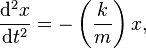
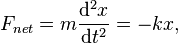
For one-dimensional simple harmonic motion, the equation of motion, which is a second-order linear ordinary differential equation with constant coefficients, could be obtained by means of Newton's second law and Hooke's law
6fedda8728eaf5ffe792a33a178a50ed.png
and
dc96864788dee12cac5cd92c0d799532.png
i don't get this part
6d939d356c64eb78a89eab7090f86ab9.png
which [PLAIN]http://upload.wikimedia.org/math/6/5/6/656fd81e91b7ad38db0c1f263dd5f4af.png[/B]

so can somebody explain it to me? Thank you
 
Last edited by a moderator:
Physics news on Phys.org
What don't you get?
 
The first part is the solution to the differential equation.
The second part is a recast of the solution with one function (cosine).
If you let ##\frac{c_2}{c_1}=\tan \phi## this is the angle sum identity for cosine.
 
6d939d356c64eb78a89eab7090f86ab9.png
why? why "w'' = the square root of 'k' divided by 'm' i don't get this equation
 
Try plugging ##x(t) = A\cos(\omega t-\varphi)## into the differential equation.
 
vela said:
Try plugging ##x(t) = A\cos(\omega t-\varphi)## into the differential equation.
how do they people get this equation?
6d939d356c64eb78a89eab7090f86ab9.png
, where does it come from? can you show me process of deducting this formula? THANKS!
 
Did you try plugging x(t) into the differential equation?
 
It is simply a notational convenience. You could continue to use sqrt(k/m) everywhere but that gets messy.
 

Similar threads

Replies
16
Views
2K
  • · Replies 11 ·
Replies
11
Views
2K
  • · Replies 13 ·
Replies
13
Views
2K
  • · Replies 2 ·
Replies
2
Views
2K
  • · Replies 13 ·
Replies
13
Views
1K
  • · Replies 8 ·
Replies
8
Views
2K
  • · Replies 1 ·
Replies
1
Views
2K
  • · Replies 10 ·
Replies
10
Views
3K
  • · Replies 14 ·
Replies
14
Views
2K
  • · Replies 3 ·
Replies
3
Views
3K