Understanding the Forces Behind Part B of the Graph

Click For Summary

Homework Help Overview

The discussion revolves around understanding the forces acting on a block connected to a spring, particularly focusing on the dynamics described in part B of a graph. The participants explore concepts related to friction, spring extension, and motion dynamics, questioning the relationship between velocity, acceleration, and the forces at play.

Discussion Character

  • Exploratory, Conceptual clarification, Problem interpretation, Assumption checking

Approaches and Questions Raised

  • Participants discuss the transition from static to kinetic friction and the implications for the block's motion. Questions arise regarding the conditions under which the block slows to zero velocity and the role of spring compression in this process. Some participants also explore the symmetry of the motion and its relation to the forces involved.

Discussion Status

The discussion is active, with participants providing insights and raising questions about the mechanics involved. There is an exploration of different interpretations regarding the relationship between spring compression and the forces acting on the block, as well as the nature of the motion being described. Some participants have simulated the scenario to better understand the dynamics, noting discrepancies in expected behavior.

Contextual Notes

Participants are navigating the complexities of the problem, including the effects of friction and the behavior of the spring. There are mentions of specific values and conditions that may influence the discussion, such as the coefficients of friction and the setup of the simulation used for analysis.

phantomvommand
Messages
287
Reaction score
39
Homework Statement
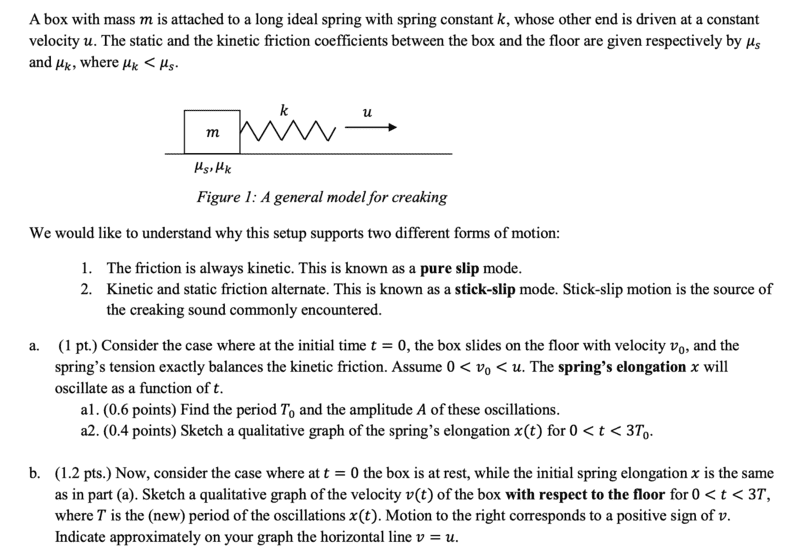
Please see the attached photo
**I am only asking about the answer to part B, but please reading through part a may give some some context/familiarity.**
Relevant Equations
No equations required, but understanding SHM and Forces is important
I am only asking about the answer to part B, but reading through part A may give some some context/familiarity.
Screenshot 2021-05-13 at 2.42.27 AM.png

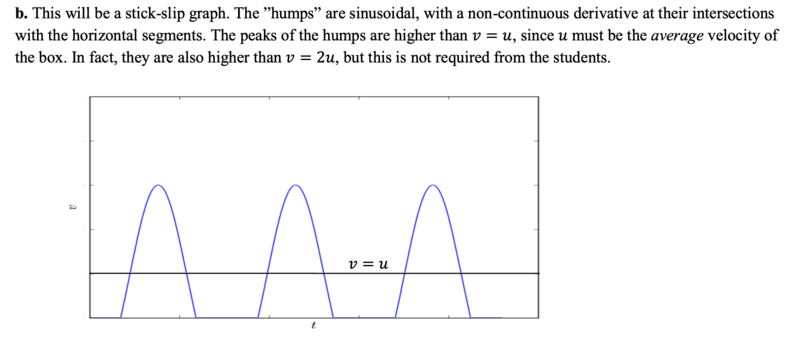
Below is the answer to part B:

Screenshot 2021-05-13 at 2.44.33 AM.png


I largely understand the graph except for 1 part. My understanding is as such:
At first, ##x = \frac {\mu_k m g } {k}##. Force exerted by the extending spring is not enough to overcome the static friction.
Ater some time, force exerted is enough to overcome the static friction, resulting in velocity increasing.
However, the spring is still extending, because velocity of pulling > velocity of block.
When ##v = u##, maximum extension has been reached, maximum rightwards force on block.
At ##v = V_{max}##, ##\mu_k mg = kx##. After which, the net force on the block slows it down.
At ##v = u## again, the block has been slowed to speed ##u##, at which point no further compression can occur. (ie max compression)
Block is now pushed leftwards and slows down.

My question:
Why must the block slow down to speed 0, at which point static friction stops it from moving anymore? The point this occurs is when the spring is still compressed.
I am hoping to get a physical explanation of why the forces on the block slow it down to 0 velocity when the spring's compression ##= \frac {\mu_s m g } {k}##. I do not find the "symmetrical graph" argument convincing enough.
 
  • Like
Likes   Reactions: Delta2
Physics news on Phys.org
phantomvommand said:
I do not find the "symmetrical graph" argument convincing enough.
While it is slipping, the equation of motion is that of SHM. Given that the velocity is zero at some point, it must become zero again.
 
phantomvommand said:
I am hoping to get a physical explanation of why the forces on the block slow it down to 0 velocity when the spring's compression =μsmg/k.
I believe this should read μkmg/k...

While the block is moving, the kinetic friction is in play and produces the force to be overcome. Once kx is smaller than μkmg, the block should stop. The static friction is generally higher than kinetic friction.
 
onatirec said:
I believe this should read μkmg/k...

While the block is moving, the kinetic friction is in play and produces the force to be overcome. Once kx is smaller than μkmg, the block should stop. The static friction is generally higher than kinetic friction.
The block started slipping when the tension was μsmg/k. The symmetry argument says that the velocity will drop to zero when the compression equals that value.
 
Ah, like the extremum of the oscillation
 
haruspex said:
While it is slipping, the equation of motion is that of SHM. Given that the velocity is zero at some point, it must become zero again.
Is it really SHM? Isn’t there friction, which means acceleration is not directly proportional to displacement?
 
phantomvommand said:
Is it really SHM? Isn’t there friction, which means acceleration is not directly proportional to displacement?
While sliding in a particular direction, friction is constant. This is the same situation as a mass hanging on an elastic string, where there is the constant force of gravity. It displaces the equilibrium position, but it is still SHM.
The difference, of course, is that friction does eventually change, so the equilibrium point shifts.
 
  • Like
Likes   Reactions: phantomvommand
haruspex said:
While sliding in a particular direction, friction is constant. This is the same situation as a mass hanging on an elastic string, where there is the constant force of gravity. It displaces the equilibrium position, but it is still SHM.
The difference, of course, is that friction does eventually change, so the equilibrium point shifts.
Would I be correct to say that when it reaches 0 velocity again, the compression, instead of extension, of the spring is ##\frac {\mu_s mg} {k}##? If we take the “symmetry” argument, it should be ##\frac {\mu_s mg} {k}## away from ##\frac {\mu_k mg} {k}##
 
phantomvommand said:
Would I be correct to say that when it reaches 0 velocity again, the compression, instead of extension, of the spring is ##\frac {\mu_s mg} {k}##? If we take the “symmetry” argument, it should be ##\frac {\mu_s mg} {k}## away from ##\frac {\mu_k mg} {k}##
Sorry for the delay.
I remained a bit bothered by this question so I simulated it, and it took a bit of effort to get the formulae right.
1620966683877.png

In the graph, the blue is the extension, measured positive in the direction of the pulling force, so tension is negative. Red is ##\dot x## and yellow is ##\ddot x##.
So at the start, the blue line is straight and acceleration zero until there's enough tension to overcome static friction. The acceleration jumps up because friction immediately reduces to the kinetic value.
Note that the horizontal sections of the red line (i.e. where it sticks) are well below the half way. This is rather different from the chart in post #1. I think it makes sense: the velocity must take a little while to catch up to the puller's velocity, and acceleration will continue to increase for that time.

But what intrigues me is that the curves are not quite symmetric. If you look carefully you will see that for the acceleration the jumps up from zero (e.g. t=1) are a bit smaller than the jumps up to zero (e.g. t=6.4).
Correspondingly, the velocity curve rises more slowly from zero than it later falls to zero.
I have no explanation for this yet. At first I thought it must be rounding error in the spreadsheet steps, but no matter how small I made the time steps it persisted.
Time to get back to the algebra.
 
Last edited:
  • Like
Likes   Reactions: Delta2 and phantomvommand
  • #10
haruspex said:
Sorry for the delay.
I remained a bit bothered by this question so I simulated it, and it took a bit of effort to get the formulae right.
View attachment 283021
In the graph, the blue is the extension, measured positive in the direction of the pulling force, so tension is negative. Red is ##\dot x## and yellow is ##\ddot x##.
So at the start, the blue line is straight and acceleration zero until there's enough tension to overcome static friction. The acceleration jumps up because friction immediately reduces to the kinetic value.
Note that the horizontal sections of the red line (i.e. where it sticks) are well below the half way. This is rather different from the chart in post #1. I think it makes sense: the velocity must take a little while to catch up to the puller's velocity, and acceleration will remain positive for that time.

But what intrigues me is that the curves are not quite symmetric. If you look carefully you will see that for the acceleration the jumps up from zero (e.g. t=1) are a bit smaller than the jumps up to zero (e.g. t=6.4).
Correspondingly, the velocity curve rises more slowly from zero than it later falls to zero.
I have no explanation for this yet. At first I thought it must be rounding error in the spreadsheet steps, but no matter how small I made the time steps it persisted.
Time to get back to the algebra.
This has been extremely helpful! Thanks so much. The velocity graph you’ve derived also resolves another issue I had with the answer key’s graph; the gradient (acceleration) is not maximum when v = u.
 
  • #11
phantomvommand said:
This has been extremely helpful! Thanks so much. The velocity graph you’ve derived also resolves another issue I had with the answer key’s graph; the gradient (acceleration) is not maximum when v = u.
I didn't say how I had the constants set. In that chart I had u=0.5, which is the value of v at max acceleration.
 
  • Like
Likes   Reactions: hutchphd and phantomvommand

Similar threads

  • · Replies 7 ·
Replies
7
Views
2K
  • · Replies 3 ·
Replies
3
Views
4K
Replies
2
Views
1K
  • · Replies 16 ·
Replies
16
Views
3K
  • · Replies 1 ·
Replies
1
Views
3K
  • · Replies 8 ·
Replies
8
Views
2K
Replies
7
Views
3K
Replies
6
Views
1K
  • · Replies 4 ·
Replies
4
Views
2K
  • · Replies 10 ·
Replies
10
Views
6K