phantomvommand
- 287
- 39
Thread moved from the technical forums, so no Homework Template is shown.
Summary:: I have come across a situation where I seem to get different equations of motion for an oscillating system. Please do help me find out where I went wrong.
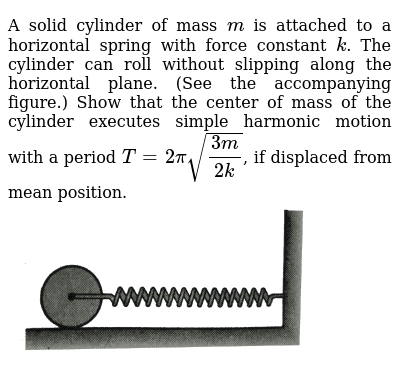
*I am not asking how to solve the problem*
I am going to consider 4 parts of the cylinder's motion, as listed below. (There is friction, denoted by f, between the cylinder and the floor.)
1. Displacement left of equilibrium, velocity towards the left
2. Displacement left, moving right
3. Displacement right, moving right
4. Displacement right, moving left
Case 1:
mx'' = -kx - f, where leftwards is taken as positive. kx is a rightwards force when displacement is leftwards, moving left implies friction is to the right.
Case 2:
mx'' = -kx + f, leftwards is positive. I have flipped the sign of friction here, because it is moving right, so friction is to the left.
Case 3:
mx'' = -kx - f, rightwards is positive.
Case 4:
mx'' = -kx + f, rightwards is positive. This is similar to Case 2, so friction is now positive too.
There are 2 different equations of motion, why are they ultimately the same?
*I am not asking how to solve the problem*
I am going to consider 4 parts of the cylinder's motion, as listed below. (There is friction, denoted by f, between the cylinder and the floor.)
1. Displacement left of equilibrium, velocity towards the left
2. Displacement left, moving right
3. Displacement right, moving right
4. Displacement right, moving left
Case 1:
mx'' = -kx - f, where leftwards is taken as positive. kx is a rightwards force when displacement is leftwards, moving left implies friction is to the right.
Case 2:
mx'' = -kx + f, leftwards is positive. I have flipped the sign of friction here, because it is moving right, so friction is to the left.
Case 3:
mx'' = -kx - f, rightwards is positive.
Case 4:
mx'' = -kx + f, rightwards is positive. This is similar to Case 2, so friction is now positive too.
There are 2 different equations of motion, why are they ultimately the same?