Understanding the LM2576 Step-Down Regulator

  • Thread starter Thread starter mulothecook
  • Start date Start date
  • Tags Tags
    Regulator
Click For Summary
SUMMARY

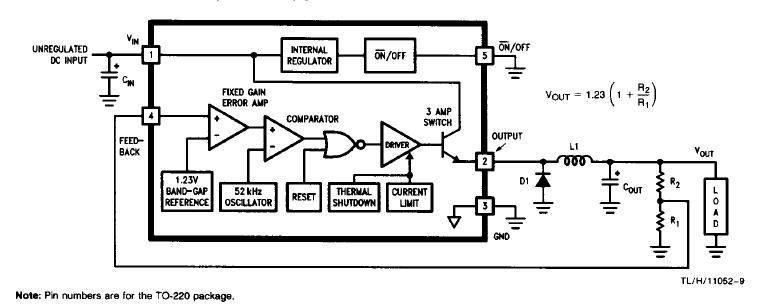
The LM2576 step-down regulator is an efficient solution for converting 15V DC to 5V DC, featuring a built-in current limit. The device operates by using a feedback mechanism where the output voltage is reduced by a voltage divider (R1&R2) to approximately 1.23V, which is then amplified by a fixed gain error amplifier. The comparator compares this error voltage with a 52kHz triangle wave oscillator, adjusting the duty cycle to maintain the desired output voltage. This switching mechanism ensures stable output by controlling the inductor current based on the error voltage.

PREREQUISITES
  • Understanding of basic electronics principles, particularly switch-mode power supplies.
  • Familiarity with feedback control systems and error amplification.
  • Knowledge of voltage divider circuits and their applications.
  • Experience with reading and interpreting electronic component datasheets.
NEXT STEPS
  • Study the LM2576 datasheet for detailed specifications and application circuits.
  • Learn about the principles of switch-mode power supply design.
  • Explore the application note referenced in the discussion for practical waveforms and examples.
  • Investigate other step-down regulators for comparative analysis, such as the LM2596.
USEFUL FOR

Electronics enthusiasts, electrical engineers, and hobbyists working on power supply projects who seek to understand the operation and application of the LM2576 step-down regulator.

mulothecook
Messages
6
Reaction score
0
Hi,

I am working on a little electronics project where I need to convert 15V DC to 5V DC. I was hinted at the LM2576 (datasheet) because it is easy to use and has a built in current limit which is just what I need.

The functional block diagram (p12) has a nice display of the internals of the regulator:
201291213024302.jpg


I am aware of the basic principle underlying the switch regulator, however I do not understand the way the parts do interact (amp, comparator and reset). Could you briefly explain to me the principle of operation of this particular device with respect to the instances shown in the block diagram? I am trying to get some working knowledge in practical electronics and every insight by an electrical engineer would be a big help to me.
Thank you.
 
Engineering news on Phys.org
Welcome to PF. Sorry about the delayed answer.
The output voltage to the “Load” is fed back to pin 4 where it is reduced by the R1&R2 voltage divider to about 1.23V. The “Fixed Gain Error Amplifier” amplifies the difference voltage between attenuated load voltage and 1.23V reference. The “comparator” then compares the error voltage with the voltage of the “52kHz (triangle wave) Oscillator”. The comparator digital output switches at 52kHz but the duty cycle changes according to the error voltage. From there on the signal is digital with fast switching edges through to the output switch transistor.
If the error voltage is low then the driver turns on for a greater proportion of the cycle, which increases the L1 inductor current and so maintains output load voltage.

Is that the sort of answer you wanted ?

Edit: take a look at the waveforms in this application note.
http://cds.linear.com/docs/en/application-note/an35f.pdf
 
Last edited:
  • Like
Likes   Reactions: mulothecook

Similar threads

  • · Replies 34 ·
2
Replies
34
Views
10K
  • · Replies 7 ·
Replies
7
Views
5K
  • · Replies 2 ·
Replies
2
Views
3K
  • · Replies 3 ·
Replies
3
Views
3K
Replies
6
Views
4K
Replies
4
Views
3K
  • · Replies 6 ·
Replies
6
Views
2K
  • · Replies 7 ·
Replies
7
Views
2K
  • · Replies 5 ·
Replies
5
Views
3K
  • · Replies 26 ·
Replies
26
Views
4K