nobahar
- 482
- 2
Hello!
I have a question regarding the normal force. From what I have read, it is a force in repsonse to compression of the atom/molecules in an object. So that the molecules are forced closed togeather by a force, and, due to Newton's third law, there is a 'reaction' force. I can understand this for forces applied perpendicular to the surface of the object: the normal force will then also be perpendicular and in the opposite direction.
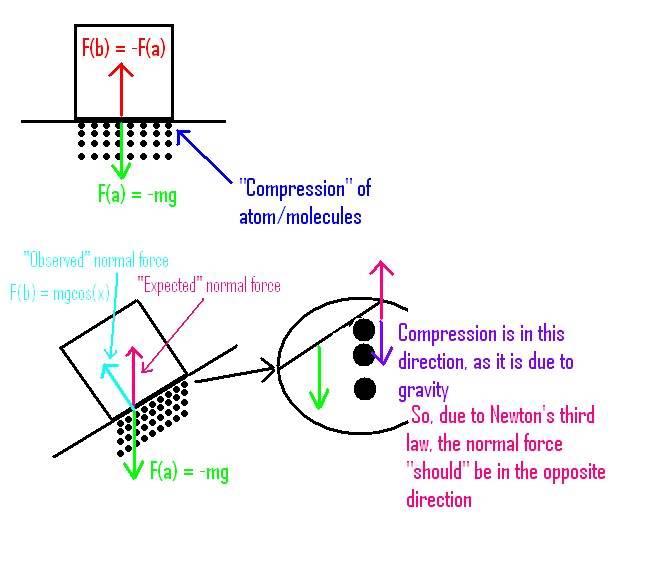
Now (I guess that you can see where this is going), when an object lies on a tilted surface, the normal force is perpendicular to the surface. I have clearly misunderstood what the normal force is or I have interpreted the compression incorrectly, as to me this would contradict the third law. Since the compression is due to gravity, would not the atoms/molecules be compressed in the direction of the force due to gravity, and therefore exert an equal and opposite force? Instead, the normal force is described by the equation -1*m*a*cos(x). I have included a rather pretty picture for your enjoyment, and because my description is probably quite poor.
I have a question regarding the normal force. From what I have read, it is a force in repsonse to compression of the atom/molecules in an object. So that the molecules are forced closed togeather by a force, and, due to Newton's third law, there is a 'reaction' force. I can understand this for forces applied perpendicular to the surface of the object: the normal force will then also be perpendicular and in the opposite direction.
Now (I guess that you can see where this is going), when an object lies on a tilted surface, the normal force is perpendicular to the surface. I have clearly misunderstood what the normal force is or I have interpreted the compression incorrectly, as to me this would contradict the third law. Since the compression is due to gravity, would not the atoms/molecules be compressed in the direction of the force due to gravity, and therefore exert an equal and opposite force? Instead, the normal force is described by the equation -1*m*a*cos(x). I have included a rather pretty picture for your enjoyment, and because my description is probably quite poor.