Discussion Overview
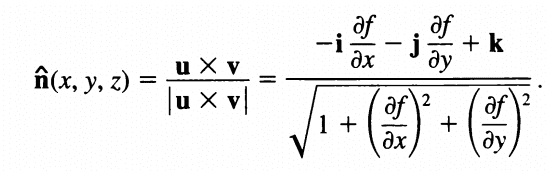
The discussion revolves around the concept of the unit normal vector of a surface, specifically addressing the ambiguity of whether a given normal vector points inward or outward. Participants explore the definitions and implications of these orientations in various contexts, including mathematical and physical applications.
Discussion Character
- Debate/contested
- Technical explanation
- Conceptual clarification
Main Points Raised
- Some participants assert that both proposed unit normal vectors are valid, emphasizing that the definitions of "inward" and "outward" depend on the context of a closed region.
- It is noted that the concepts of inward and outward normals cannot be defined locally without reference to a larger context.
- One participant questions whether there is an easy method to determine the orientation of the normal vectors.
- Another participant explains that the expressions for the normal vector are determined up to a sign, which indicates the direction (inward or outward) of the normal vector.
- It is mentioned that if two tangent vectors are swapped, the sign of the normal vector changes, affecting its orientation.
- A participant introduces the idea that a continuous normal vector field that is strictly inward or outward exists only for orientable surfaces, using the Mobius Strip as an example of a non-orientable surface where the normal vector must change discontinuously.
Areas of Agreement / Disagreement
Participants do not reach a consensus on which unit normal vector is correct, as multiple competing views regarding the definitions and implications of inward and outward normals remain present throughout the discussion.
Contextual Notes
The discussion highlights the dependence of normal vector orientation on the context of the surface and the surrounding region, as well as the implications of surface orientability on the existence of continuous normal vector fields.