Understanding the Point Of Action of a Force

  • Thread starter Thread starter tomtomtom1
  • Start date Start date
  • Tags Tags
    Force Point
Click For Summary
The discussion focuses on determining the Point of Action of a force on a rectangular wall holding back water. It emphasizes the importance of understanding the relationship between the centroid of the wall and the centroid of the pressure exerted by the water. A sketch of the pressure versus depth is recommended to visualize the problem and identify the centroid of the pressure distribution. The equation y' = 2/3 * Y is mentioned, with clarification needed on its derivation and meaning. Understanding the concept of centroids in relation to forces acting on the wall is crucial for solving the problem effectively.
tomtomtom1
Messages
160
Reaction score
8
TL;DR
Understanding Point Of Action Of A Force

y' = 2/3 * Y
Hello all

I was hoping some could help shed light on the idea of a Point Of Action of a force.

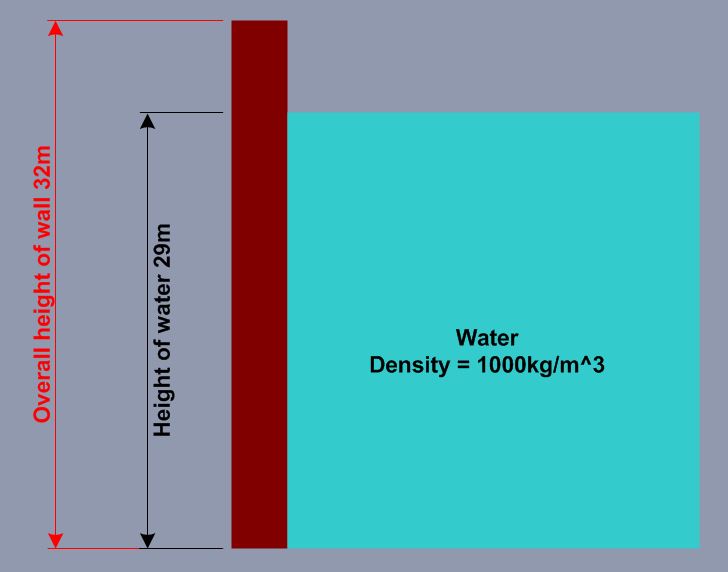
I have a rectangular wall of 32m which is holding back water, the water is at a height of 29m.

Where is the point of action of the force?

The problem is illustrated below:-
poa force.JPG
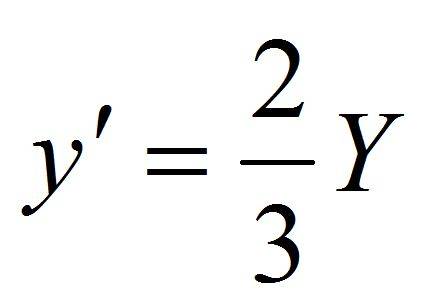
I have been told that to find the point of action of the force for a rectangular wall I need to use the following equation:-
paa2.JPG
I need some help applying this because it does not make a lot a sense to me.

From research and help from the community about other questions, I feel that the point of action should be related to the centroid, but I am struggling to put all the pieces together.

Can anyone help?

Thank you.
 
Engineering news on Phys.org
A good way to understand this is to sketch the water pressure vs depth. It helps to put the pressure vs depth sketch on the wall. The centroid of the pressure vs depth sketch is the height of the point of action of the total force.

When working on problems like this, it is a good idea to make a simple sketch of everything you know before looking for an equation. Many times, a good sketch will make the solution obvious, or at least less confusing.
 
jrmichler said:
A good way to understand this is to sketch the water pressure vs depth. It helps to put the pressure vs depth sketch on the wall. The centroid of the pressure vs depth sketch is the height of the point of action of the total force.

When working on problems like this, it is a good idea to make a simple sketch of everything you know before looking for an equation. Many times, a good sketch will make the solution obvious, or at least less confusing.

I manage to find the pressure at any point on the wall and was able to find the centroid of the wall itself, this is what I have:-

k1.JPG


Still not sure how the equation y' = 2/3 * Y comes from.

I am assuming that y' is the distance from the bottom of the surface of the water to the point of action or y' is from the water surface down to the point of action.

That's all I have.
 
There are two centroids, the centroid of the wall itself, and the centroid of the pressure against the wall. Note 2 in the diagram refers to the centroid of the wall itself. It has nothing to do with the centroid of the pressure against the wall.

Imagine that the wall is mounted to a movable hinge. If the hinge is at the top of the wall, the water pressure will swing the bottom of the wall outward. If the hinge is at the bottom of the wall, the water pressure will swing the top of the wall outward. If the hinge is at the centroid of the pressure, the wall will stay in position. Knowing that, and without any math, can you mark the approximate centroid of the pressure? Then, and only then, are you ready to find or derive the equation for the exact location of the centroid of pressure.
 
  • Informative
Likes anorlunda
What mathematics software should engineering students use? Is it correct that much of the engineering industry relies on MATLAB, making it the tool many graduates will encounter in professional settings? How does SageMath compare? It is a free package that supports both numerical and symbolic computation and can be installed on various platforms. Could it become more widely used because it is freely available? I am an academic who has taught engineering mathematics, and taught the...

Similar threads

Replies
4
Views
3K
  • · Replies 8 ·
Replies
8
Views
5K
  • · Replies 6 ·
Replies
6
Views
3K
  • · Replies 7 ·
Replies
7
Views
3K
  • · Replies 9 ·
Replies
9
Views
3K
Replies
13
Views
3K
  • · Replies 9 ·
Replies
9
Views
18K
  • · Replies 26 ·
Replies
26
Views
856
Replies
10
Views
3K
  • · Replies 9 ·
Replies
9
Views
3K