Understanding the Product Rule: Common Factor Simplification Confusion Explained

Click For Summary
SUMMARY

The discussion centers on the application of the Product Rule in algebra, specifically regarding the simplification of expressions involving common factors. The user questions why one instance of the common factor, x²(x+1), disappears from the numerator after simplification. The confusion arises from the application of the rule where both sides of an equation are multiplied by the common factor, leading to the cancellation of terms. The resolution lies in understanding that only one instance of the common factor is necessary for simplification, which is a standard practice in algebraic manipulation.

PREREQUISITES
  • Understanding of algebraic expressions and equations
  • Familiarity with the Product Rule in calculus
  • Knowledge of common factor simplification techniques
  • Basic skills in manipulating fractions and rational expressions
NEXT STEPS
  • Study the Product Rule in calculus for deeper insights
  • Practice simplifying algebraic fractions with common factors
  • Explore examples of algebraic manipulation involving rational expressions
  • Learn about the concept of cancellation in algebraic equations
USEFUL FOR

Students learning algebra, educators teaching mathematical concepts, and anyone seeking to clarify their understanding of the Product Rule and simplification techniques in algebra.

fitz_calc
Messages
41
Reaction score
0
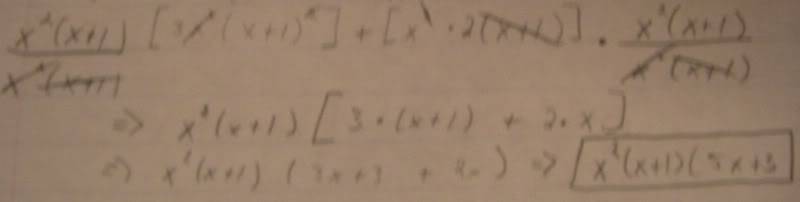
I've already done the problem (here is the last part, sorry for crappy pic)
Picture002.jpg


My question; if I multiply both sides of the + by x^2(x+1) / x^2(x+1) as the common factor to simplify the equation, then why does on of the x^2(x+1) disappear from the numerator in the final answer? It appears as though both denominators were used to simplify both sides of the +, yet only one numerator was used in the final calculation. Please tell me I'm not going crazy!
 
Physics news on Phys.org
Because the two terms in []'s on the first line are combined into a single [] on the second line.
 

Similar threads

  • · Replies 4 ·
Replies
4
Views
2K
  • · Replies 18 ·
Replies
18
Views
2K
  • · Replies 14 ·
Replies
14
Views
2K
Replies
6
Views
3K
Replies
2
Views
2K
  • · Replies 3 ·
Replies
3
Views
2K
  • · Replies 1 ·
Replies
1
Views
2K
Replies
3
Views
2K
  • · Replies 9 ·
Replies
9
Views
3K
Replies
3
Views
2K