Understanding Transistor Models

Click For Summary

Discussion Overview

The discussion revolves around understanding transistor models, specifically the common emitter and common collector configurations. Participants explore the equations related to input and output impedances, as well as the role of various components in these models.

Discussion Character

  • Exploratory
  • Technical explanation
  • Conceptual clarification
  • Homework-related

Main Points Raised

  • One participant questions why the emitter resistance (Re) is multiplied by Beta in the common emitter model and why other resistances like ro, Rc, or Rload are not considered.
  • Another participant explains that the current through Re is Ic, which can be expressed in terms of Ib and Beta, leading to a specific equation for input voltage (Vb).
  • This participant also notes that the gain of the amplifier does not depend on Beta but rather on the combination of Rc and Rload with Re.
  • In the common collector model, the same reasoning about Ic and Ib applies, but all output resistors must be considered due to the absence of a current source.
  • A later reply clarifies the definitions of Zin and Zout in the context of a 4-terminal network, indicating the conceptual boundary for input and output impedances.
  • Several participants express gratitude for the clarifications provided, indicating that the discussion has been helpful.
  • A new participant introduces themselves and seeks assistance with transistor topics, indicating a desire for further help.

Areas of Agreement / Disagreement

Participants generally agree on the definitions of input and output impedances and the role of Beta in the equations, but there are nuances in how different components are treated in the models. The discussion remains open with varying levels of understanding and additional questions from newer participants.

Contextual Notes

Some assumptions about the circuit configurations and the significance of certain components may not be fully articulated, leading to potential gaps in understanding for those less familiar with circuit theory.

Who May Find This Useful

Students and individuals seeking to deepen their understanding of transistor models and circuit theory, particularly in relation to input and output impedances.

Number2Pencil
Messages
204
Reaction score
1
This is more of a "help me understand" than "help me find the answer" problem. forgive me for not using the template.

this is the "little r-e" model, similar to the hybrid model
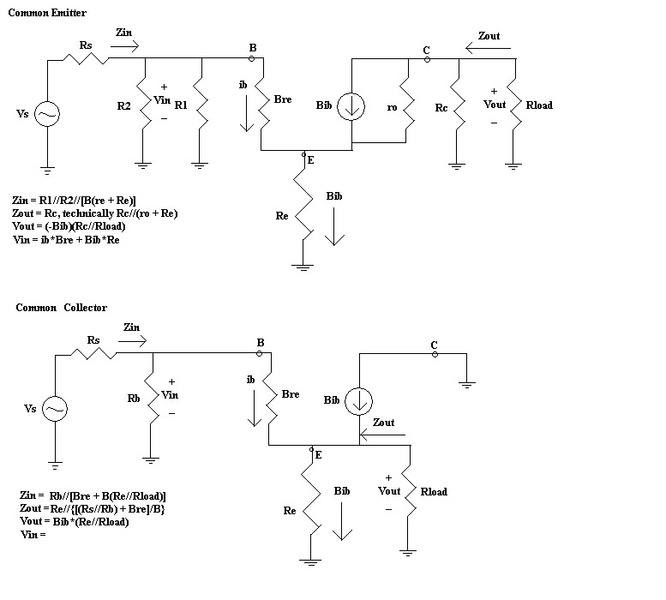
transistorremodel.jpg


I'm having a bit of trouble understanding how my professor got the equations for these two examples.

\\\\\\\\\\\\\\\\\\\\\\\\\\\\\
Common Emitter:
/////////////////////////////

Zin: why does Re get multiplied by Beta?
Why does he not consider ro, Rc, or Rload?

Zout: Why does he not consider Bre, R1, R2, or Rs?

\\\\\\\\\\\\\\\\\\\\\\\\\\\\\
Common Collector:
/////////////////////////////

Zin: once again, Beta being multiplied by what is connected to the emitter?

Zout: now he DOES consider all the resistors on the left, AND divides it by Beta.


\\\\\\\\\\\\\\\\\\\\\\\\\\\\\
attempt
/////////////////////////////

I think I can see why Re is being multiplied by Beta in the common emitter. The current going through Bre is ib and the current going through Re is Bib, so apparently there needs to be a multiplying factor of Beta to make up for it...for what reason, I have no clue.
 
Last edited:
Physics news on Phys.org
Common Emitter:

-Why does Re get multiplied by beta:

The answer is simple, what current goes through Re ? Ic, right? So Ic can be expressed as Ic = \beta\cdot I_{b}
So you'll get something like this:

V_{b} = I_{b}\cdot \beta r{e} + I_{c}\cdot R_{e}

substituting I_{c} = \beta I_{b} gives:

V_{b} = I_{b}\cdot \beta r{e} + \beta \cdot I_{b}\cdot R_{e}

If you go a little be further, you can easily show that the gain of the amplifier doesn't depend on \beta
it only depends on \frac{R_{c}||R_{load}}{r_{e}+R_{e}}, since \beta I_{b} gets canceled out.

Including r_{o} into your calculation does not affect gain formula, since you'll get R_{c}||R_{load}||r_{o} and as you know, combining very large impedance with small impedance, will result in small impedance, r_{o}||R_{c}||R_{load} will be approximated to R_{c}||R_{load}

-Why does he not consider ro, Rc, Rload

ro is VERY large, hence it does not affect the circuit(open circuit), hence no point of using it.
Rc, Rload has nothing to do with the input impedance. Rc, Rload only affects output impedance.

Common collector:

Zin: same answer as before, rewrite Ic as combination of \beta and Ib, you'll get the same answer.

Zout: Now there is no current source in front of the output resistors, hence all of the resistors have to be considered.

Tips: Read up on circuit theory, deriving equations for those circuits is essential!
 
Last edited:
hmm...so there is just an invisible dividing line that says "input impedance ends here"?

other than that, thanks I got it
 
For a 4-terminal network, Zin is defined as the input impedance when the output current is 0.

Zout is defined as the output impedance when the input current is 0.

That's where the "invisible divding line" comes from.

http://en.wikipedia.org/wiki/Two-port_network
 
Last edited:
"Invisible dividing line" - I like it ;) AlephZero is correct.
 
Thank you, this definently helped. I'm glad I asked
 
Number2Pencil said:
Thank you, this definently helped. I'm glad I asked

No problem ;)
 
new

hello! i am new in here. anyone who can help me in the transistor topics? i am nathan and i would be very glad if you could help me out in this thing. thanks!

email me here:
deejay_nathan08@yahoo.com
 

Similar threads

  • · Replies 5 ·
Replies
5
Views
2K
  • · Replies 1 ·
Replies
1
Views
2K
  • · Replies 14 ·
Replies
14
Views
4K
  • · Replies 10 ·
Replies
10
Views
2K
  • · Replies 3 ·
Replies
3
Views
4K
  • · Replies 3 ·
Replies
3
Views
2K
  • · Replies 8 ·
Replies
8
Views
2K
  • · Replies 7 ·
Replies
7
Views
2K
  • · Replies 4 ·
Replies
4
Views
6K
  • · Replies 3 ·
Replies
3
Views
2K